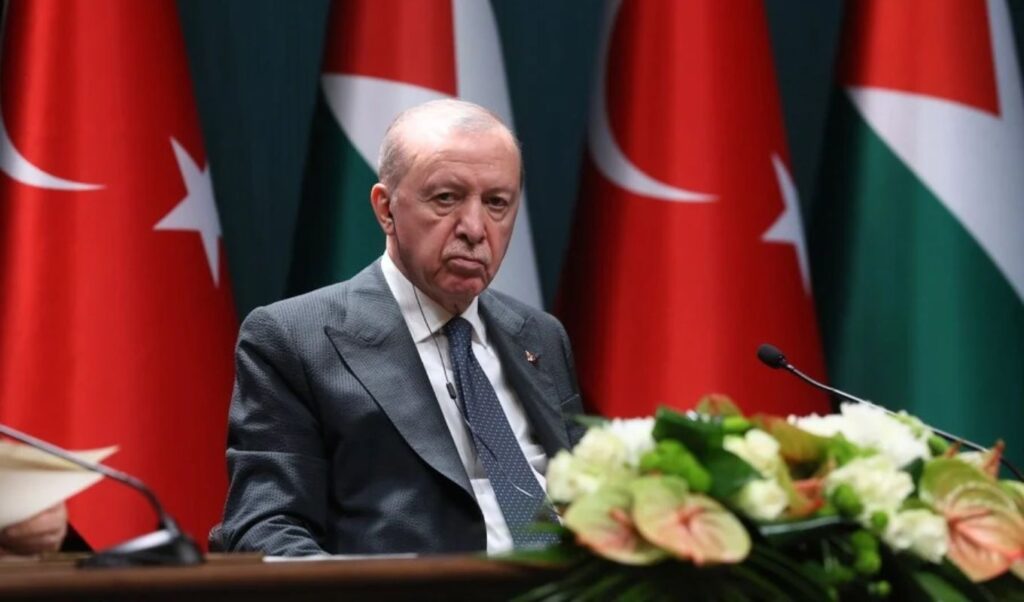
Turkish President Recep Tayyip Erdogan has opened the door to a possible membership of Egypt in the recent defense agreement signed by Turkey with Saudi Arabia and Pakistan. In an exclusive interview with Al Jazeera, the Turkish leader described Cairo’s potential membership as a realistic prospect, emphasizing that the landmark agreement remains open to new member states wishing to join.
Read also: Erdogan on the Mecca Agreement: “Our goal is to bring all countries of the region under the same umbrella” — “We are not targeting any country”
What the Mecca Agreement means for defense cooperation
The Mecca Agreement, signed last Friday, establishes a new framework for defense solidarity between Turkey, Saudi Arabia, and Pakistan. Recep Tayyip Erdogan, Crown Prince Mohammed bin Salman, and Prime Minister Shehbaz Sharif agreed on a collective defense mechanism that commits members to coordinated action whenever one of them faces an external threat. The agreement stipulates that any armed attack against one of the three states will be treated as an attack against all. Analysts have drawn comparisons to NATO’s Article 5, although officials in Islamabad clarify that this is not an equivalent alliance and is not directed at any specific country. Erdogan stressed that the agreement sends a powerful message to the international community, and that Egypt is among the countries that could strengthen this alliance.
Regional crises and Turkey’s position
During the interview, set to air Sunday evening on Al Jazeera Arabic, the Turkish president spoke at length about critical issues across the Middle East. Turkey considers the reopening of the Strait of Hormuz a top priority, with Erdogan arguing that its prolonged closure serves no one’s interests. He also acknowledged Qatar’s significant contribution to ceasefire mediation efforts.
On Syria, Recep Tayyip Erdogan pledged that Ankara will support the country’s stabilization by every means available. He announced plans to visit Syrian territory and assured that Syrian Kurds would play an active role in peace and reconstruction. Turkey is committed to strengthening ties with Kurdish communities and protecting their rights across the region. Regarding Gaza, the Turkish leader stressed that his country will not abandon the Palestinian people and will continue to provide all necessary support. He noted that Hamas is fulfilling its obligations in good faith, while Israel continues its military operations. On Lebanon, Erdogan expressed deep concern over the ongoing Israeli strikes, an issue he raised directly with Donald Trump during the latter’s recent visit to Turkey, underlining Washington’s decisive role in achieving a ceasefire.
Recep Tayyip Erdogan confirmed that Turkey maintains unwavering support for Sudan, describing his relationship with Sovereignty Council head Abdel Fattah al-Burhan as excellent. He also assured that Ankara’s ties with Libya remain strong and that Turkey will not leave the country defenseless.
The “divorce” from Europe and Trump’s F-35 promise
On relations with Europe, the Turkish president adopted a hardline stance. He stated that the European Union shows no genuine willingness to accept Turkey as a member, adding that EU accession is no longer a top priority for Ankara. Erdogan warned that the European Union will ultimately be the loser in this situation.
One of the most significant topics raised concerned the F-35 fighter jets. Recep Tayyip Erdogan revealed that he received a promise from Donald Trump regarding the delivery of the aircraft and expects it to be honored. Turkey was excluded from the F-35 program in 2019 following its acquisition of the Russian S-400 air defense system, a move Washington deemed a threat to the stealth technology of the F-35. At last month’s NATO summit in Ankara, Donald Trump pledged to lift the CAATSA sanctions imposed on Turkey in December 2020 over the S-400 purchase. He also stated that Turkey’s reinstatement into the F-35 program is something his administration would seriously consider. However, any such sale faces significant obstacles in the US Congress. A 2020 law prohibits the Pentagon from transferring F-35 aircraft to Turkey for as long as it retains the S-400 system, making the fulfillment of Trump’s promise to Erdogan a particularly complex undertaking.