Explosive findings from the Arson Crime Investigation Division (DAEΕ), brought to light by ANT1, identify power grid infrastructure as the primary cause behind the devastating wildfires that swept across Greece this summer.
Read also: Wildfire alert on Sunday: Red Code mobilization declared across multiple regions of the country
Greece wildfires: Power grids linked to 78.3% of all burned land this summer
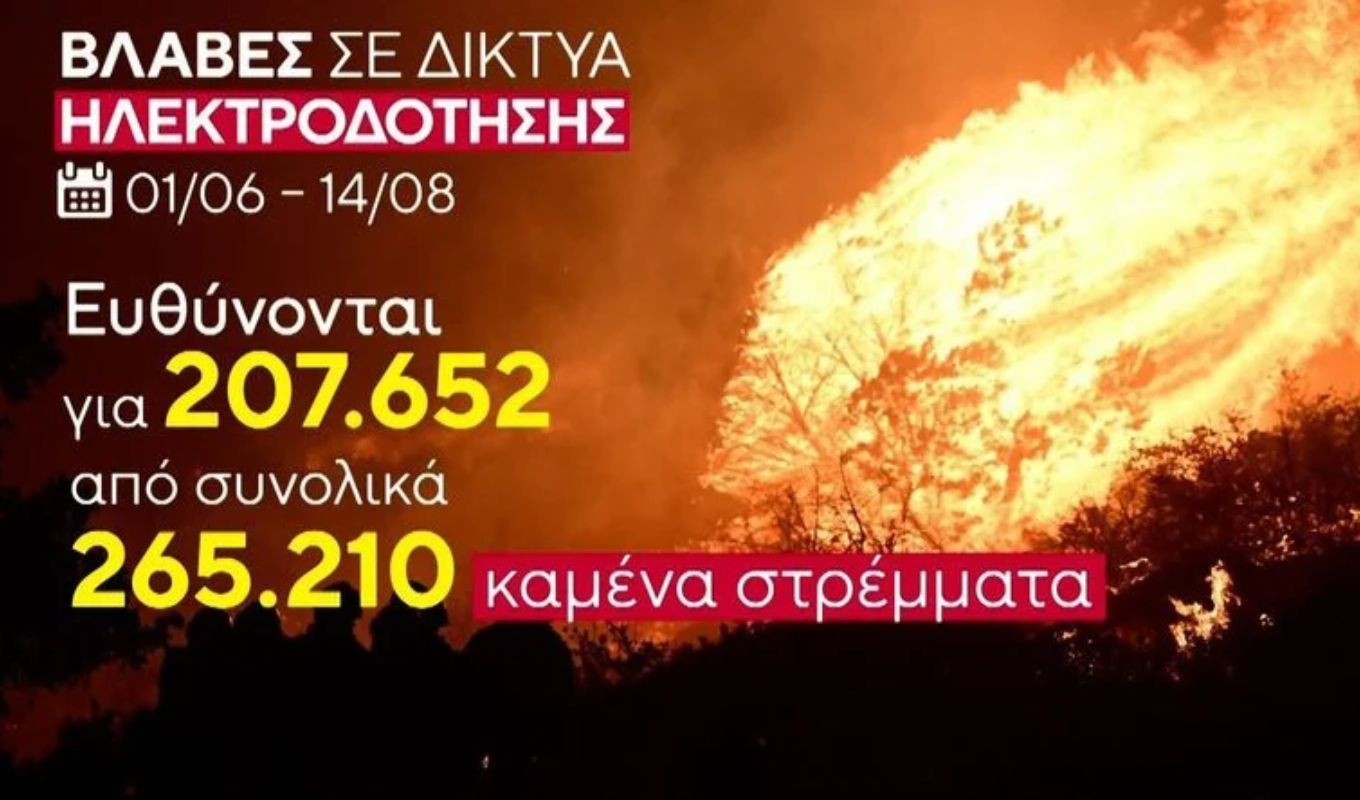
More specifically, between June 1 and August 14, out of a total of 265,210 acres burned across the country, some 207,652 acres — a staggering 78.3% — have been provisionally attributed to technical failures and short circuits within the power grid. A telling example is the three major wildfires that erupted in late July: in the Attica-Boeotia region (111,000 acres, where the fire is believed to have originated from a wind farm network), in Kryα Vrysi, Rethymno (46,000 acres, claiming the lives of two firefighters), and in Xironomi, Boeotia (32,000 acres).
Power lines branded a “serial arsonist” as wind farms come under fire
Commenting on the findings, natural disaster professor Kostas Synolakis described electrical grids as a “serial arsonist,” noting that in the past, the lack of thorough investigations frequently led authorities to search for “the usual unknown suspects.” Meanwhile, the Arson Investigation Division is conducting a sweeping investigation into all wind farm installations across the country.
How the power distributor and its workers are responding
The grid’s alleged involvement has resulted in arrests and criminal charges being filed against employees of HEDNO (the Hellenic Electricity Distribution Network Operator). From the workers’ side, Kostas Iliakis, president of the Chania trade union, stresses that technicians bear no responsibility, pointing to severe staff shortages and chronic under-maintenance of infrastructure. HEDNO, however, rejects the accusations, arguing that the percentage of fires ultimately and legally attributed to the grid through court proceedings has historically been negligible — just 1% for 2025. The operator speaks of “convenient scapegoating” that does not serve the truth, maintaining that such claims create false impressions and serve short-term agendas aimed at deflecting local accountability.