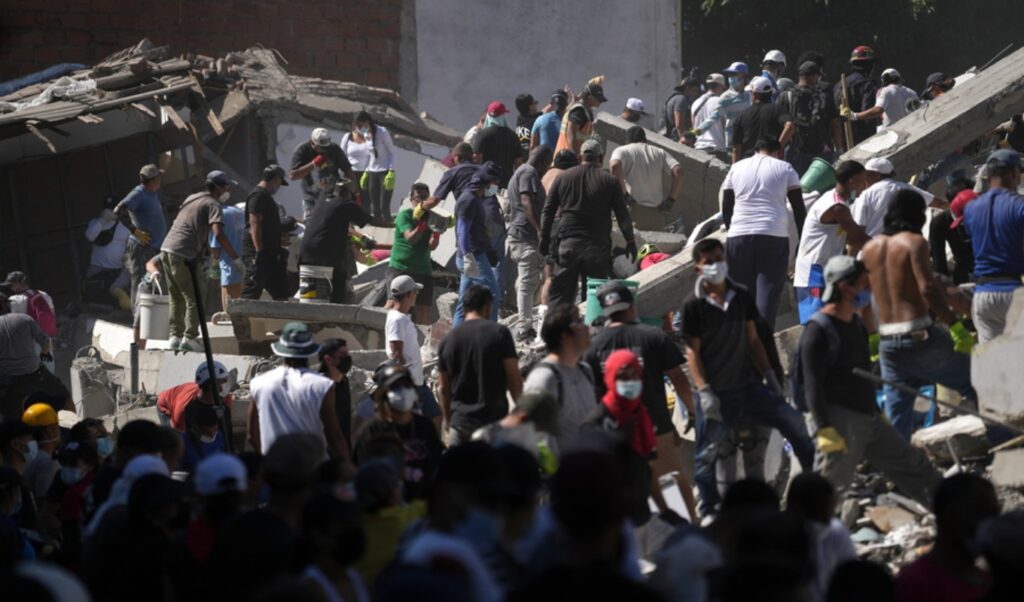
A race against time is underway in Colombia following Monday’s devastating 7.4-magnitude earthquake, as the death toll continues to rise and the desperate search for survivors trapped beneath the rubble intensifies. At least 164 people have been killed, 700 injured, and hundreds more remain missing, according to the latest Reuters figures — with the quake being described as the most powerful to strike the country “this century.”
The seismic event devastated cities across western Colombia, including Cali, Pereira, Quibdó, and Manizales, and was felt as far away as neighboring Ecuador and Panama. These countries sit atop the so-called Pacific Ring of Fire — a region of intense seismic and volcanic activity caused by the movement of tectonic plates beneath the Earth’s surface.
According to the United States Geological Survey (USGS), the epicenter was located near San José del Palmar in the Chocó region, approximately 400 kilometers west of the capital Bogotá. The earthquake struck at a depth of 107 kilometers. By Monday afternoon, seismographs had recorded 47 aftershocks, according to Colombia’s geological survey.
The earthquake caused widespread destruction in cities such as Cali, Pereira, Armenia, and Manizales, with more than 1,600 buildings damaged and dozens completely collapsed.
Hope amid the rubble
Amid the scenes of destruction, a deeply moving moment captured in Cali became a powerful symbol of hope — proof that life can endure even in the most devastating circumstances. A video that quickly went viral on social media captured the moment rescue teams pulled a six-month-old baby out alive from beneath the rubble of a collapsed building.
Rescue operations were in full swing when crews detected signs of life deep within the wreckage. But beneath tons of concrete, it wasn’t only the infant boy who had been trapped — his mother was there too, shielding him with her own body amid the debris.
The dramatic rescue moved the entire nation, offering a rare ray of hope amid the overwhelming images of destruction left behind by the powerful earthquake.
Debajo de los escombros hay esperanza de vida
Una mujer y su bebé de seis meses de nacido fueron rescatados en Cali después de quedar en medio de los escombros tras el terremoto de 7.4 grados.
El rescate lo hicieron voluntarios que ayudaron al escuchar voces de auxilio de la… pic.twitter.com/UFrkL76nnC
— ZonaCero (@zonacero) August 10, 2026
The strongest earthquake of the 21st century
The last earthquake to cause comparable loss of life in Colombia occurred on January 25, 1999, in the country’s Coffee Region. That 6.1-magnitude quake killed 921 people in Armenia alone, injured 5,377 others, and damaged or destroyed more than 21,000 homes, according to records held by Colombia’s Geological Survey. National estimates place the total death toll from that disaster at more than 1,000.
Colombia earthquake: Race against time to save the trapped — harrowing images from collapsed hospital pediatric wing
Search and rescue operations are in full swing, with rescue workers, firefighters, and military personnel deployed to sites where buildings have collapsed.
Among the structures that suffered severe damage are the pediatric and neonatal units of a hospital in Cali, prompting a massive emergency response from authorities.
Hours of anguish have unfolded in Cali, where the university hospital partially collapsed: the pediatric wing — and in particular the intensive care unit — has been reduced to a pile of rubble, with fears that many children may still be trapped beneath. The Villa Salud clinic, one of the city’s best-known private medical facilities, was also destroyed. It is located just a few kilometers from the amphitheater where Abelardo De La Espriella was inaugurated as president just three days earlier — making this natural disaster the first major crisis he faces in his new role.
🇨🇴‼️🚨 HOSPITAL COLLAPSED
Couple of doctors just managed to run outside before the Hospital Universitario de Cali collapsed.
How many patients and staff are under the rubble is unclear.
Oh man, pray 🙏 https://t.co/eD6A7hae6c pic.twitter.com/HsdUZ1wrxP
— Lord Bebo (@MyLordBebo) August 10, 2026
The hospital’s director, Irne Torres, described the situation as “a tragedy within a tragedy,” confirmed the death of at least one patient, and warned that 10 others remain trapped in the ruins, expressing fear that the death toll will rise. “The collapse affected 30% of the structure, particularly the pediatric and intensive care wings. At this moment, we know there are at least 10 people trapped and we can confirm at least one death, but we fear there could be as many as five,” Torres told Radio Caracol.
The director of the largest public hospital in southwestern Colombia did not specify, citing privacy concerns, whether any of the victims were children in the pediatric wing. “It is a tragedy within a tragedy. We cannot accept more patients and we need blood. One hundred percent of hospitalized patients have taken refuge in the gardens because the entire structure has been damaged. This is an absolute emergency,” Torres added. Approximately 600 people are believed to be receiving care in the streets outside, including newborn infants.
#Cali • Vida en medio de la tragedia
Tras el devastador terremoto, el colapso de parte de un hospital en Cali obligó al personal médico a salir a las calles para continuar atendiendo a los pacientes.
Entre el caos, el miedo y la angustia, enfermeras tuvieron que atender a… pic.twitter.com/g10Sw7a7Ru
— Cristian Crespo F. 🇨🇺 (@cristiancrespoj) August 11, 2026
This happened to a patient in Cali, Colombia, during today’s earthquake. He had to stay in place while doctors and staff evacuated the hospital.
No words… pic.twitter.com/Hx6VjRqW19
— Semper Raw ™️ (@SemperRaw) August 10, 2026
Footage circulating on social media captured the moment the top four floors of the pediatric wing’s facade gave way — a semicircular structure with large windows that crumbled like a sandcastle under the force of the powerful tremors.
Torres also reported damage to a hospital facility affiliated with the University Hospital in Cartago, a municipality located closer to the earthquake’s epicenter in San José del Palmar, in the Chocó region. “We are also receiving reports of a partial building collapse there,” she said. Meanwhile, a surgeon at the Valle Salud clinic — one of the country’s leading private healthcare centers — posted a desperate plea for help on social media.
“Everyone who can come and help, please come to the Valle Salud clinic. I have many ICU patients trapped. We need to get them out. The hospital has collapsed,” wrote Dr. Juan Gallego on Instagram just minutes after the main quake struck.
Footage broadcast from inside the building — amid the screams of doctors and patients — revealed the severe structural damage sustained by the hospital and the panic that erupted immediately after the earthquake. According to the doctor, the collapse affected the third, fourth, and fifth floors of the building.
According to authorities, at least seven hospitals in Cali sustained serious damage — a situation that complicates not only the care of existing inpatients but also the treatment of the many earthquake casualties now requiring urgent medical attention. The affected facilities, as announced by local authorities, include the Alba, Rey David, Nuestra Señora del Rosario, Sanitas Tequendama, Valle Salud Cali, Carlos Holmes Trujillo, Urgencias Pasoancho, and Versalles clinics.
📌Panorama en el Hospital Universitario del Valle (HUV) de Cali luego del terremoto de 7,4. pic.twitter.com/k4fqGbx6mB
— Tony Venet (@TonyVenet274186) August 10, 2026
Six hours trapped on a cable car in Pereira
One of the most dramatic rescue operations took place in Pereira, where 16 people became stranded inside aerial cable car cabins when the earthquake struck.
🚨🇨🇴 ¡QUÉ MIEDO! ☠️😱
Un grupo de colombianos se encontraba viajando en un teleférico cuando comenzó el fuerte terremoto que sacudió al país. 🌎💥
Mientras la tierra se estremecía, las personas quedaron suspendidas en el aire, viviendo momentos de verdadero terror. 😰🚡
Las… pic.twitter.com/OJBCuINgLE
— Ventana Pública (@ventanaXpublica) August 11, 2026
The passengers remained suspended in mid-air for approximately six hours before being successfully evacuated, at around 1:30 p.m. local time.
OMG, this is terrifying. Footage showing the shaking from the M7.2 earthquake that hit Colombia earlier.
👀 Watch until the end.
📍 Pereirapic.twitter.com/vS2slBg53X
— Volcaholic 🌋 (@volcaholic1) August 10, 2026
Colombia’s 7.4-magnitude earthquake vs. Venezuela’s double tremor: no connection between the two
The 7.4-magnitude earthquake that struck Colombia came just over a month after two earthquakes that killed more than 6,300 people in neighboring Venezuela. However, beyond the fact that both countries share the same tectonic plate, the two seismic events have little else in common, according to a geology expert.
“The geological and geotectonic context is completely different,” said Gustavo Ortiz, who holds a doctorate in geological sciences from Argentina’s National Scientific and Technical Research Council.
In western South America, earthquakes frequently occur when one plate — in this case, the Nazca Plate in the Pacific — slides beneath the South American Plate in a process known as subduction, Ortiz explained to CNN’s Rafael Romo.
According to Jorge Archbold, assistant professor at the Universidad del Norte, the tremor recorded in Colombia is consistent with a subduction-related earthquake, whereas the earthquakes in Venezuela were crustal earthquakes — meaning they occurred at a far shallower depth.