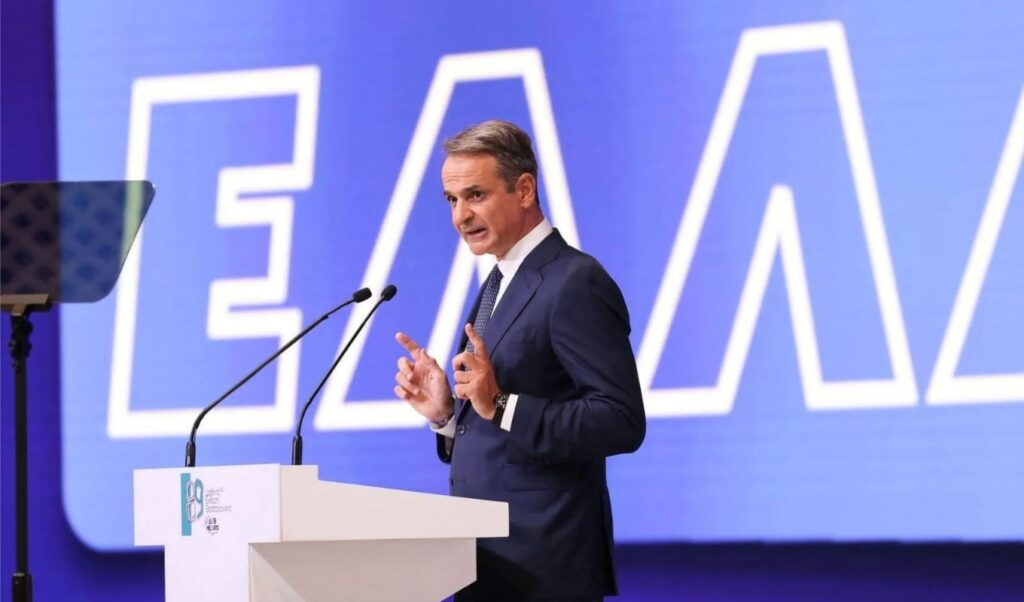
All eyes at the Maximos Mansion are fixed on Thessaloniki and the Vellidio stage, with just three days remaining until the prime minister’s speech at the opening of the 90th Thessaloniki International Fair. The package of measures has already been finalized since late August, and the government team is now focused on the final crafting of the announcements and, above all, on the political message that will accompany them. This year’s appearance by Kyriakos Mitsotakis at the fair carries particular weight for the government camp. For the eighth time, the prime minister will take to the Vellidio podium, seeking not only to present the government’s new interventions, but also to redefine its relationship with Greek society.
The new “contract of truth”
Inside the Maximos Mansion, officials are speaking of a new “contract of truth,” with the government seeking to politically capitalize on the consistency between its pre-election commitments and the work it has delivered. The words expected to dominate the prime minister’s speech are clear and deliberate: credibility, consistency, trust, and stability.
Behind these four concepts lies the government team’s core strategy. New Democracy wants to present Kyriakos Mitsotakis as the politician who can guarantee continuity, stability, and effectiveness — in contrast to an opposition that, according to the government’s narrative, struggles to put forward a convincing alternative vision for governance.
A flurry of pre-speech meetings on the measures
The final days before the speech are therefore critical. Meetings at the Maximos Mansion are focused on the fine details, ensuring that the announcements do not come across as a mere list of economic measures, but are instead embedded within a broader political narrative with a clear and lasting imprint.
The government’s goal is to convince the public that the interventions to be announced are not piecemeal handouts, but part of a coherent strategy for the period ahead. At the same time, the choice of the word “stability” is anything but coincidental — it is a central pillar of the government’s political argument ahead of the next electoral contests.
Within the government camp, there is a firm belief that the alignment between words and actions, combined with demonstrated effectiveness, represents the prime minister’s strongest competitive advantage. This is precisely what Kyriakos Mitsotakis will attempt to highlight from the Vellidio stage.
The Thessaloniki International Fair is, therefore, shaping up to be a critical political test for the government. It will be judged not only on the scale and scope of the measures announced, but also on the prime minister’s ability to convince the public that the government’s course remains credible, consistent, and effective — and that choosing stability is still the safest political proposition for what lies ahead.
A new minimum wage increase
According to reporting by Christos Maltis for Apogevmatini, front and center is a new increase to the minimum wage, with the primary target set at raising it from €920 to €970 by 2027 — exceeding the goal the New Democracy government had set at the start of its four-year term. The additional increase was previewed last Friday by Kyriakos Mitsotakis during his tour of Western Macedonia. This intervention is expected to benefit more than 1,300,000 workers in both the private and public sectors. In addition, 500,000 employees who complete three years of service will see an extra 10% increment added to their pay, while on the table is also an increase in the value of meal vouchers from €6 to €10 per day.
Interventions for businesses
At the same time, for businesses, a series of interventions are being examined: the professional duty fee, tax advance payments, the corporate profit tax rate, and employer social security contributions. For the self-employed, interest is centered on a new model of presumptive taxation, under which tax compliance could lead to a gradual reduction — or even full elimination — of the presumed income threshold. The increase in gross wages translates into higher net earnings, although the final benefit will depend on the tax and social security framework in force in 2027. Under current parameters, €920 gross corresponds to approximately €772 net for a full-time employee. If the minimum wage rises to €970 gross, the net amount reaches approximately €808, while at €1,000 gross, net earnings are estimated to reach around €829.
The new increase is not, however, the end of the road. The planning has a horizon stretching to 2030, with the minimum wage target set in the range of €1,350–€1,400. In parallel, bringing the average wage close to €2,000 by 2031 has been set as a long-term ambition.
Restoration of three-year pay increments
A significant boost to the earnings of hundreds of thousands of workers is also expected from the restoration of three-year pay increments. Following the “unfreezing” of wage maturity allowances in 2024, the first employees are now completing the required three-year period, and from January 1, 2027, they are expected to begin receiving the corresponding increment.
The first three-year increment provides a 10% raise. For a single employee who began working for the first time on January 1, 2024, and is paid at the minimum wage of €920, the increment amounts to €92, bringing gross earnings to €1,012. For a married employee, who is also entitled to a marriage allowance, the figure can reach €1,104. The key point is that the increment from the three-year service period works in addition to the minimum wage adjustment — meaning that those who qualify will receive a compounded pay boost.
A similar effect is expected for civil servants. The minimum wage in the Compulsory Education category is expected to settle in the range of €960–€970. In addition, an increase of approximately €40 is planned at each pay grade step, affecting all salary scales — including special ones. The final benefit for each civil servant will depend on their pay grade, accumulated seniority allowances, changes to bonuses, and any sector-specific increases, such as those for uniformed personnel.
Increase in meal voucher value
Another significant intervention for disposable income could come from the increase in the value of meal vouchers. The proposal calls for raising their daily value from €6 to €10, and has been jointly submitted by social partners. If adopted, the measure could affect approximately 800,000 salaried employees. On a full working-day basis, the increase in voucher value could translate into a benefit approaching €300 per month. The government is also examining an upward revision of the threshold up to which meal vouchers are exempt from social security contributions.
Professional duty fee
On the business front, one of the most significant interventions concerns the professional duty fee. This levy has already been abolished for the self-employed as of 2025, but continues to burden companies with amounts ranging from €800 to €1,000 per year. Its full abolition for businesses would carry an annual fiscal cost of approximately €240,000,000.
In parallel, a reduction in the corporate profit tax rate from 22% to 20% is being examined — a move that would further ease the tax burden on businesses. Of even greater fiscal significance is the reform of advance tax payments. Currently, companies prepay an amount equal to 80% of their income tax liability, while for the self-employed the rate stands at 55%. The scenarios on the table envisage reducing the advance payment to 40% for professionals and to 50%–60% for small businesses, depending on turnover. The package of measures also includes a new reduction in employer social security contributions of 0.5 percentage points. Since 2019, the total reduction in contributions has reached 5.4 percentage points. If the new intervention proceeds, the overall rate will drop to 35.66%. The annual fiscal cost is estimated at approximately €245,000,000.
Particular interest surrounds the new model being considered for the approximately 700,000 self-employed workers. The core idea is to link presumptive taxation to the degree of tax and social security compliance. Under the model being examined, the presumed income threshold would not necessarily operate as a permanent, across-the-board taxation mechanism. Instead, those who demonstrably show high compliance could see their presumed income gradually reduced. In cases of particularly strong tax compliance, the complete elimination of the presumptive calculation method is not ruled out.
Child benefit
According to reporting by Antonis Vasilopoulos for Parapolitika, the package of interventions also includes measures for families with children. One of the scenarios under consideration involves a significant increase in the base amounts of the A21 child benefit, without any change to income eligibility criteria. An increase of around 30% is estimated to carry an annual fiscal cost of approximately €200 million. This particular intervention is considered highly targeted, as it would directly strengthen households that already meet the existing income thresholds. Also in the mix is the possibility of repeating the one-off €150-per-child bonus payment — a measure that could provide immediate relief for families, particularly at a time when the cost of housing, food, and everyday needs continues to squeeze household budgets.
Nurseries and childcare
Alongside the provision of childcare vouchers for nurseries and daycare centers without income criteria for large families, a new increase to the income thresholds for other family categories is also being examined. Currently, the income ceiling for families with up to two children stands at €35,000 per year, rising to €38,000 for families with three children. The program covers infants, toddlers, and children enrolled in nurseries and daycare centers, as well as children and teenagers participating in after-school activity centers (KDAP). Additionally, a broadening of income criteria for families with two or three children is being planned. Significant changes are also planned for parents with three or more children who wish to purchase a family car. A full exemption from the registration tax already applies for vehicles up to 2,000cc, while a 50% exemption is provided for larger-engine vehicles.
Increased rent reimbursement for young people under 30
Among the proposals being examined by the economic team is an increase in rent reimbursement for young people up to 30 years of age. The primary scenario being costed involves the reimbursement of two months’ rent per year — as is currently the case for teachers, doctors, nurses, and other healthcare workers serving in regional areas. Under consideration is also the possibility of raising the reimbursement to three months’ rent per year in cases where two young people share a dwelling. The measure is estimated to provide relief, among others, to tens of thousands of students.
Pensions: Abolition of the personal difference cap
The government also intends to fully abolish the personal difference — the mechanism that has effectively capped pension increases for more than 671,586 older retirees. This intervention would change the landscape from January 1, 2027, as pensioners would no longer see increases reflected only on paper, but would actually receive a higher pension amount in their bank accounts. The change primarily affects older retirees — those who had already retired before the implementation of the Katrougalos Law and continue to show a positive personal difference following the recalculation of their pensions. The average monthly increase is estimated at approximately €44, amounting to €528 per year, while the actual benefit will vary depending on the insurance fund and the pension amount.
Finally, still open is the possibility of establishing a 13th pension payment for low-income pensioners, with an expansion of eligibility to include those who retire from age 62 and receive a pension of up to €1,000 gross. The support amount would affect 1,800,000 pensioners, who would receive a sum equivalent to the current national pension (€446.87). This particular benefit would be introduced from 2028, replacing the existing November bonus — currently set at €250, which for this year is expected to rise to €300 or even €400. The existing November bonus is currently received by low-income pensioners aged 65 and above.