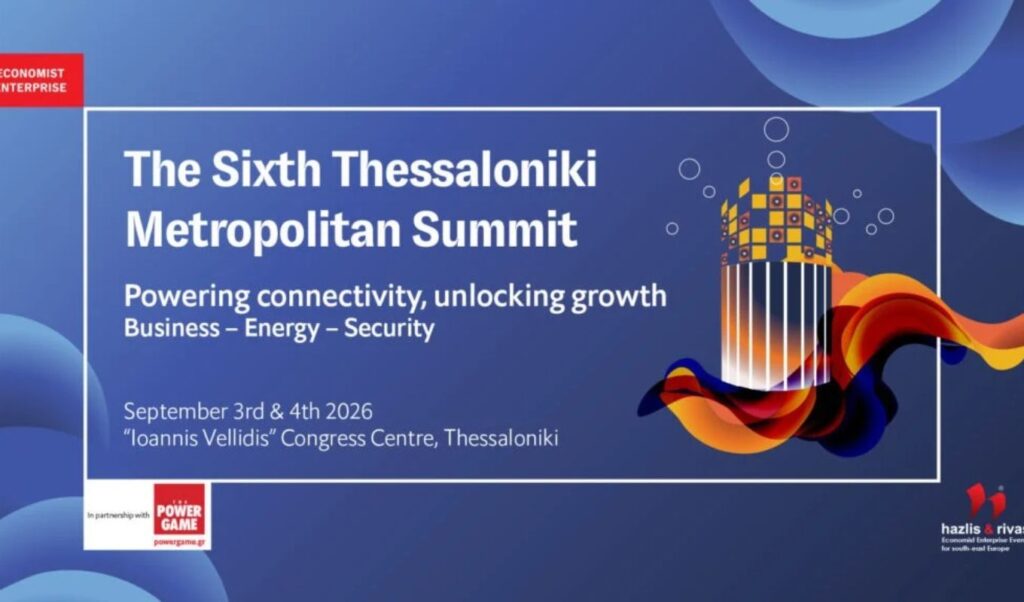
The major changes and shifts expected to shape Greece’s trajectory through 2030 will take center stage at the 6th Thessaloniki Metropolitan Summit, organized on September 3 and 4 at the “Ioannis Vellidis” Convention Centre in Thessaloniki by powergame.gr and The Economist. The new geopolitical and economic balances in the Southeastern Mediterranean, the vertical energy corridor, the post-Recovery Fund landscape, and digital infrastructure form the key pillars of the two-day event. Titled “Horizon 2030: Connectivity and Growth for Southeastern Europe,” the conference aims to map out the role and prospects of Greece and its neighboring countries during a period of significant realignment.
Read also: Economist Conference: Greece 2030 in focus at the 6th Thessaloniki Metropolitan Summit
The Thessaloniki Metropolitan Summit programme
The conference opens on the evening of Thursday, September 3, with a reception and a conversation between Eurogroup President and Minister of Economy and Finance Kyriakos Pierrakakis and Peter Frankopan, Professor of Global History at the University of Oxford and Senior Fellow at the Blavatnik School of Government. The discussion will focus on four key weights pressing down on Europe’s long-term growth potential: sluggish productivity, demographic pressures, external shocks, and structural weaknesses — most notably the fragmentation of capital markets, which constrains the eurozone’s economic dynamism.
The second day opens on Friday, September 4. Shlomo Ben Ami, former Israeli Foreign Minister and Vice President of the Toledo International Centre for Peace, will speak about the day after in Israel and the Middle East following the elections. This is followed by a new session on the Europe-United States-Turkey triangle and the shaping of a safer, more interconnected transatlantic space, featuring former Turkish Minister for European Affairs Egemen Bağış and Ian Lesser, Senior Fellow and Advisor to the President of the German Marshall Fund of the United States, an organization dedicated to transatlantic relations.
The agenda then turns to Canadian investments in Greece and the sectors offering the greatest opportunities, with Canada’s Ambassador to Greece Sonya Thissen, Secretary General for International Economic Relations at the Ministry of Foreign Affairs Dimitrios Skalkos, and Christos Balaskas, Vice President and Head of Eldorado Gold for Greece and President of Hellas Gold.
Giorgos Karakoussис, Deputy Chief Executive Officer of the PPC Group with responsibility for retail, will address electricity as the backbone of economic competitiveness, industrial decarbonization, and energy security, with an emphasis on investments in modern grids and policies ensuring affordable and reliable power for households and businesses.
The session on the new geopolitical order at 12:00 positions Southeastern Europe and the Eastern Mediterranean as increasingly interconnected regions, pivotal for energy security, trade, defense, and global connectivity. The panel will feature Foreign Affairs Minister Giorgos Gerapetritis and Romania’s Foreign Affairs Minister Oana-Silvia Țoiu.
The agenda returns to connectivity, with reference to the European Union’s new fiscal period and the “Regions 2030” agenda. Participants include Minister of Infrastructure and Transport Christos Dimas, Deputy Minister to the Prime Minister Thanasis Kontogeorgis, Greece’s Ambassador to the OECD Giorgos Pagoulatos, Romania’s Consul General in Thessaloniki and former European Commissioner for Cohesion and Reforms Corina Crețu, and Marcel Cobuz, Chairman of the Executive Committee of the TITAN Group.
Alexandros Exarchou, Chairman and Chief Executive Officer of the AKTOR Group of Companies, will hold a discussion with Fotis Kollias, Director of Powergame and Energygame, and Lalela Chrysanthopoulou, Editor-in-Chief of energygame.gr, on how strategic investments in transport, energy, and critical infrastructure can position Southeastern Europe as a gateway for Europe’s future growth.
This is followed by an extended discussion on the vertical energy corridor, described as one of Europe’s most strategic energy initiatives. The corridor connects six countries — Greece, Bulgaria, Romania, Moldova, Ukraine, and Serbia — strengthening supply security and reducing dependence on individual suppliers. Taking the floor will be Joshua Volz, Special Envoy for Energy Integration at the U.S. Department of Energy, Minister of Environment and Energy Stavros Papastaurou, Bulgaria’s Energy Minister Iva Petrova, North Macedonia’s Minister of Energy, Mining and Mineral Resources Sanja Božinovska, and Ukraine’s Deputy Minister for Reconstruction, Infrastructure and Transport Artem Rybchenko. The market perspective will be provided by Gianfranco Amoroso, Chief Executive Officer of Enaon and Head of International Activities at Italgas.
Dinos Benroubiis, Vice President and Chief Executive Officer of METKA ATE, will speak on overcoming obstacles in project implementation. The discussion then opens up to the question of financing the next phase of development, as the Recovery and Resilience Facility nears completion. Contributing will be Deputy Minister of National Economy and Finance Nikos Papathanasis, Chief Executive Officer of the Hellenic Development Fund Giannis Papachristou, Viorel Beltechi, Chief Executive Officer of Therme Group China and Vice President of Energy and Engineering on the group’s international council, and Ondrej Safar, Chief Executive Officer and President of Romanian electricity distribution company Distribuție Oltenia.
The agenda closes with a session on data centers and artificial intelligence. The panel features Secretary General for Information Systems and Digital Governance Demosthenis Anagnostopoulos, Governor of the Independent Authority for Public Revenue Giorgos Pitsilis, Gianna Andronopoulos, General Manager and Managing Director of Microsoft for Greece, Cyprus and Malta, Laura Bononcini, Director of Public Policy for Southern Europe at META, and Giorgos Kollidas, Partner and Technology Lead in PwC’s consulting division. The conference concludes with Deputy Prime Minister Kostis Hatzidakis and the session titled “Greece 2030: Strengthening Connectivity, Unleashing Growth.”