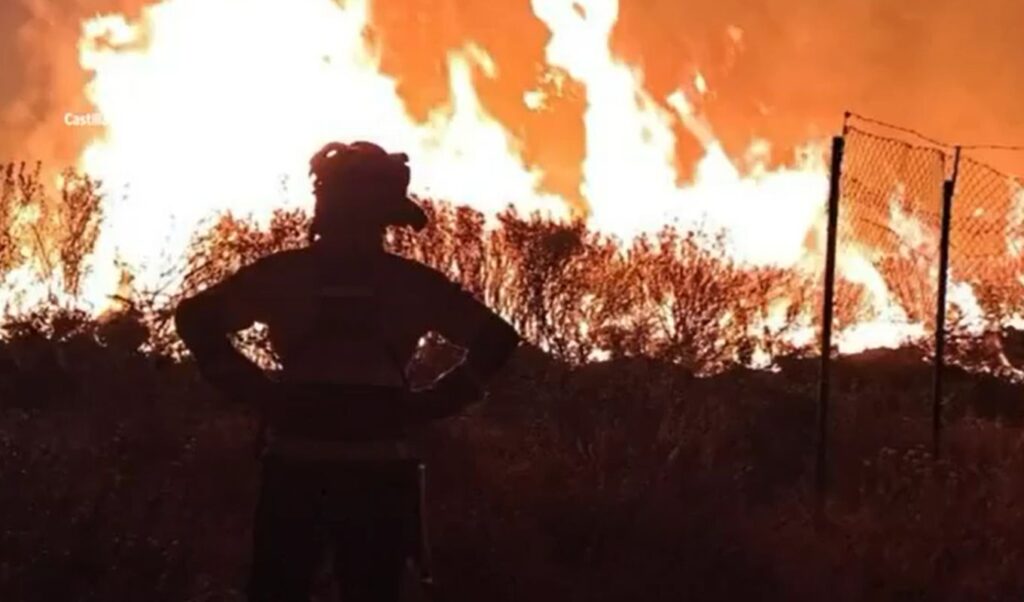
The wildfire that broke out last Thursday (July 17) in the Guadalajara region, located 100 kilometers from Madrid, has burned through 29,000 hectares (approximately 290,000 stremmata). According to local authorities, it is “one of the most complex” fires in Spain’s modern history, with 600 firefighters and military personnel deployed alongside 30 aerial units to combat the blaze.
Read also: Spain: Wildfire raging since Thursday turns 26,000 hectares to ash, 1,200 displaced (Video)
Concerns mount as a new heatwave approaches
The forest fire in the Guadalajara region — the largest in Spain this year — is causing serious concern among authorities as a new heatwave begins today, creating conditions that further fuel the spread of the devastating blaze.
A wildfire raged out of control across Spain’s central Guadalajara province, burning for a sixth day and becoming the largest blaze of the year. pic.twitter.com/glnIYwumf8
— Al Arabiya English (@AlArabiya_Eng) July 21, 2026
The president of the Castilla-La Mancha region, Emiliano García, described it as the largest mobilization of firefighting forces in the region’s history, while adding that after overnight efforts he had “begun to see a light at the end of the tunnel” following days of grueling battle. Authorities consider this fire particularly complex because it ignited in a nearly uninhabited zone that is exceptionally arid, with vast expanses of abandoned scrubland and low vegetation — conditions that accelerate its rapid spread. Firefighters did manage to halt the fire’s advance toward the city of Soria in the neighboring Castilla y León region.
Spain is on Fire now? Don’t win the Cup…
SPAIN 🇪🇸 Wildfire scorches 26,000 hectares (65,000 acres) north of Madrid. pic.twitter.com/BfUts2u1bx
— ❤️🔥ZeroSympathy❤️🔥 (@ZeroSympathy76) July 20, 2026
It is worth noting that Spain recently experienced one of the deadliest wildfires in its history — a forest fire in Andalusia that claimed 13 lives and destroyed 7,000 hectares of land. The country has been increasingly battered in recent years by more frequent and prolonged heatwaves, with temperatures regularly exceeding 40 degrees Celsius.