Athens is working to counter Turkish provocations on multiple fronts. While Turkish President Recep Tayyip Erdoğan was meeting Russian President Vladimir Putin in Bishkek, Kyrgyzstan — signing new agreements despite Turkey’s NATO membership — Greek Foreign Minister Giorgos Gerapetritis was briefing his European counterparts at the informal EU Foreign Ministers’ meeting in Wicklow, Ireland.
Greek-Turkish relations: Greece’s diplomatic response to Turkey’s provocations
Greece’s diplomatic efforts are aimed at pushing back against Turkey’s actions, including the unlawful designation of Marine Parks in the Aegean and the direct challenge to Greek sovereignty over Greek islands — a challenge that followed a statement by Turkey’s Foreign Ministry spokesperson in response to Greece’s new Special Spatial Framework for Renewable Energy Sources. Greek diplomacy has already formally protested these moves to Ankara through a diplomatic note.
The tension quickly spilled over into the field of maritime notices. Just one day after the signing of the bilateral defense agreement with Israel — the “Achilles’ Shield” — Ankara continued its provocations. Turkey issued a NAVTEX notice claiming the maritime area south of Kastellorizo for scientific research activities until September 15. Greece responded swiftly, as the area falls within its potential Exclusive Economic Zone (EEZ), with the Heraklion, Crete station immediately issuing a counter-NAVTEX.
Theodoros Tsikas speaks to parapolitika.gr: What worries Athens about Turkey’s NAVTEX south of Kastellorizo
Analyzing Turkey’s moves, international relations analyst Theodoros Tsikas tells parapolitika.gr that what concerns the Greek side most is the fact that this activity is taking place precisely in the area where Turkey has unilaterally declared Marine Parks on its own maps. As he explains: “That’s why we can see that Greece is monitoring this more closely than on previous occasions — because Greece fears that Turkey may begin conducting activities in that specific area that are linked to the declaration of the Marine Parks. However, what Turkey is saying is that it will carry out scientific research in the ‘water column.’ That is not prohibited — meaning being on the sea’s surface. And that’s why, if you look at the statement we issued, it notes that the Turkish vessel does not intend to conduct seabed research in the area of the continental shelf. That’s where the real problem will arise, precisely because we have left the issue open — we have not been able to resolve the question of the continental shelf.”
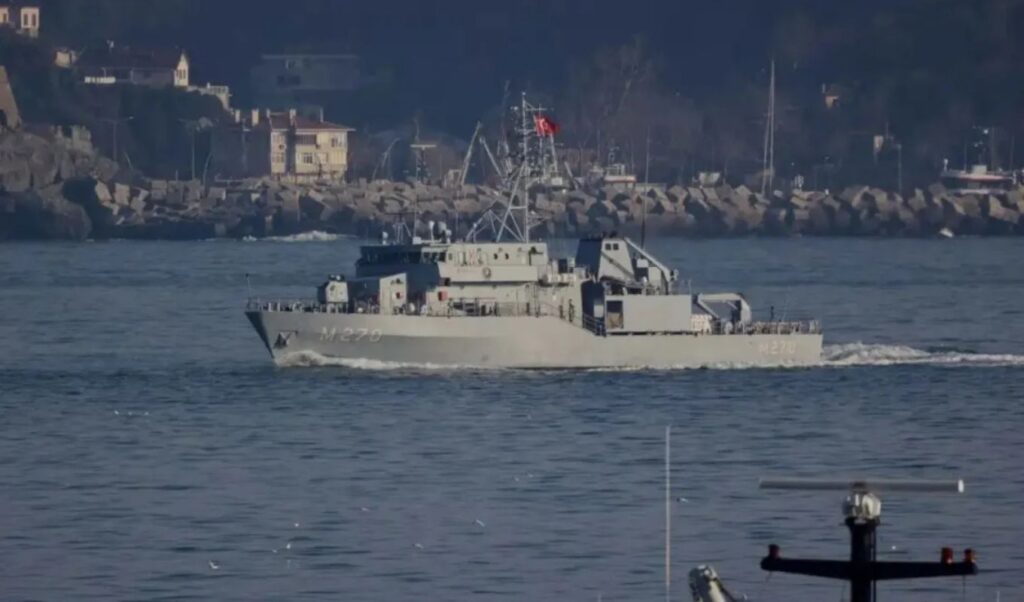
At the same time, Turkey’s provocative behavior is taking on broader geopolitical dimensions. The presence of Turkish warships in the Eastern Mediterranean has put Israel on alert. A report in the Jerusalem Post has drawn Greece and Cyprus into the frame of the Ankara-Tel Aviv confrontation.
Tsikas: Israel is Turkey’s biggest problem
According to Tsikas, Turkey’s biggest problem is not Greece — it’s Israel. As he argues: “The fact that the country with which Turkey has its greatest conflict — Israel — will be installing weapons systems extremely close to its shores is a major concern for Ankara. Regarding the Jerusalem Post report, in my view, the question of Israel’s involvement requires very careful attention. Because Netanyahu in particular, given that he faces elections at the end of October, is very likely to escalate his confrontation with Turkey. And that actually suits Erdoğan to some extent, because he too is trying to present himself as a kind of representative of the Muslim world — at least of Sunni Islam — against Israel. And here lies the danger that Greece could somehow get drawn in. We need to be very clear: there is a real risk that we could find ourselves entangled in this conflict, because Netanyahu, for his own reasons, is actively pursuing a climate of confrontation.”
“Achilles’ Shield”: The Greece-Israel defense deal in Turkey’s crosshairs
Meanwhile, the Turkish press continues to react sharply to the Greece-Israel alliance through the “Achilles’ Shield” defense procurement program, framing it as part of a strategy to encircle Turkey. Reports claim that Greek public opinion is opposed to the agreement — citing the situation in Gaza as a source of domestic resistance to the deal struck between the Greek government and Netanyahu’s administration. Turkey’s Daily Sabah even predicts that “the agreement signed on Monday is one of the largest for Israel and will bolster Greece’s ‘Achilles’ Shield’ air defense system. For Mitsotakis, however, it may prove to be his Achilles’ heel in the 2027 elections.”