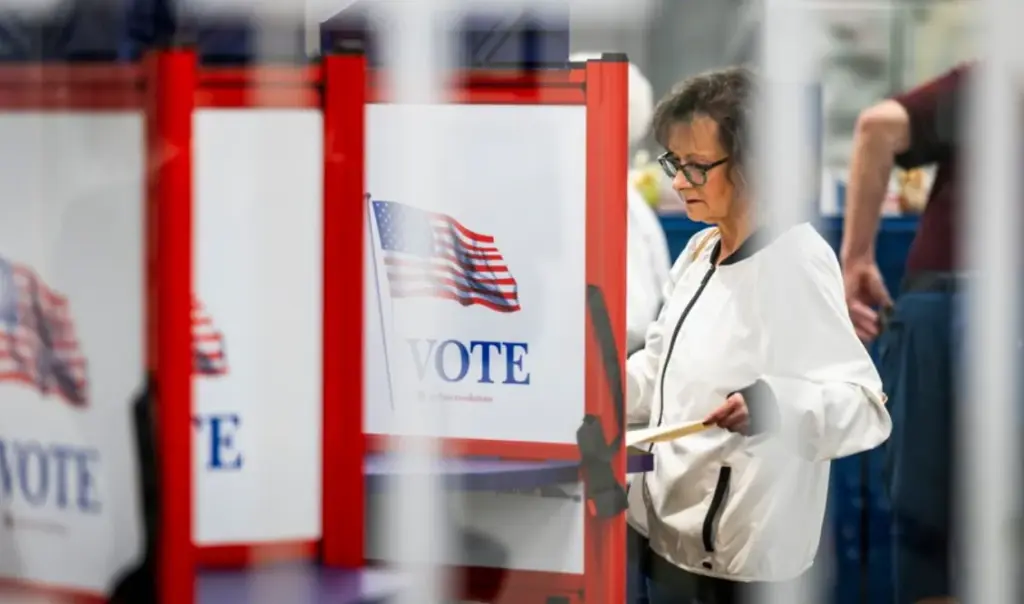
This electoral contest in the United States has evolved into an informal political confidence test for Donald Trump and his administration’s handling of the country. The midterm elections, which traditionally don’t attract the same level of international attention as presidential contests, find themselves at the center of global interest this time around — as their outcome will determine not only the balance of power in Congress, but also the scope of the American president’s political and legislative room to maneuver. Their significance, moreover, extends well beyond the domestic political arena. The trajectory of Trump’s second presidential term, since his return to the White House in 2024, has taken on broader international dimensions, with his foreign policy emerging as one of the key areas of focus.
A telling sign of the political message he has chosen to project during his campaign is that Trump repeatedly invoked France as an example, attempting to link immigration with social unrest and security concerns. However, his insistence on hardline immigration policy may well backfire, narrowing his electoral appeal in states such as Texas.
At the same time, the outcome of this contest will largely be decided in key battleground states, where polls are recording a strengthened Democratic presence. Of particular interest is the fact that the latest surveys show Democratic candidates holding a significant lead even in traditionally Republican strongholds such as Texas, while in Michigan the Senate battle remains critical for maintaining Democratic representation in Congress.
US midterm elections: Key battleground states and the Democratic lead
Specifically, with Senate races being decided in states previously considered safe territory, Michigan and Texas are taking on special significance: the former as a ground for holding a Democratic seat, the latter as a potential upset of a 38-year political tradition.
In the final New York Times/Siena Research Institute poll, published on November 1st and covering seven critical states, Democrats lead in Kansas, Maine, Ohio, Texas, and Michigan. In Alaska the margin is just two points, while in Iowa the race appears essentially tied.
Michigan: Democrats have won both recent contests
Michigan is not a state where Democrats have been absent for decades. On the contrary, they have managed to maintain their Senate presence: Gary Peters was re-elected in 2020, while in 2024 Elissa Slotkin won the other seat, defeating the same Republican candidate who now stands against the Democrats — Mike Rogers. Slotkin’s victory was razor-thin: 48.6% against 48.3%, a margin of approximately 19,000 votes. In 2026, following Peters’ decision not to seek re-election, Democrats are working to hold his seat.
Their candidate, Abdul El-Sayed, finds himself at the center of a race with significant political and social implications. In the final New York Times/Siena poll, he pulls 53% against Rogers’ 42%. The campaign was complicated by the decision of Haley Stevens — who lost in the Democratic primary — to throw her support behind Republican Rogers. The disagreement is also tied to El-Sayed’s position on Israel and Gaza, as well as an advertisement from an outside liberal group linking the cost of living in the US to American support for Israel.
El-Sayed has also come under attack from Trump himself, who called him a “jihadist,” with his religious and family background thus being drawn into the political fray. If elected, he would be the first Muslim senator from Michigan. The race is testing, therefore, not only partisan loyalty, but also the extent to which issues of identity and foreign policy can influence the vote in a state with a strong industrial tradition and significant economic anxieties.
Texas: 38 years without a Democratic senator
The historical dimension of the battle in Texas is even greater. The last Democrat elected to the Senate from the state was Lloyd Bentsen, in 1988. Since then — for 38 consecutive years — Republicans have held both of the state’s Senate seats. In 2024, Ted Cruz defeated Democrat Colin Allred with 53.1% against 44.6%, while in 2020 John Cornyn beat Democratic challenger M.J. Hegar with 53.5% against 43.9%.
This year, Democrat James Talarico faces Republican Ken Paxton, Texas Attorney General, who won the primary against incumbent Senator John Cornyn. The final New York Times/Siena poll gives Talarico 50% and Paxton 43%. Other surveys show a smaller gap or even a tie. The stakes go beyond the numbers: a Democratic victory would break a tradition spanning nearly four decades and would have an immediate impact on the battle for control of the Senate.
Talarico, a state legislator and former teacher, is working to broaden his appeal beyond the traditional Democratic base, with a sharp focus on the cost of living and economic inequality. Paxton, for his part, is aligning his campaign closely with Trump’s priorities — particularly border security and deportations. In a state where immigration has long been a central issue, the race will reveal whether the hardline approach continues to energize the base or whether it is triggering pushback among independent voters and communities with a strong Hispanic presence.
Immigration: from political asset to political liability
The central contradiction of the Trump campaign lies in the immigration issue. In 2024, the promise of strict border control and mass deportations played a decisive role in his electoral comeback. Today, however, the implementation of that policy is drawing criticism even from voters who continue to support border security in principle.
The example of Springfield, Ohio is telling. Trump has brought the city back into his rally speeches — the same city where, in 2024, he made the claim that Haitian immigrants were eating pets. Today, the presence of ICE and ongoing deportation proceedings have generated anxiety within the community. The administration frames these operations as the enforcement of existing law, but the intensity of the measures is causing discomfort even among citizens who do not question the need for border control.
France as a campaign-trail cautionary tale
In his effort to keep immigration at the top of the agenda, Trump frequently invokes France. He uses images of social unrest and incidents in French cities as a warning of what, he argues, could happen in the United States if Democrats prevail. This rhetorical move attempts to link immigration with security and cultural identity, steering the conversation away from inflation, employment, and everyday economic concerns.
Yet the repeated references to France do not address the fundamental question preoccupying American voters: whether the administration’s policies are actually improving their lives, and whether those policies are being implemented in a way they consider fair. Trump has urged his supporters to vote as though he himself were on the ballot, acknowledging that their turnout is critical. Midterm elections, after all, frequently function as a referendum on the party in power.
The result in Michigan will reveal whether Democrats can hold a seat they have won in both of the last two contests. Texas will show whether it is possible to overturn a 38-year political tradition. In both cases, immigration, the economy, and Trump’s personal involvement in the campaign all converge into the same overarching question: how durable is the political coalition that brought him back to the White House — and how willing are voters to hand him a blank check for the next two years.