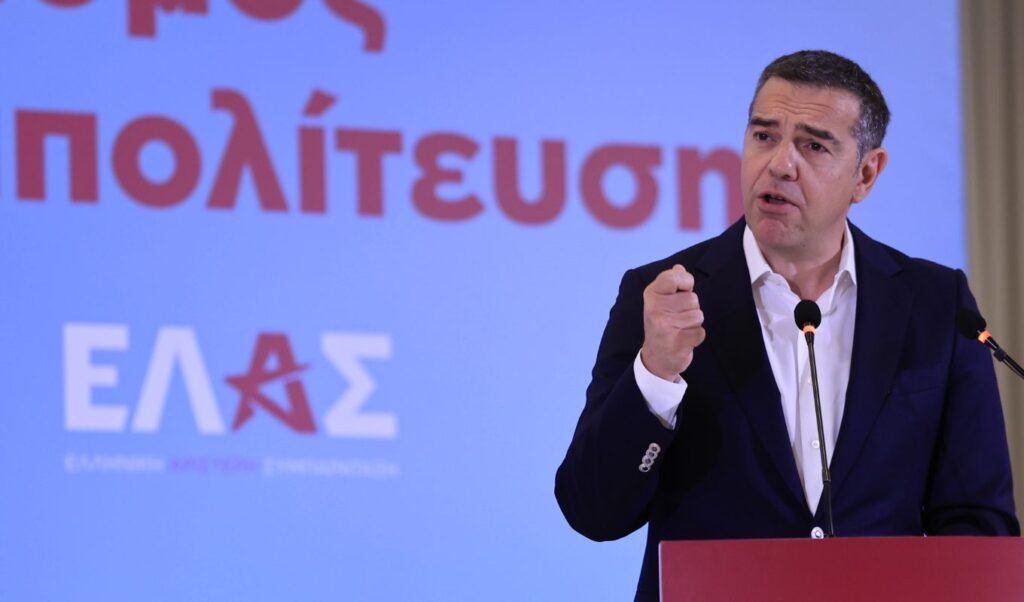
The president of the Greek Left Alliance (ELAS), Alexis Tsipras, outlined the key pillars of ELAS’s economic and tax program in the third installment of his interview with in.gr, published today (12/8) — offering a preview of the announcements he plans to make in September at the Thessaloniki International Fair.
Tsipras is promising a reduction in taxation on salaried workers, pledging that business taxation and the middle class will not see “a single euro” in tax increases, while declaring that “we will tax wealth.” On the issue of non-state universities, Tsipras takes a more pragmatic line: he says he will amend the Pierrakakis law to ensure a non-profit character and a minimum standard of academic quality, while also making clear that any government must respect court rulings.
On the topic of the devastating wildfires, he acknowledges that “the climate crisis plays a very significant role,” but insists that the critical question is “what you do to protect yourself against the effects of the climate crisis.”
Tsipras emphasizes that strategically important networks — such as energy and water — must remain under public control. On recent changes to municipal water utilities (DEYA), he says the moves “smell like a privatization plan,” and states that a government led by him would seek to reverse policies he believes work against the public interest.
Tsipras: “We will tax wealth”
Tsipras draws a clear distinction between taxing great wealth and taxing entrepreneurship. “We will tax wealth. Why would we tax businesses? We will not raise taxes by a single euro on what we call entrepreneurship and the middle class. Not a single euro,” he states.
He argues that the concentration of wealth in the hands of a small number of individuals and corporations has become a European-wide issue, citing as an example the disproportionate share of business profits concentrated among a limited number of listed companies.
For Tsipras, the debate centers on the distinction between great wealth and middle incomes: “The middle class clearly should not be burdened any further.”
Tsipras: “We will reduce taxation on salaried workers”
He previews tax relief for employees, stressing: “At the Thessaloniki Fair, you will hear our tax policy,” and arguing that the “deep imbalance” within the Greek tax system must be corrected. As he puts it, “salaried workers in Greece pay 25% more in taxes than capital does.” “We will present our plan for reducing the tax burden on salaried labor,” he notes, while also challenging the narrative of across-the-board tax cuts in recent years, pointing to rising VAT and income tax revenues as evidence to the contrary.
“The business registration tax must be abolished”
Among the proposed tax interventions is the abolition of the business registration levy (telos epitidevmatos). “The business registration tax must be abolished. It makes no sense,” he says. He argues that the same flat charge is imposed regardless of a business’s financial size, meaning a small enterprise faces the same burden as a company with vastly greater resources.
Tsipras: “Through our integrity, we will find the money”
On how his proposals would be funded, he states pointedly that “through our integrity, we will find the money.” He elaborates: “The party of corruption, of direct contracts, of closed tenders, of bribes and kickbacks — that will stop. It will stop.” In his view, curbing these practices can generate the fiscal space “to support society.” He also criticizes how the Recovery Fund has been used, arguing that a major opportunity to build infrastructure of lasting social and developmental value was squandered.
Tsipras: “The climate crisis cannot be an alibi for everything”
On civil protection, Tsipras acknowledges the decisive role of the climate crisis but rejects its use as the sole explanation for the scale of the destruction. He compares Greece to other Mediterranean countries and raises the question of why the increase in burned land area is, according to the figures he cites, significantly higher in Greece than elsewhere.
The key issue, he notes, is “what you do to protect yourself against the effects of the climate crisis,” placing the emphasis on prevention, infrastructure, and strengthening the civil protection mechanism.
Tsipras: “The approach cannot simply be ‘send a 112 alert and we’re done'”
He also criticizes what he sees as the government’s approach to natural disasters. Human life, he makes clear, is the absolute priority. However, he argues that civil protection cannot be limited solely to the timely evacuation of areas. “It’s not that you only care about that and don’t care at all whether forests burn, whether property burns, whether homes burn,” he says.
Tsipras: “Water is a public good — what has happened with municipal water utilities smells like a privatization plan”
On the issue of water and utility networks, he states: “Water is a public good and must remain under public control.” According to Tsipras, these networks are the property of the Greek people and their operation must serve the public interest — not primarily the profit of private entities. On the recent changes to municipal water and sewage utilities (DEYA), he is even more explicit: “What has happened with the DEYA smells to me like a privatization plan. I want to be absolutely clear.”
Tsipras: Local government must stop being governed from above
Tsipras connects the water issue to his broader vision for local government. “First, the DEYA must become financially viable, energy costs must fall, and then — yes — our plan is for them to come under municipal control,” he notes. The goal, he says, is for “decisions to be made as close to the citizen as possible.”
He outlines ELAS’s “Aristotle” plan for local governance, with the central aim of bringing decision-making closer to citizens and strengthening the participation of local communities.
He criticizes the current administrative structure, referring to “monster municipalities” and arguing that in some cases citizens must travel many kilometers just to reach their town hall.
He also previews the restoration of municipal communities with elected presidents, along with the institutionalization of participatory planning and participatory budgeting. “A portion of decisions should be taken — with the help of digital technology — directly by citizens themselves,” he states.
Tsipras: “We will amend the Pierrakakis law to guarantee the non-profit character of non-state universities in practice” — “We will not act unlawfully”
ELAS leader Alexis Tsipras makes clear that his policy remains oriented toward strengthening the public university system. However, he acknowledges that a future government must operate within the institutional and judicial framework that will be in place at the time.
“We will amend the Pierrakakis law,” he declares. As he explains, the goal will be to ensure the non-profit character of institutions is guaranteed in practice and to establish a strict minimum standard of academic quality. “This free-for-all that is taking shape — with substandard degrees and so-called colleges offering bare-minimum courses — we will not allow it to develop,” he says.
He is nonetheless unequivocal: “We will not act unlawfully. We will not go against the framework of principles that governs a law-abiding state.”
“The point is to grow the pie”
Beyond taxation and redistribution, Tsipras signals that the second major pillar of his economic plan will focus on growth. “One issue is how you distribute the pie fairly. But if the pie keeps shrinking, no matter how fairly you divide it, no one will be satisfied. The point is to grow the pie,” he notes. The plan, he says, will pursue sustainable growth rates over a four-to-five-year horizon and a transformation of the current production model.
Tsipras: “We cannot be Europe’s waiters”
Tsipras challenges a development model built primarily on real estate and tourism. “No economy can be based solely on real estate and tourism. Full stop,” he states.
He sets out the primary and secondary sectors, the development of the country’s competitive strengths, and a “holistic industrial policy” as key priorities.
“I am not convinced by the fairy tale that this country cannot produce. Let’s forget it — we’ll just be Europe’s waiters. I am not convinced. This country has potential. It has just never had a plan,” he says.
The economic program to be unveiled on September 2nd
Tsipras announces the timeline for his economic policy announcements. The full program for “Greece 2030” will be presented on September 2nd in Thessaloniki, at a dedicated event at the Porto Palace hotel.
On September 9th, he will visit the Thessaloniki International Fair and hold the customary press conference. At the heart of the proposals, as he summarizes them, will be “a different production model, a plan to grow the pie, and our proposals for how that pie will be distributed more fairly to the Greek people.”