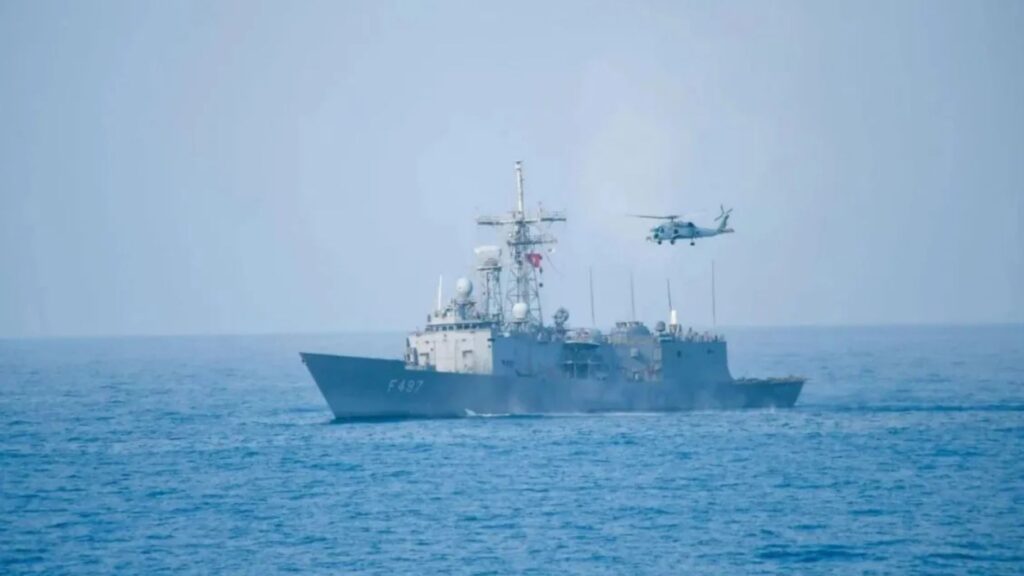
The persistent and systematic escalation in Turkey’s rhetoric in recent months has placed Athenian diplomatic circles on high alert. Analysts at the Greek Ministry of Foreign Affairs and key decision-making centers are working to decode Ankara’s moves, no longer ruling out any scenario for the future of bilateral relations. The Turkish side appears determined to push tensions even further, confirming deep-seated concerns that it has no intention of backing down from its longstanding territorial claims.
Yesterday, the Turkish Ministry of Defense forcefully revived the issue of the demilitarization of Greek islands. The latest trigger was reports concerning the possible establishment of an unmanned aerial vehicle (UAV) base on the island of Rhodes. At the same time, Ankara openly expressed satisfaction over the relocation of the Patriot missile defense battery from Karpathos to Crete. Beyond the diplomatic front, pressure is also escalating daily in the skies, with ongoing violations of Greek airspace by Turkish-operated American-made F-16 trainer jets — a clear show of force over the Aegean.
Among the immediate flashpoints expected to test relations between the two countries is the issue of laying an undersea cable. The Greek government has stated its firm intention to proceed with the project, with the support of French company Meridian. Turkey, meanwhile, is using orchestrated media leaks to demand its own approval over the project. Additionally, Ankara is keeping on the table the threat of passing the “Blue Homeland” bill in the Turkish Grand National Assembly, possibly as early as October — a move designed to create facts on the ground, even without any international legitimacy.
Greece can no longer limit itself to invoking international law against Turkey
Against this explosive backdrop, recent statements by Greek Foreign Minister Giorgos Gerapetritis — that “we are ready for every scenario” — signal that all contingencies are being considered. Leading analysts point out that Athens can no longer afford to rely solely on invoking international law. Instead, Greece must demonstrate in practice that it has both the will and the capability to defend its sovereign rights when necessary.
The question of how likely a Greek-Turkish conflict scenario truly is remains at the forefront of the debate. Panagiotis Ioakimidis, Emeritus Professor of European Studies at the University of Athens, tells parapolitika.gr that such a scenario can no longer be ruled out, describing it as “a very probable scenario.” As the professor explains, “Turkey is cultivating the perception that Greece, possibly in cooperation with Israel, is planning to wage war against it. A potential conflict could be triggered either by a random incident or by a fully calculated action on Turkey’s part.”
According to Professor Ioakimidis’s analysis, the scenario of deterring a Greek-Turkish conflict can only succeed if an external actor among Greece’s allies — such as NATO, the United States, or France — intervenes to “pull the emergency brake.” In the event of an armed confrontation, international actors would be expected to act according to their own national interests, with each country adopting a different stance. The US and NATO would find themselves facing an exceptionally complex situation due to the conflict involving two alliance members. Meanwhile, Israel and Egypt are assessed as likely to exert diplomatic pressure to prevent further escalation. Within this framework, the defense agreement with France remains Greece’s strongest card.