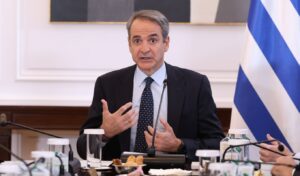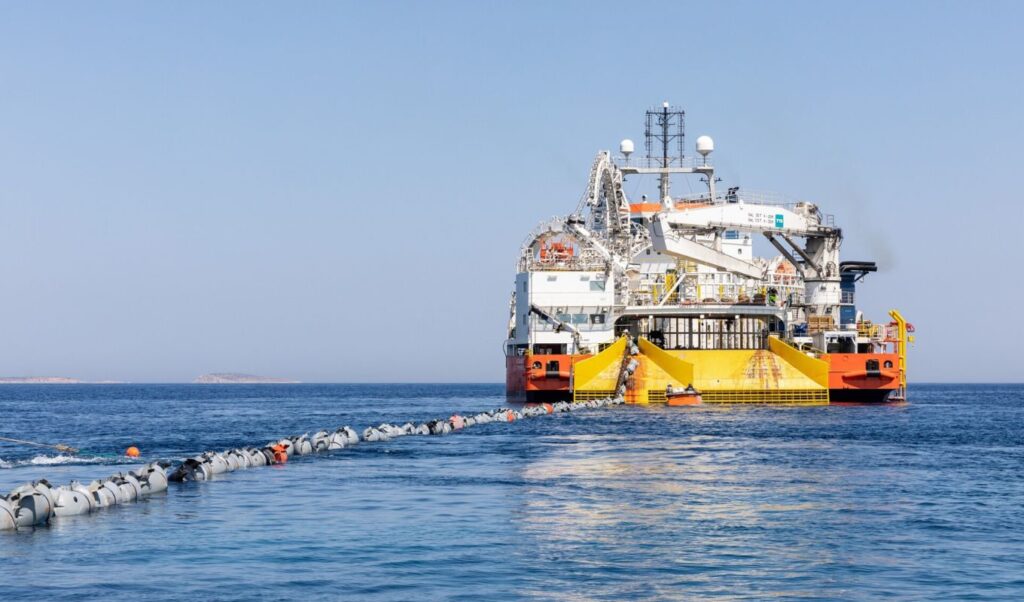
Athens is prepared for all contingencies in order to defend its sovereign rights, which are likely to be tested during the undersea survey operations for the Greece–Cyprus electrical interconnection cable (GSI). Prime Minister Kyriakos Mitsotakis reiterated in an interview on Alpha 9.89 that the project will move forward and that the permit will be issued by the Greek side, stressing that “we will address the rest in due course” — while declining to comment on how Greece would respond to any potential harassment.
Read also: Greece–Cyprus electrical interconnection: Final stretch before surveys begin — expected to focus on the Kasos maritime area — What the former Cypriot Ambassador Michalis Stavrinos tells parapolitika.gr
Athens on operational alert for new Turkish provocations
Foreign Minister Giorgos Gerapetritis briefed members of the Parliamentary Committee on Foreign Affairs and National Defence, assuring lawmakers that if Turkey attempts to obstruct the project, the government is prepared to respond with operational interventions.
According to all available information, a NAVTEX notice is expected to be issued by the end of this week or the beginning of next week, authorizing the French research vessel Abeille Marengo — currently anchored in Heraklion, Crete — to set sail for Kasos, where it is scheduled to resume seabed surveys that were previously halted due to Turkish harassment.
For Lieutenant General Spyros Belegratsis, “Greece has made it clear that it will not allow European Projects of Common Interest (PCI) to be held hostage or obstructed due to power projection by its neighbor.” As he argues in an exclusive interview with parapolitika.gr, “energy infrastructure in the Eastern Mediterranean should not be approached as a zero-sum game or a field of power competition, but as an opportunity to leverage geography for the promotion of regional security and cooperation, always in accordance with the provisions of international law — including UNCLOS 1982.”
From this perspective, the Lieutenant General attributes Ankara’s reactions to its inability to advance its revisionist claims under the guise of international legitimacy, arguing that Turkey is instead seeking to impose geoeconomic faits accomplis — with the ultimate aim of establishing itself as the primary conduit for energy routes and securing a dominant position in the market. According to Belegratsis, “by artificially delaying the GSI’s preparatory surveys — through invalid NAVTEX notices, harassment, and legal challenges — Turkey also aims to increase the financial risk of the investment, making the project economically unviable. The ultimate objectives of its strategy combine all of the aforementioned actions, alongside simultaneous or ongoing efforts to extract maximum benefit from the potential plundering of sovereign rights in the EEZ of both Cyprus and Greece.”
Bahçeli sends fresh messages of defiance from Ankara
Meanwhile in Turkey, Devlet Bahçeli — coalition partner of Recep Tayyip Erdoğan and leader of the Nationalist Movement Party (MHP), who consistently voices Turkish government positions in the most forceful terms — described the Libyan parliament’s ratification of the Turkey–Libya memorandum as “a welcome development.” Speaking to his party’s parliamentary group, Bahçeli argued that Turkey must take all necessary measures to protect the sovereign rights of both itself and the pseudo-state, declaring that “there is no room for faits accomplis in the Eastern Mediterranean.”
He also launched an attack against Greece, the Republic of Cyprus, Israel, and the European Union, accusing the EU of siding with Greek and Cypriot positions at Turkey’s expense. Commenting on the joint statement issued by the leadership of the European Commission and the European Council, he said sharply that “pointing a finger at Turkey… is not something anyone can impose — not even Europe,” underlining that Turkey and Libya are under no obligation to act in accordance with the expectations of third countries.
On the Greek side, Deputy Foreign Minister Alexandra Papadopoulou, speaking at the London School of Economics (LSE), stressed that Greece seeks cooperation and dialogue, while emphasizing that “no country can claim a dominant role in the Eastern Mediterranean” and that “in our region, no one can be sovereign” — describing any such ambition as “a recipe for disaster.”
Addressing the Turkey–Libya memorandum, Papadopoulou characterized it as contrary to international law and the EU’s position, noting that it completely disregards Greece’s rights — and those of Crete in particular. “We are not talking about a rock in the Aegean or a small island. We are talking about Crete, a large island, which the memorandum treats as if it doesn’t exist,” she said pointedly.
Turkey–Libya memorandum: Reactions and warnings from within Turkey
Notably, significant skepticism about the Turkey–Libya agreement is also emerging within Turkey itself. Former Turkish Ambassador Selim Kuneralp has launched a sharp critique of the Turkey–Libya memorandum strategy. In an article published on the “Ekopolitik” website, Kuneralp warns that Turkey cannot “erase Crete from the map” and that a military confrontation would come at a heavy cost.
He further emphasizes that Turkey’s position — seeking to restrict the maritime zones of Crete, Rhodes, and Cyprus to just 6 nautical miles — has no realistic chance of gaining international acceptance, stressing that “the principle of equity will not allow Crete to be overlooked.” The former Turkish diplomat warns of the dangers of sending research vessels into disputed waters, urging the government not to “play with fire for electoral gain” and invoking the crises of 1976 and 2020 as cautionary precedents. He also points out that Egypt is rallying Arab states — including Bahrain and the UAE — against the memorandum in support of the Greek position, ultimately calling on Ankara to avoid pre-election bravado and instead pursue a negotiated compromise.