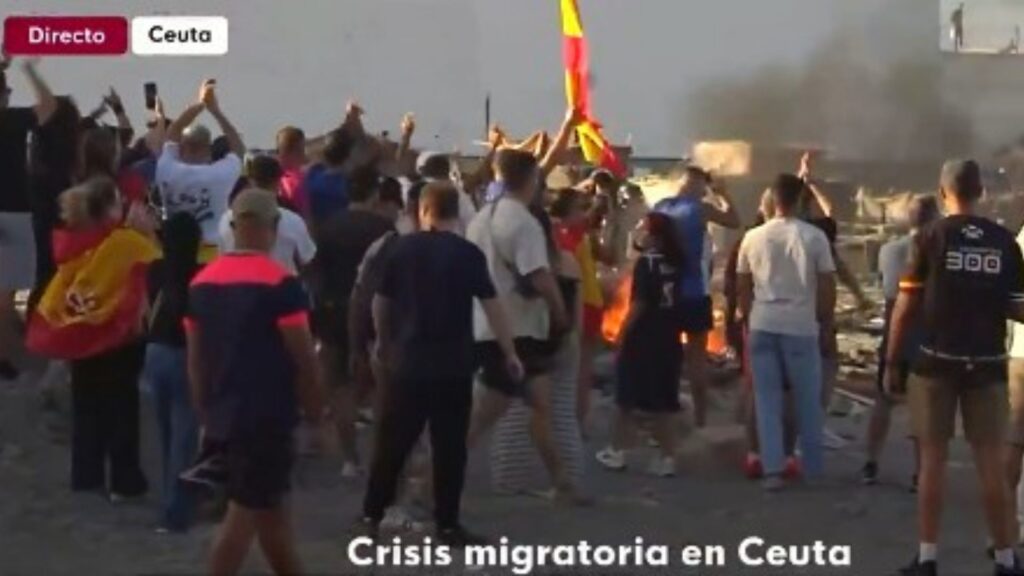
Protesters set fire Thursday to a migrant camp in the Spanish enclave of Ceuta, in northern Africa, demanding that migrants be sent back to Morocco. Footage from Benítez beach, where migrants had been staying for weeks, shows demonstrators repeatedly throwing objects into the flames.
VIDEO | El grupo de manifestantes que esta tarde ha impedido la entrada de un camión de Cruz Roja en la playa del Trampolín, en Ceuta, con comida para los migrantes, ha incendiado dos sombrillas de paja en otro pequeño campamento junto a otra playa adyacente y contigua a la… pic.twitter.com/al0jzgxFij
— EFE Noticias (@EFEnoticias) August 27, 2026
Police intervened to separate protesters from migrants, who sought refuge on a nearby pier. Earlier, demonstrators had attempted to block Spanish Red Cross vehicles delivering food and water to the migrants.
🇪🇸 Ceuta, España | 🔴 AHORA: La Policía interviene en la playa del Trampolín y trata de echar a los manifestantes que prendieron fuego a varias cabañas de inmigrantes ilegales. https://t.co/FW2xFXLlPM pic.twitter.com/v8olXH1fp4
— 𝐄𝐥 𝐈𝐦𝐩𝐞𝐫𝐢𝐚𝐥 (@ElImperialEsp) August 27, 2026
80,000 migrants crossed into Ceuta in late July — Spain bans mass deportations
An estimated 80,000 migrants crossed en masse into Ceuta from Morocco in late July, many of them swimming across. At least 96 people lost their lives, according to official figures.
Most were returned to Morocco in the days that followed, but several thousand remain in Ceuta.
The conservative opposition — both the People’s Party (PP, center-right) and Vox (far-right) have described the situation as an “invasion” — is demanding that all remaining migrants be deported. However, international agreements and rulings by Spanish courts prohibit mass deportations, requiring each case to be assessed individually.
Unaccompanied minors are entitled to special protection. Among the migrants still in Ceuta, approximately 1,500 are believed to be children and teenagers, with 500 considered extremely vulnerable — primarily girls — who are expected to be transferred to mainland Spain.
Mounting pressure on the Sánchez government
The center-left government of Prime Minister Pedro Sánchez has faced mounting pressure over the crisis, with the opposition loudly accusing it of inaction and abandoning Ceuta’s residents.
The Socialist (PSOE) government has also come under fire over contradictory statements regarding whether authorities had received prior warning of the mass crossing.
Defense Minister Margarita Robles stated that the CNI, Spain’s intelligence service — which reports directly to her — had issued a warning one day before the mass attempt to enter Ceuta.
Interior Minister Fernando Grande-Marlaska and other government members have countered that no warning was received about the scale of the crisis.
Prime Minister Sánchez is expected to address the issue — which has sparked international reactions — in the Spanish parliament next week.
ANA-MPA