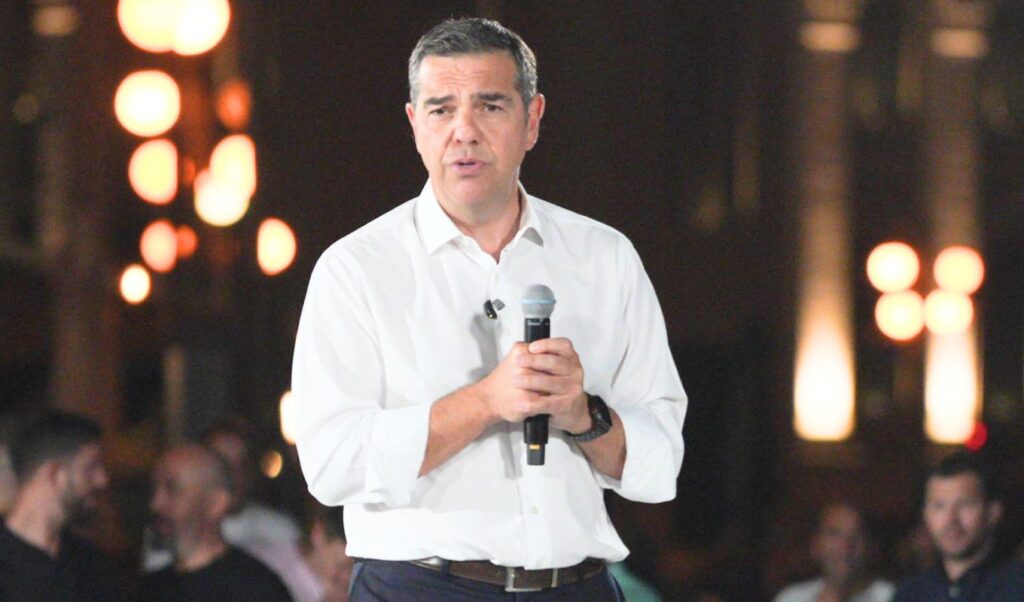
Alexis Tsipras is set to present his new agreement on Local Government this afternoon at a major event attended by dozens of local government officials. The event will open with an address by ELAS Secretary Miltos Hatzigianakis, who previously served as Mayor of Skyros.
In his speech, Tsipras will outline five major reforms needed in local government and will stress that “Greece remains one of the most centralized countries in Europe. This is not simply an institutional problem. It is one of the main reasons citizens experience more bureaucracy, delays, uneven development, and a regional periphery that is gradually emptying out. Decision-making is concentrated in the central state, processes remain slow, municipalities have limited resources and powers, and citizens have little meaningful say in decisions that affect their daily lives.”
Tsipras will further argue that “the problem is not only institutional — it is deeply social and developmental. The regions are finding it increasingly difficult to remain places where people can live, work, and build a future. Local government is not just another tier of public administration. It is the face of the state that citizens encounter every day. It is the municipality that maintains the school, the neighborhood, the park, the social services, civil protection, and quality of life.”
The former Prime Minister will emphasize that “in Greece in 2026, the reality of local government is that the majority of decisions are still made by the central administration or by intermediary state mechanisms. The scale of this gap is captured in a single OECD figure: sub-national authorities in Greece manage just 6.5% of public spending, compared to around 34% across the European Union. Moreover, municipalities operate under conditions of severe financial strain. KEDE itself, along with a joint EETAA–KEDE study, estimates an operational funding gap of approximately €2.5 billion. Greek municipalities spend around €913 per resident — one of the lowest figures in Europe — while local government accounts for roughly 4% of GDP, also among the lowest rates on the continent. At the same time, European institutions consistently point to the limited powers, unclear allocation of responsibilities, and weak financial autonomy of Greek local government.”
The ELAS leader will also argue that “the systemic failings consistently highlighted by European institutions are not abstract institutional matters. They translate into real, everyday problems: delayed projects, excessive red tape, fewer services, resource deprivation, missed development opportunities, and ultimately fewer possibilities for people to live, work, and build their lives in their own communities. The country needs a new decentralization agreement — one that transfers real power, responsibilities, resources, and democratic accountability to local communities. Municipalities and regions can no longer operate as mere administrative bodies managing limited competencies; they must function as genuine local-level governments.”
The five major reforms Alexis Tsipras will outline are:
1. Redesigning the local government map: clear accountability, less bureaucracy, faster processes, and administration closer to the citizen
Today, accountability is lost between ministries, Decentralized Administrations, Regions, and Municipalities. Responsibilities overlap, approvals multiply, processes stall, and citizens are often left not knowing who ultimately decides — or who is answerable. At the same time, the transfer of powers to local government takes place without the necessary financial resources, personnel, or tools to exercise them effectively, turning decentralization into little more than a transfer of responsibility without the means to deliver.
Our proposal changes this logic from the ground up. We are moving toward a comprehensive redesign of the local government map with a clear distribution of responsibilities, so that each public duty is assigned to a single body and every body has the resources, staff, equipment, and costed mandate needed to carry it out effectively.
The central state will take responsibility for strategic planning, legislation, and ensuring legality. Regions will organize and coordinate policies at a regional scale. Municipalities will govern their areas and be directly accountable to their citizens. This restores the principle that each level of governance does what it can do best and closest to the citizen. As part of this reform, the Decentralized Administrations will be abolished — an intermediary state mechanism that currently functions as a bureaucratic filter, slowing down the delivery of projects and investments. Their responsibilities will be transferred to elected Regions, together with the corresponding staff and resources, while those with a genuinely national or supra-local character will be returned to the relevant ministries.
At the same time, we are reviewing the local government map — not on the basis of size, but on the coherence of each local community. The mergers carried out under the “Kallikratis” reform created, in many cases, excessively large, geographically disconnected, and socially heterogeneous municipalities. The solution is neither to preserve a flawed map nor to pursue a new round of blanket mergers. It is to have municipalities that reflect the real geographic, social, and economic character of each area, and that cooperate with one another where necessary. This reform will be underpinned by a new Local Government Code — one that does not simply codify existing legislation, but redefines the relationship between the state, local government, and the citizen. The goal is a public administration that is more effective, more decentralized, more democratic, and clearly accountable to the people it serves.
2. Reviving communities: strong local societies
Decentralization is incomplete if it stops at the municipal level. It must reach all the way down to the neighborhood and the village. Today, local communities and municipal districts have a limited role — without meaningful responsibilities, without resources, and without a real ability to influence decisions that affect residents’ daily lives.
Our proposal changes this. Communities and district councils will gain a substantive role in the planning and decision-making processes that shape everyday life. Community councils will be elected through their own separate ballot. We will restore local districts and municipal units with a meaningful role in project planning and budgeting. Communities will be given specific responsibilities over day-to-day matters, their own budget, stable and direct funding, and an institutionalized participatory budgeting process.
3. Meaningful multi-level governance: cooperation over centralization, decentralization, and vibrant regions
Multi-level governance and decentralization become tools for demographic renewal, economic development, and social cohesion — enabling young people to stay and build their futures in their own communities. Our proposal gives Greece a new governance architecture in which each level takes on the role it can perform most effectively.
There are challenges that go beyond the boundaries of a single municipality — such as transport, flood protection, water management, major infrastructure, or civil protection — but these do not need to revert to the central state. The solution is multi-level governance: strong inter-municipal cooperation networks, metropolitan coordination in major cities, a strengthened role for Regions, and a new National Policy for Geographic Equality, so that geography no longer determines citizens’ opportunities. The goal is an administration that collaborates, leverages economies of scale, and delivers better services — without removing decision-making from local communities.
4. Participatory democracy: citizens decide
Renewing local government is not only about more powers and more resources. It is also about a different way of making decisions. Our goal is to move from a model of token consultations to genuine participatory governance — where citizens are not limited to the role of bystanders but become active co-creators of local policy.
To this end, we are proposing a new participatory governance framework that includes binding participatory budgeting, local referendums with decision-making power, a combination of digital and in-person participation, public monitoring of project progress, mandatory justification for the rejection of citizen proposals, sortition-based citizen assemblies for complex issues, and transparency and evaluation across all participatory processes. Democracy does not end at the ballot box. It continues every day through citizens’ ability to participate, hold power to account, and co-shape the decisions that affect their lives.
5. Financial empowerment: no local government without resources
Genuine local government cannot exist without financial autonomy. Today, most municipalities are heavily dependent on decisions and grants from the central government — creating delays, uncertainty, and an inability to plan for the long term. The average fiscal autonomy index for municipalities stands at just 24.9%, with roughly half of the country’s municipalities covering less than 20% of their regular revenues from their own sources. On top of this, there is a funding gap exceeding €2.5 billion for operational and investment needs.
Our proposal guarantees stable and predictable resources for the entire duration of each municipal term, strengthens the Central Autonomous Resources fund, assigns the resilience levy to municipalities, increases funding from the Green Fund, secures a permanent share of European funds, and creates a new investment programme called “Philodemos.” It also provides technical support and project maturation tools, so that resources are converted into infrastructure, services, and development. The goal is clear: every municipal authority should know what resources it will govern with, plan with a five-year horizon, and be accountable to its citizens for results — not to a ministry for the next approval.