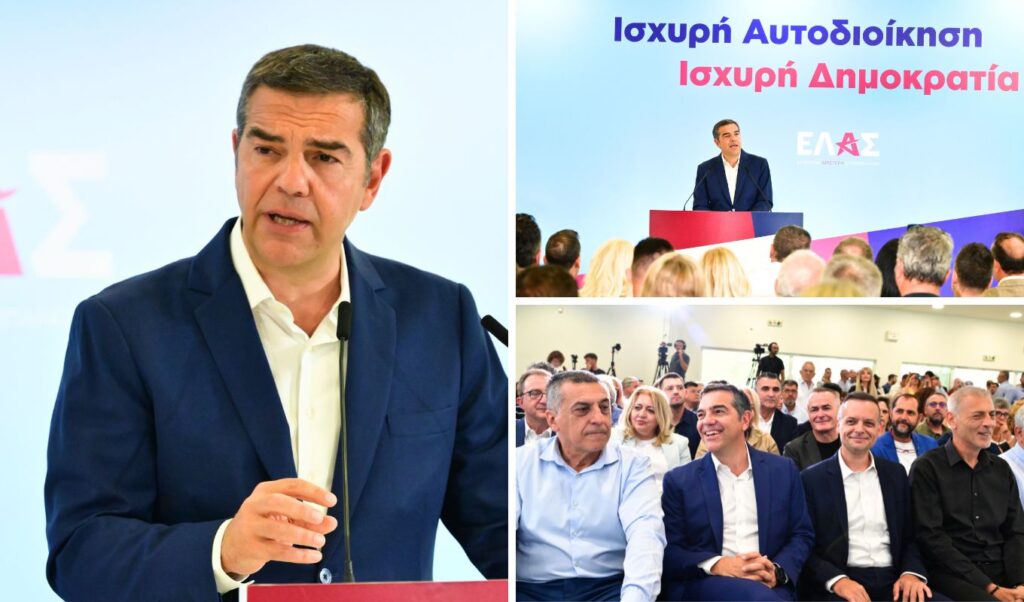
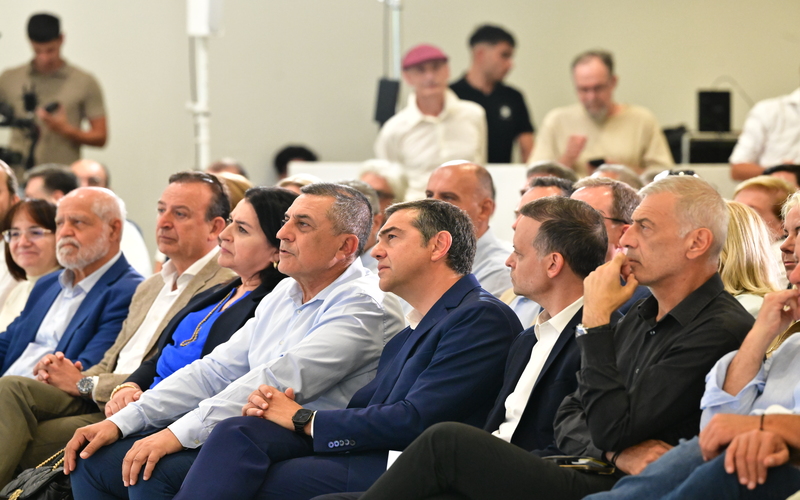
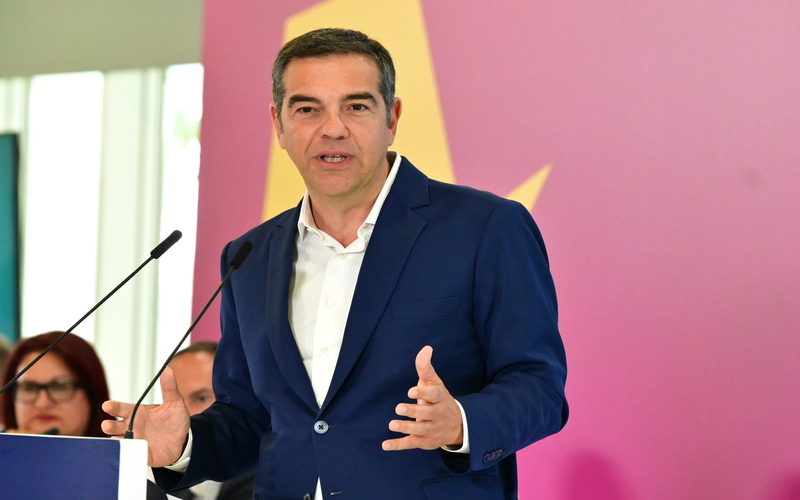
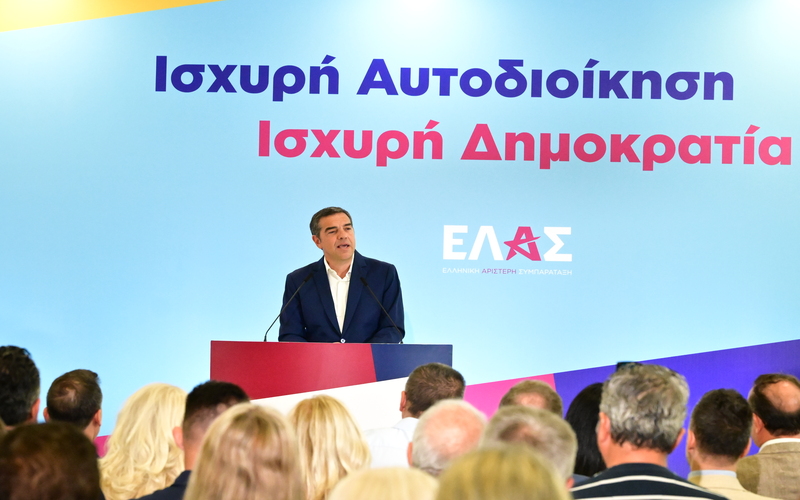
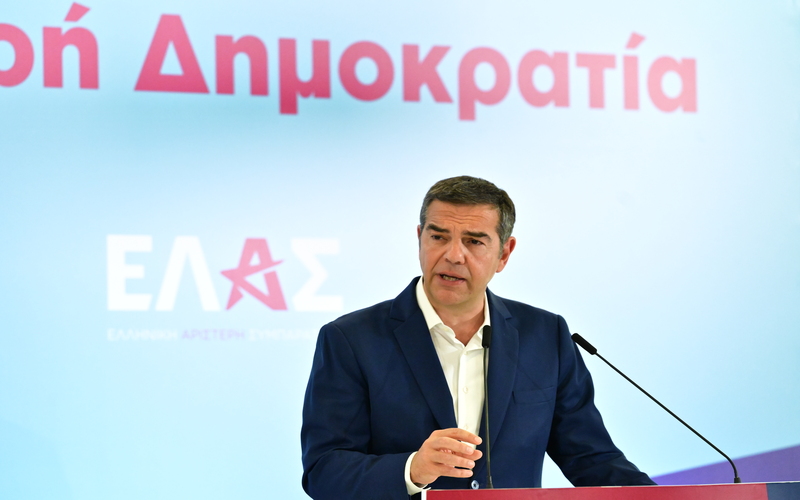
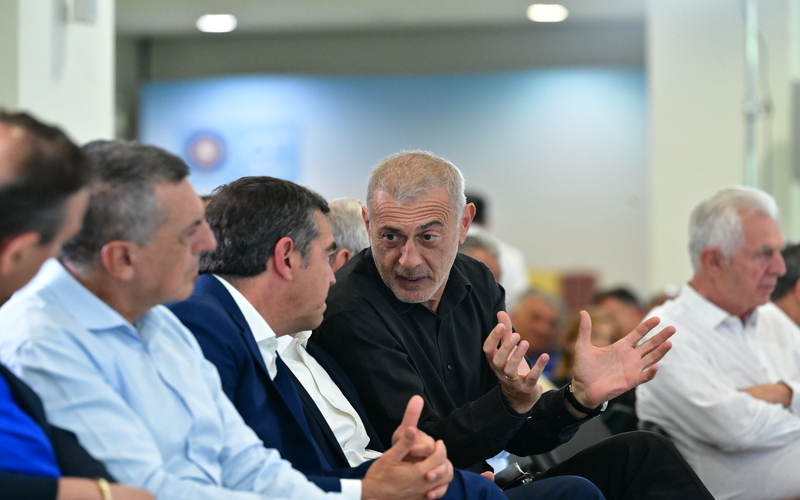
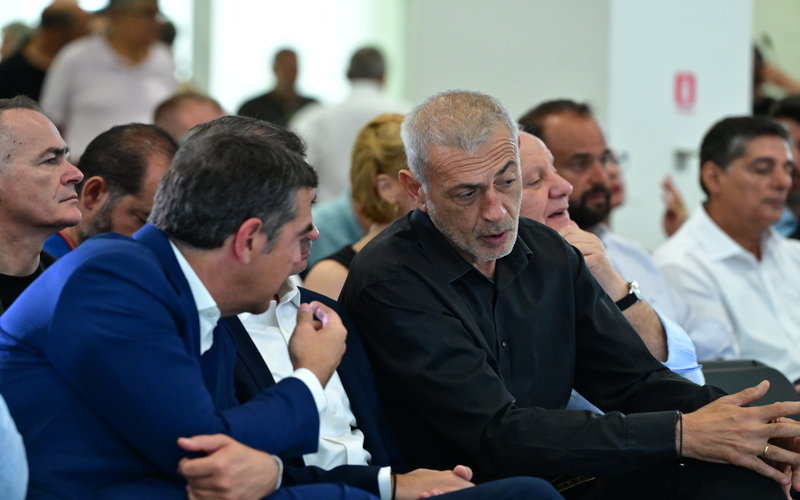
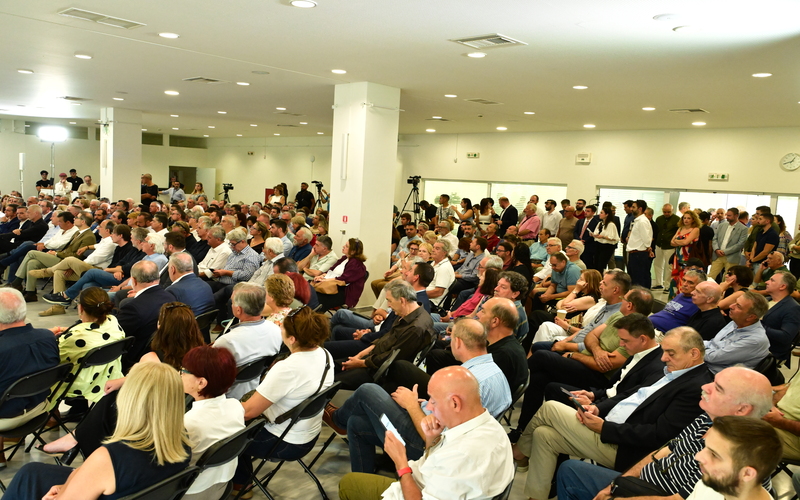
At the Serafeio sports complex of the Municipality of Athens, Alexis Tsipras and the leadership of his newly founded party EL.A.S. presented a reform program under the codename “Aristotle.” The plan outlines a comprehensive proposal for restructuring and redesigning the architecture of local government in Greece.
Read also: Alexis Tsipras presents EL.A.S. proposals for local government reform (Images & Video)
Tsipras on local government: the “Aristotle” plan and the “New Democratic Transition”
The central pillar of the plan is the establishment of a new relationship between central government and local self-governance, as part of EL.A.S.’s broader vision for a “New Democratic Transition” in Greece. The proposal also targets the structural problem that has long plagued the Greek state — an intense concentration of resources and responsibilities at the central level — while placing democratic governance and transparency in local communities at the forefront of the agenda.
In his remarks on the failings of the current local government system, Tsipras invoked the late resistance hero and politician Manolis Glezos, recalling his memorable phrase: “we don’t have self-governance, we have other-governance,” and described the current state of local administration as a distortion. “We don’t want to present bureaucratic changes, but a new vision for Greece,” he said.
The philosophical origins of the name and the push against centralization
The plan’s name was chosen because Aristotle was the philosopher who laid the foundations for political organization based on the principle of balance and moderation — a quality that should, according to Tsipras, be reflected in the currently inadequate decentralization of the Greek state.
“With this name, we want to show that the roots of our history and of Greek thought can and must bear modern fruit. It is time for us to truly become a part of Europe,” he added.
For Tsipras, excessive centralization creates significant bureaucratic obstacles while simultaneously acting as a “brake” on development in the regions.
He also raised the alarm over Greece’s demographic decline and the depopulation of rural areas, noting that “young couples need almost an entire monthly salary just for rent and cannot afford to leave their parents’ home at 30 or 35.” He further stressed that “Greece has become one of the most centralized countries in Europe.”
The four pillars of the plan and regional “development contracts”
The plan rests on four core principles: proximity, effectiveness, subsidiarity, and democratic accountability. The underlying rationale is that every decision must be made as close to the citizen as possible and with the citizen’s participation — meaning genuine decentralization, genuine democracy, and genuine trust. Citizens must know who is making decisions and who is accountable for them.
At the same time, Tsipras brought into focus the need to reshape the country’s development strategy and build what he described as a new economy.
“No European country has ever developed because decisions were made in the capital,” he stated pointedly.
The former prime minister proposed that each region obtain its own development contract with specific goals, projects, and measurable outcomes. “Its own social contract,” Tsipras said emphatically.
Abolishing decentralized administrations — transferring powers to elected regional authorities
Tsipras also proposed the abolition of the Decentralized Administrations, which are chronically understaffed and create a host of problems for local authorities, with their responsibilities to be transferred to elected regional governments.
The role of the central state would resemble that of a strategic headquarters — responsible for planning and evaluation — while local government would bear the primary burden of implementing decisions.
The plan also includes provisions for energy democracy at the municipal level, through the establishment of an energy community in each regional unit. Tsipras pledged the allocation of dedicated energy resources for local authorities and committed to restoring net metering for energy communities serving municipalities and municipal water and sewage companies (DEYΑ).
Creating up to 150 new municipalities and sharp criticism of the “Kallikratis” reform
Another key provision is the creation of up to 150 new municipalities, which would address a series of administrative efficiency issues as well as restore the historical and geographical cohesion of communities that, in many cases, were artificially merged together.
This proposal came alongside fierce criticism of the “Kallikratis” plan, passed under the last PASOK government, which merged municipalities and reduced their number from approximately 1,000 to just 325. The number later rose slightly to 332 under the subsequent “Kleisthenis” reform introduced by the SYRIZA government.
Tsipras used the municipality of Vari-Voula-Vouliagmeni as a central example — a municipality currently led by Grigoris Konstantellos, first vice president of the Central Union of Municipalities of Greece (KEDE).
“The spatial consolidation brought about by ‘Kallikratis’ created oversized administrative units, resulting in a qualitative degradation of local democracy and citizen participation in public life,” he noted, adding that “more than 100 municipalities in the country can reclaim their autonomy.”
Financial relief for local authorities: resilience levy, new “Filodimon” programme, and guaranteed central grants
Tsipras painted a bleak picture of local government finances, drawing on the findings of a study conducted by KEDE in cooperation with EETAA (the Greek Agency for Local Development and Local Government).
It should be noted that the funding gap facing municipalities amounts to €2.5 billion, of which €1.3 billion relates to operating expenses and €1.2 billion to investment needs.
As a remedy, he proposed enshrining the Central Autonomous Resources (KAP) grants as a guaranteed percentage of GDP, along with the establishment of a dedicated and predictable investment funding stream, to be activated by unlocking dormant reserves, European funds, and locally generated fees and levies.
The “Aristotle” plan includes the development of a range of financial instruments, such as directing the full proceeds of the resilience levy — amounting to €582 million — to municipalities.
In the same vein, 6% of the resources of the Green Fund would be allocated to local government as investment capital for projects with a positive environmental impact.
Furthermore, 40% of the new ESPA (National Strategic Reference Framework) funds would flow to local and regional government, with €6 billion earmarked exclusively for municipal projects.
Under the plan, the National Development Programme would commit €250 million which, leveraged through borrowing from the European Investment Bank, would form a new “Filodimon” programme worth €3.5 billion over five years — equivalent to €700 million per year — with no additional fiscal cost.




Metropolitan associations for Athens and Thessaloniki
The EL.A.S. leader proposed the creation of flexible metropolitan associations with competencies covering spatial planning, infrastructure, water management, mobility, and civil protection.
This framework is envisioned to be established initially in Athens and Thessaloniki, with these bodies not replacing the existing powers of individual municipalities within those areas.
More broadly, Tsipras remarked that “major cities cannot function solely as municipalities. Great metropolitan areas plan, decide, implement, and are held accountable.”
No responsibilities without corresponding resources
As a fundamental obligation, Tsipras stressed a rule that is written into the constitution but is frequently applied only partially or selectively in practice.
“No responsibility will be transferred without the corresponding resources and personnel needed to carry it out,” he stated with emphasis.
Restoring the two-round ballot and a 50%+1 majority threshold
Addressing issues of democratic governance, the former prime minister argued that the current electoral system for local government serves the ruling party’s interests in municipalities and regions.
The EL.A.S. proposal for the local government electoral system calls for the restoration of the runoff second round, which was abolished by the recently passed New Local Government Code, and for the election of mayors and regional governors to require an outright majority of 50%+1.
Tsipras argued that “the previous system worked effectively,” adding that “real problems require mayors with a strong mandate.” Regarding the electoral system introduced by the new Local Government Code, he noted that it “did not have the consent of any collective body of local government.”
The principle of geographic equality
Tsipras stressed that “Greece cannot be divided into two-tier citizens” and that quality of life must not depend on where one lives. He announced the establishment of a National Policy for Geographic Equality.
SEO