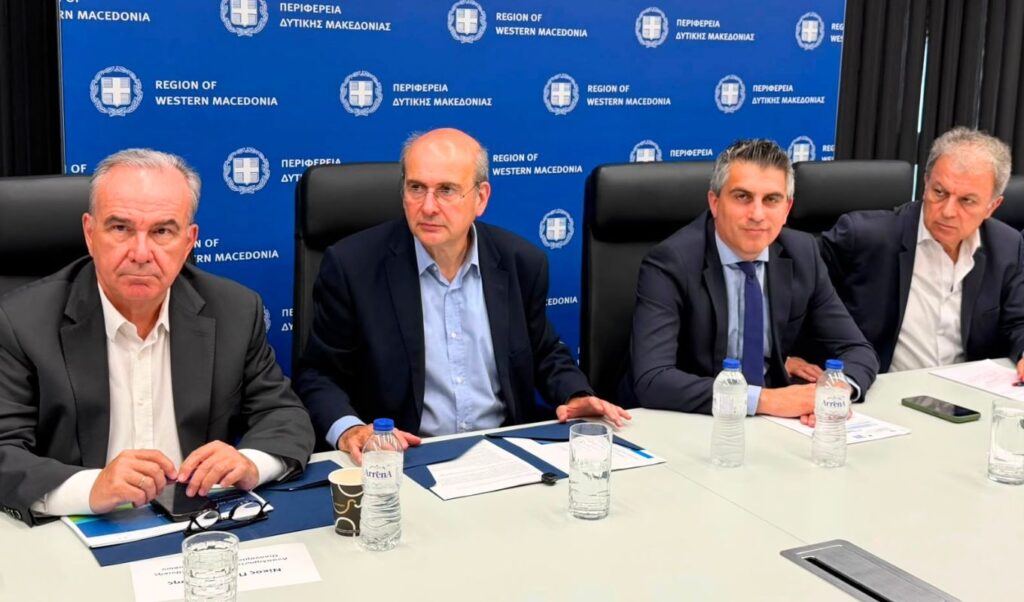
“Today in Kozani and Western Macedonia, the government is speaking through action. Projects that have been completed in recent years or will be delivered in the coming months. I understand the concerns of local organizations and residents — concerns that exist in every country implementing decarbonization programs,” said Deputy Prime Minister Kostis Hatzidakis during his visit to the region today.
Read also: Hatzidakis fires back at the opposition during constitutional revision debate: “Party passion blinds reason”
“I want to stress that the government is no longer coming with plans and promises — it is coming with completed projects. I challenge anyone to dispute that the works we presented today have been delivered. And I invite everyone to come back on December 31st to hold us accountable for what we have planned. I understand the criticism, and I’m not claiming we are infallible — but we are moving forward with concrete, measurable, and tangible results,” Hatzidakis continued. Leading a delegation of seven ministers, he visited the region, touring construction sites operated by both the Public Power Corporation (PPC/DEI) and private companies, and held meetings with business leaders, workers, and local government officials.
“Western Macedonia has never before seen an investment program of this scale. This is clearly driven by the need to give special attention to a region that we must support — among other reasons — for national strategic purposes,” Hatzidakis noted. He also emphasized that the PPC investments and projects in the area are expected to create 7,500–8,000 jobs, in addition to 3,200 positions tied to private investments already approved under the Just Development Transition Plan.
Kostis Hatzidakis presents progress report and future plans for the region
At the press conference held following the ministerial delegation’s visits across the regional units of Kozani, Kastoria, Florina, and Grevena, Kostis Hatzidakis presented a full account of completed actions and the roadmap for the period ahead.
The breakdown is as follows:
– 16 actions already completed, including the E65 motorway, the recently established horizontal Just Transition Clause, school and healthcare infrastructure upgrades, and employment programs by the Public Employment Service (DYPA).
– 7 projects to be completed by year-end, including PPC’s Combined Heat and Power (CHP) unit to supply district heating networks, the Grevena–Vasilitsa road connection, and new natural gas networks in four regional cities.
– 3 actions to be implemented by year-end: a new subsidy program for heat pumps, solar water heaters, and battery-integrated photovoltaic systems covering 10,000 households; new support for the fur industry; and income loss compensation.
– 6 public works projects to be tendered by year-end, including the Ptolemaida–Xyno Nero road link, the Nestorio Dam, student residences, and others.
– 5 private investment plans currently at an advanced stage of implementation.
During the press conference, ministers outlined the initiatives within their respective portfolios, highlighting the following key points:
Minister of Infrastructure and Transport Christos Dimas stated: “In the coming days, a tender will be launched for the Nestorio Dam — a long-pending project. Funding is secured and we are confident it will move forward swiftly. Yesterday, the Government Committee for Strategic Contracts approved the Ptolemaida–Xyno Nero axis, and we aim to launch the tender as soon as possible. As promised, we delivered the northern section of the E65 in July 2026 — one of the most significant infrastructure projects in the country, connecting Western Macedonia with Thessaly and Central Greece, cutting travel times, improving regional connectivity, and enhancing road safety.”
Deputy Minister of National Economy and Finance Nikos Papathanasis presented progress on the Just Development Transition programs for Western Macedonia, totaling €1.38 billion (€1 billion from ESPA 2021–2027, €186.7 million from the National Development Programme 2021–2025, and €191 million from the Just Transition Mechanism). He noted that 677 projects have been incorporated into ESPA, with calls for proposals covering 98% of the budget, and that grants are tied to specific job creation targets. He also announced four new business support initiatives — covering very small enterprises, companies in the energy and agri-food sectors, hydroponics, and strategic technologies — totaling €211 million.
Deputy Minister to the Prime Minister Thanasis Kontogeorgis highlighted that local development plans (presented in December 2024) are 90% complete in Grevena and Florina, and 85% complete in Kastoria and Kozani, despite delays encountered in the interim. He expressed optimism about the region’s future, pointing to development potential in energy, tourism, and agricultural production.
Deputy Minister of Environment and Energy Nikos Tsafos underscored the importance of PPC’s investment plan for the region. He provided an update on the construction of district heating projects and outlined plans to support the local community during the transition period until their completion — a framework to be finalized by regional stakeholders in the near future. He also noted that the new subsidy program will offer support rates of up to 60% for heat pumps and solar water heaters, with a sliding scale for battery-integrated photovoltaic systems. The program carries a €50 million budget and will benefit 10,000 households.
Deputy Minister of Development Lazaros Tsavdaridis announced a new €17 million support program for fur industry businesses, following successive programs totaling €11.7 million implemented since 2022. He noted that investment incentives under the Development Law have already generated more than 500 jobs in the region.
Deputy Minister of Labour and Social Security Kostas Karagkounis stated that — without wishing to paint an overly rosy picture — official data show that unemployment in Western Macedonia stood at 23.8% in the third quarter of 2019 and has since fallen to 11.9% in the first quarter of 2026. He also referenced DYPA’s employment programs in the region, which have benefited 21,124 individuals, with an additional 30,808 enrolled in vocational training.
Alexandros Soumelidis, Director General of Production Planning and Development at the PPC Group, announced that the new Combined Heat and Power (CHP) unit — with a budget of €80 million, designed to supply the district heating network — will enter test operation by year-end. He presented investment programs for solar photovoltaics, pumped-storage hydropower units with irrigation capabilities, battery storage systems, the conversion of the Ptolemaida 5 unit to natural gas, and a planned data center by the group. He also noted that beyond voluntary exit schemes for permanent staff, PPC provides free vocational training and retraining through the group’s apprenticeship schools for contract workers and employees of its contractors.
Regional Governor of Western Macedonia Giorgos Amanatidis stressed the need to address the structural unemployment problem, which — he noted — was already high even during the peak years of lignite-based energy production. He called on citizens to judge the government by its actual projects, rather than by the misleading narratives some are circulating. “There are challenges,” he concluded, “but there are also significant opportunities ahead.”