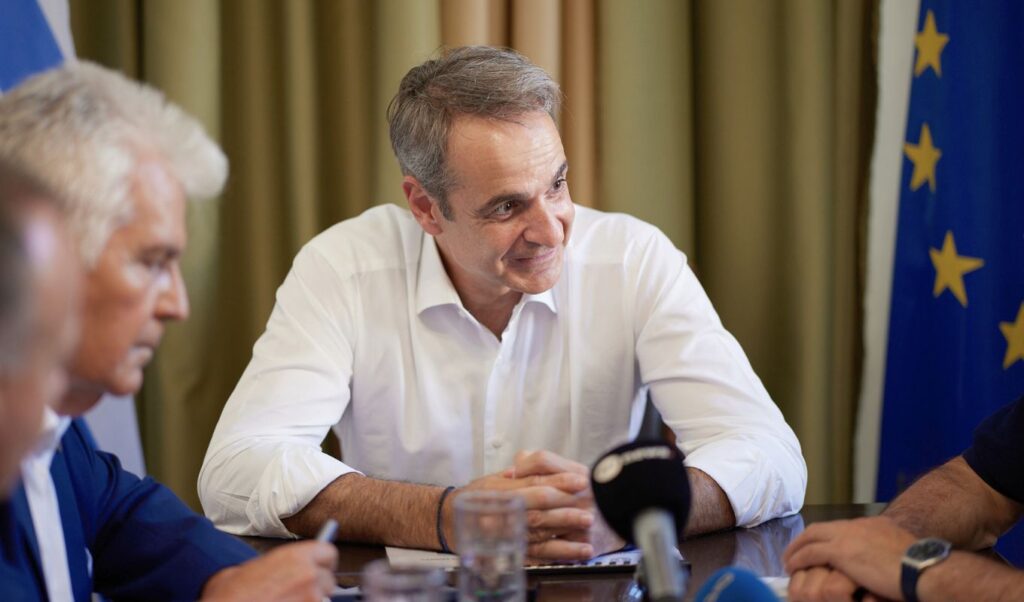
Kyriakos Mitsotakis continues his nationwide tour highlighting the tangible results of the Recovery Fund, visiting regions across Greece where projects funded by this landmark European financial instrument have been completed or are nearing completion. With a firm deadline approaching, Greece must absorb the full €36 billion it is entitled to receive from the EU Recovery and Resilience Facility — a combination of loans and grants.
Government launches wide-scale showcase of Recovery Fund projects and reforms
According to figures presented by the government, Greece has so far successfully completed seven grant payment requests and six loan payment requests covering 204 milestones, receiving European funding totalling €24.6 billion — equivalent to 10.93% of the country’s GDP (based on 2023 data) and 68.5% of the plan’s total budget. Two months ago, Greece submitted its eighth grant payment request and seventh loan payment request, having fulfilled an additional 34 milestones and reaching a total of 238 milestones — a completion rate of 62%, above the current EU average of 60%.
With the 2027 elections on the horizon, the Prime Minister’s office is pushing for broad public visibility of the projects completed and reforms implemented using Recovery Fund resources. Mitsotakis recently called on his ministers to individually promote “the significant work achieved as a result of Recovery Fund financing,” stressing that “the benefits for Greek society are many, spanning a wide range of areas, and they deserve to be highlighted.”
Mitsotakis: “When people ask where the money went — this is where the money went”
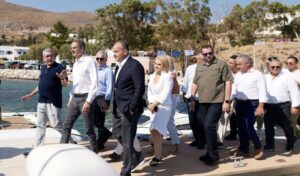
Yesterday, the Prime Minister travelled to the island of Leros, where he visited the State Therapeutic Centre — General Hospital and Health Centre. The facility has undergone extensive renovation and modernisation works, partly funded by the Recovery Fund. “Within the coming months, with the closing of the Recovery Fund, the government will have completed the largest intervention in the infrastructure of the National Health System since its founding. And it is truly gratifying that wherever I go, across all of Greece, I see interventions in hospitals, emergency departments, and health centres — all proving that Recovery Fund resources, particularly in the area of healthcare, have made a real difference,” Mitsotakis stated. He also visited the port of Lakki, where significant maintenance works funded by the Recovery Fund have been carried out, with plans already underway to extend the main pier as part of a broader upgrade of the facility.
Just days earlier, the Prime Minister attended the handover ceremony for the northern and final section of the E65 motorway, connecting Lamia with Grevena and the Egnatia Odos highway. His remarks were in the same vein: “Let me say it again — when people ask where the Recovery Fund money went, this is where it went. Right here.”
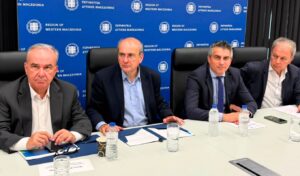
Last week, the European Commission issued a positive assessment of Greece’s proposed revision to the National Recovery and Resilience Plan “Greece 2.0,” submitted on 8 May as part of the final phase of the Recovery and Resilience Facility’s implementation. According to the Ministry of Finance, the revision enables the transfer of completed milestones from both loans and grants into the eighth payment request, increasing the disbursement amount to €4.5 billion and bringing total resources received to €29.1 billion.
Speaking at a public gathering in Agia Marina on Leros on the same evening, Mitsotakis returned to the theme of the Recovery Fund, this time drawing a direct line to the next round of EU funding — and the next general election. “Sometimes I hear people say: ‘the big players pocketed the Recovery Fund money.’ Really? Who actually carried out the Recovery Fund projects here? Small and medium-sized local construction companies, who won contracts and delivered these projects on very demanding schedules,” the Prime Minister said, connecting this narrative to one of the central dilemmas he intends to put to voters. “Why does this matter? Because in the period ahead — possibly not before the end of 2026, as these negotiations could extend into 2027 — there will be a major new negotiation over the next EU budget. In plain terms: how much we will receive from the new structural funds, how much for agricultural development, how much for our fishermen, how much for civil protection.” He also reminded the audience that on 1 July 2027, Greece will assume the Presidency of the European Union, adding: “One of the key stakes of the upcoming elections will be which government and which Prime Minister will hold the EU Presidency when these critically important decisions are made — for the future of Europe, for the future of Greece, and for the future of our islands. We have proven — and I will close with this, friends — that we have the knowledge, the credibility, the standing, and the capability to negotiate with Europe in ways that will ultimately benefit our country.”