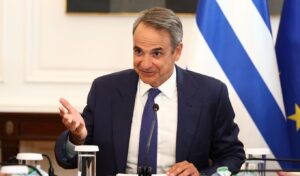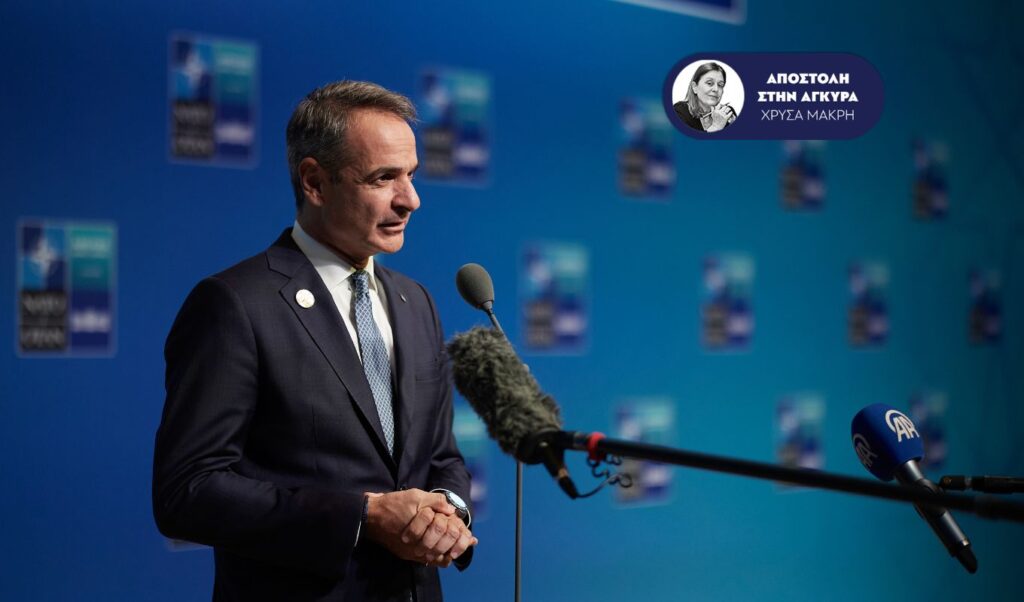
“It is not my place to comment on the choices of other countries. Nor is Greece obviously the one to tell the US to whom it should or should not sell defense systems.” This was Kyriakos Mitsotakis’ response following the NATO Summit, addressing Donald Trump’s statements that the US would seek to fulfill Turkey’s request to acquire F-35 fighter jets.
Mitsotakis: “Greek pilots will begin F-35 training in 2027”
Responding to questions from journalists, Mitsotakis also pointed to the significant legal obstacles within US legislation that stand in the way of Turkey acquiring F-35s. “I would remind you that the reason Turkey was removed from the F-35 program was linked to its purchase of the S-400 system — a system that NATO and the US consider to be directly incompatible with the F-35 program itself,” he noted.
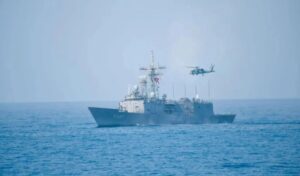
The Prime Minister also highlighted that Greece has placed its own order for F-35s: “Since 2019, since I have had the honor of serving as Prime Minister, Greece has significantly strengthened its air force. I would like to recall that we inherited a stalled F-16 modernization program. Today, that program is moving at a fast pace — we have surpassed 50 aircraft and will soon reach 83. We have procured 24 state-of-the-art Rafale jets through an expedited process, and we have already entered and are actively participating in the F-35 program.” He underscored that Greece’s involvement is tangible, adding that “Greek pilots will begin training on the F-35s in 2027.”
Regarding Turkey’s potential F-35 acquisition from the US, Mitsotakis made his position clear: “I will not comment on the purchase or make recommendations to the US, just as I will not accept anyone telling us what we should buy to defend our country.”
On the casus belli
When asked about his earlier reference — made upon arriving at the Summit — to Turkey’s standing casus belli threat against Greece, the Prime Minister stated: “This is not the first time I have raised the issue of the casus belli. I had the opportunity to do so during my bilateral meeting with President Erdoğan a few months ago. I believe it is a historically anachronistic decision, one that is inconsistent with the United Nations Charter and incompatible with the constructive atmosphere we want to build as two neighboring countries that, despite our differences, must learn to coexist peacefully and develop good neighborly relations.”
He added: “I believe all of my European counterparts understand that this threat of war — which, as I said, dates back to 1995 — is also incompatible with the spirit of our Alliance. I think the time has come to put it behind us.”
Speaking to reporters on the sidelines of the Summit, Mitsotakis described the casus belli as a “historical anomaly,” stressing that this was not the first time he had raised the issue — including directly within Turkey — and expressing his wish for peace among Alliance members.
Relations with Turkey were, unsurprisingly, the first topic Mitsotakis was pressed on, and he was direct in his response: “What I can say is that an alliance must be built on the fundamental principles of good neighborly relations. My country faces a persistent threat of war from Turkey — if Greece extends its territorial waters, we would have to remain on alert.”
Turning to the situation in the Middle East, the Prime Minister expressed cautious optimism, saying he hoped the situation would return to a framework of dialogue — with continued talks between Iran and the United States and renewed respect for the ceasefire already agreed upon. “Allow me to see the glass as half full,” he said.
On the rise in oil prices, Mitsotakis acknowledged concern but urged perspective: “It worries me, of course, but I want to believe it is a temporary increase. As you can see, oil prices fluctuate considerably. That is why I prefer to assess prices over a horizon of weeks or months. We are in a downward trend, and I believe that once this crisis is resolved, we will return to price levels that are, at least for the Greek economy, manageable.”
Defense spending
Kyriakos Mitsotakis opened his remarks by addressing defense spending, reiterating in essence that Europe needs to wake up when it comes to defense — both in terms of investment and cohesion.