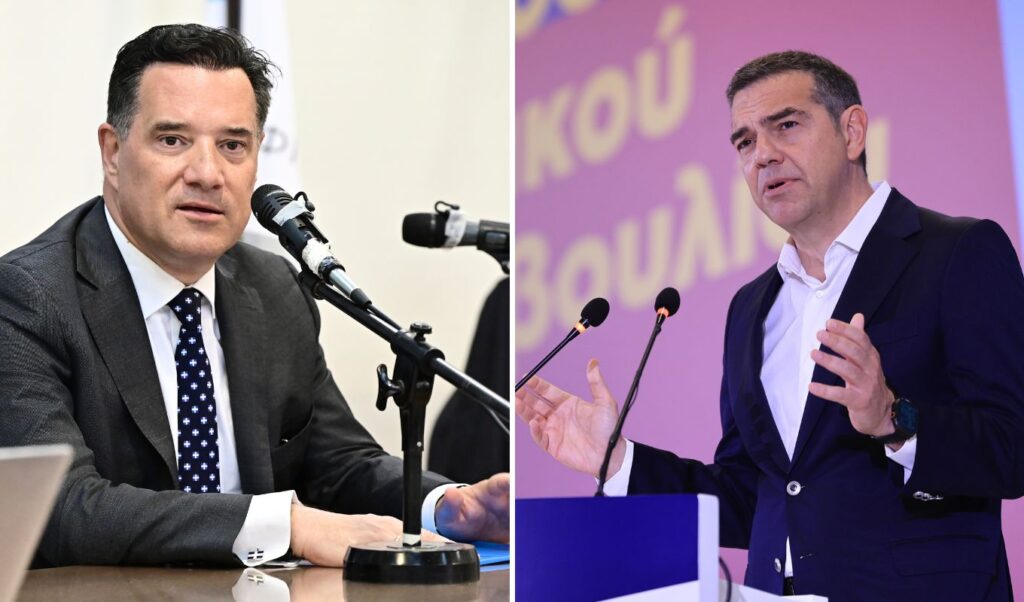
Adonis Georgiadis has fired back at critics who, as he puts it, are “sensitive and politically correct” figures who accused him of toxicity following his allegation that Alexis Tsipras “received money to vote for the Penal Codes.” In a lengthy post, the minister draws on the famous Hans Christian Andersen fairy tale to explain why, in his view, “Tsipras is naked.”
Read also: Georgiadis goes on the offensive against Tsipras: “The most corrupt prime minister of the post-junta era” (Video)
Addressing his original allegation, Georgiadis argues that “all of this was revealed at the time by former Justice Minister Stavros Kontonis, who described the decision to pass the Codes on the eve of elections as a ‘mark of shame and disgrace,’ and later characterized the manner in which the new Penal Code was ‘orchestrated and passed’ as an ‘extreme instance of collusion.’ Mr. Kontonis didn’t mention money specifically — true — but when you say collusion, what exactly do you mean? That implies an exchange — and to me, an exchange means money. Simply put, Mr. Kontonis said there was a quid pro quo for this to happen, and Mr. Tsipras has never said a word about any of it.”
Recalling what political opponents had said about the Tempi rail disaster — targeting both Kyriakos Mitsotakis and members of the ruling party — Georgiadis writes: “The Left, ever since the Civil War, had methodically and with great skill built what it called its ‘moral advantage.’ The left-wing person was by definition the ‘good one,’ the ‘honest one,’ the ‘clean one,’ while everyone else had to prove whether or not they possessed these qualities. This so-called moral advantage — which, of course, never actually existed in reality but was entirely manufactured — trapped our country for decades under the ideological dominance of the Left, which seriously damaged Greece and was the primary reason for its economic and cultural underdevelopment. In plain terms: they held us back.”
“This ‘moral advantage’ was lost under Alexis Tsipras. The greatest gift of the Tsipras five-year period to Greece is that after it ended, all of those axiomatic assumptions about left-wingers vanished — and I thank him very much for that,” Georgiadis continues.
Responding to Tsipras’s attempts to rebuild his so-called “moral advantage,” the New Democracy vice president writes: “Really? And who appointed Alexis Tsipras the most ‘honest prime minister’? Was there some kind of formal evaluation? Was there a ruling from the civil service appointments board? Did the members of his left-wing alliance decide this? In reality, it’s nothing but his own fantasy — and yet, like all fantasies, if left unexposed, they can create a virtual reality that becomes very difficult to change afterward.”
“Well, those arguments went out the window after my intervention the day before yesterday. And of course Mr. Tsipras won’t file a lawsuit against me, simply because he doesn’t want public debate to shift toward a review of his record as prime minister — because then the whole narrative of the ‘ethical’ Tsipras versus the ‘corrupt’ Mitsotakis would collapse under the weight of the uproar I would create, and he knows it,” adds Georgiadis, going on to reference the Novartis affair, the Mati wildfire tragedy, the television license tender scandal, the Petsitis case, and Tsipras’s letter to Venezuelan President Maduro to cover up sexual harassment by his ambassador in order to avoid political damage.
The Health Minister then delivers his final message directly to Alexis Tsipras: “Don’t provoke me — because having personally lived through your attempt to have me imprisoned on lies and to destroy my family, don’t expect any courtesy from me on these matters.”
Adonis Georgiadis’s full post:
“Tsipras is naked…”
In the spirit of Hans Christian Andersen’s fairy tale, “The Emperor Has No Clothes.”
A great uproar has erupted, and once again the sensitive and politically correct crowd from the political world has begun accusing me of toxicity, and so on.
“How dare Adonis say that Tsipras took money to vote for the Penal Codes in 2019…” “Adonis is outrageous — he’s a slanderer, how can he say this without evidence,” etc.
“But why would Adonis say this without evidence,” and so on.
So let’s go back to the beginning and take things in order:
The political opponents and media commentators of every stripe who are attacking me today are the very same people who, for the past three years, have been saying or amplifying claims that:
“Mitsotakis covered up the Tempi disaster to protect a smuggler — or that he was personally involved in the smuggling” — and they had temporarily convinced 80% of the Greek public of this. These are the same people who sat around earnestly discussing opposition MP Famellos’s claim in parliament that “Kyriakos Mitsotakis ordered the killing of a prosecutor’s son in Larissa to cover up the Tempi crime.” They are the same people who viewed Zoe Konstantopoulou’s statement that “every single member of New Democracy’s parliamentary group has blood on their hands” as legitimate political criticism. And today, across every media outlet and even inside parliament, they are saying that “the Mitsotakis government is steeped in corruption” and is a “criminal organization” — yet apparently I’m the toxic one for daring to say that Tsipras took money?
They really are quite something.
That’s why I say: don’t fall for it.
I have one particular trait:
Sometimes it serves me well, sometimes it doesn’t — but that’s what speaking freely means. If it were a cost-free virtue, everyone would have it.
When I said that Mrs. Papandreou sent a file against New Democracy MPs to parliament in order to blackmail her way to re-election through the Supreme Court, everyone piled on me with roughly the same arguments. But when subsequent rulings from the Judicial Council and the clash between the Supreme Court and prosecutor Kovesi, along with the Tycheropoulos report on those cases, fully vindicated me — did anyone apologize for the accusations they had leveled at me?
No.
So be it.
I speak to the people I represent, and it is to them that I am accountable. I am writing this piece to explain what I did, what I said, and why.
The Left, ever since the Civil War, had methodically and with great skill built what it called its “moral advantage.” The left-wing person was by definition the “good one,” the “honest one,” the “clean one,” while everyone else had to prove whether or not they possessed these qualities. This so-called moral advantage — which of course never actually existed in reality but was entirely manufactured — trapped our country for decades under the ideological dominance of the Left, which seriously damaged Greece and was the primary reason for its economic and cultural underdevelopment. In plain terms: they held us back.
This “moral advantage” was lost under Alexis Tsipras.
The greatest gift of the Tsipras five-year period to Greece is that after it ended, all those axiomatic assumptions about left-wingers vanished — and I thank him very much for that.
With the creation of Tsipras’s left-wing alliance, already from his first television interview on Alpha, Mr. Tsipras — who knows that this “moral advantage” can be a powerful political asset — attempted to build it around his own persona this time:
“I am the most honest prime minister of the post-junta era,” he said — implying he is more honest than Konstantinos Karamanlis, Georgios Rallis, Andreas Papandreou, Konstantinos Mitsotakis, Costas Simitis, Costas Karamanlis, George Papandreou, Antonis Samaras, and of course Kyriakos Mitsotakis — who is naturally the ultimate target.
Really? And who appointed Alexis Tsipras the most “honest prime minister”?
Was there some kind of formal evaluation? Was there a ruling from the civil service appointments board?
Did the members of his left-wing alliance decide this?
In reality, it’s nothing but his own fantasy — and yet, like all fantasies, if left unexposed, they can create a virtual reality that becomes very difficult to change afterward.
This move of his was executed very cleverly and with great precision, as our political opponents have systematically cultivated and continue to cultivate the image of a “corrupt Mitsotakis government” — an image reinforced by the party’s continuous hold on power for a length of time that the Greek public generally dislikes.
And so, while on one hand we hear all day long from the media and our opponents about the “corrupt government,” “direct public contracts,” “wiretapping scandals,” and so on, on the other hand we hear — somewhat insidiously — from journalists and politicians friendly to Tsipras the line: “Still, whatever Tsipras’s mistakes, no one ever talked about money” or “Whatever criticism he faces, no one has ever questioned his personal ethics,” etc.
Well, those arguments went out the window after my intervention the day before yesterday. And of course Mr. Tsipras won’t file a lawsuit against me, simply because he doesn’t want public debate to shift toward a review of his record as prime minister — because then the whole narrative of the “ethical” Tsipras versus the “corrupt” Mitsotakis would collapse under the weight of the uproar I would create, and he knows it.
But let those who remember recall, and let those who don’t learn — a few moments from the era of Mr. Alexis Tsipras — and then let’s think rationally about whether he deserves the title he tried to bestow upon himself as “the most honest prime minister,” etc.
1. Is Mr. Tsipras or is he not the prime minister of the Novartis scandal? After the courts convicted — at both first and second instance — the false witnesses as slanderers, did he ever apologize? Did he explain why his minister Papaggelopoulos was convicted for manipulating justice in that case? Did he say anything? Anything at all? He doesn’t even include a single word of apology in his book. Can someone who orchestrated a major conspiracy be simultaneously honest and ethical?
2. On the night of the Mati tragedy, when he was caught on camera lying that they didn’t yet know about fatalities — while the first bodies had already been collected and he was managing the situation purely as a communications exercise — was he being honest?
3. When he was rigging the television license tender — with pasture land valuations and all the rest — and bearing in mind that Mr. Kalogritsas’s secretary testified in court about bags of black money — did the “most honest” prime minister ever offer any explanation?
4. Regarding Petsitis and whether money was received from Venezuela — did he ever say anything? (Just wait until documents start emerging as that regime collapses and a few people come crashing down from their pedestals…) Did he say anything?
5. Regarding his letter to Maduro asking him to cover up the sexual harassment committed by his ambassador here — to avoid political damage — did the “most honest” one ever say anything?
I could go on for pages, but let me close with the Penal Codes.
On the night of the 2019 European elections, following his defeat by a margin of -10% against Mitsotakis, the “most honest” gentleman said he was resigning and that elections would be held on June 30 — but then, the following day, he changed his mind and pushed the date to July 7, so that the outgoing parliament would have time to pass the new Penal Codes.
Among the changes, the offense of active bribery was downgraded from a felony to a misdemeanor — meaning that defendants who had been standing trial for this offense and whose cases had passed the five-year statute of limitations were acquitted, whereas under the old code they would have been convicted.
Don’t ask why we didn’t reverse it — we did. But in criminal law, a defendant is always tried under the provision most favorable to them, which means that those whom Tsipras wanted to acquit through this mechanism were indeed acquitted. And let’s be clear: active bribery is not committed by the poor.
All of this was exposed at the time by former Justice Minister Stavros Kontonis, who described the decision to pass the Codes on the eve of elections as a “mark of shame and disgrace,” and later characterized the manner in which the new Penal Code was “orchestrated and passed” as an “extreme instance of collusion.”
Mr. Kontonis didn’t say money specifically — true — but when you say collusion, what exactly do you mean?
That implies an exchange — and to me, an exchange means money.
Simply put, Mr. Kontonis said there was a quid pro quo for this to happen, and Mr. Tsipras has never said a word about any of it. Not a peep — and yet he remains “the most honest” prime minister.
Yesterday, when the relevant controversy erupted, the new faces being sent out to speak on his behalf — because the old ones were swallowed by the political stage — put forward the following argument against me:
“A preliminary investigation was conducted by the prosecutor into Kontonis’s allegations at the time, and the case was filed away” — so “why is Mr. Georgiadis bringing it up again?”
Yes — but when justice filed away the charges against me in the Novartis conspiracy case, Mr. Tsipras not only never apologized to me, but sent Mrs. Gerovasili to the Supreme Court to protest and demand that the decision be reversed.
So back then, filing away a case was bad — but now it must be respected?
And let me ask something even more current to the charming members of Mr. Tsipras’s left-wing alliance:
Haven’t the “wiretapping” cases also been filed away — twice, in fact?
So why do they keep bringing those up?
Is that a bad filing and the other a good one?
They should drop all of that.
As for the disgrace of the Penal Code changes, Mr. Tsipras — despite billing himself as “the most honest prime minister of the post-junta era” — has not offered the slightest explanation. He has said absolutely nothing, and he won’t — because if he engaged with the debate, he would have to explain why he did it. And I’m sorry to say, as toxic as it may sound to some, there is simply no other rational explanation for the “collusion quid pro quo” as described by Kontonis — or the money, as I put it more plainly.
So, my dear Alexis: set aside your talk of moral superiority, enjoy your beautiful villa in Sounio — nestled among the trees, with what is practically a private beach at your doorstep, which your remarkable “good fortune” secured for you at a mere €500 a month, while others pay that much for a studio apartment in Kypseli. Go ahead and offer whatever political criticism you want of this government — but don’t provoke me. Because having personally lived through your attempt to have me imprisoned on