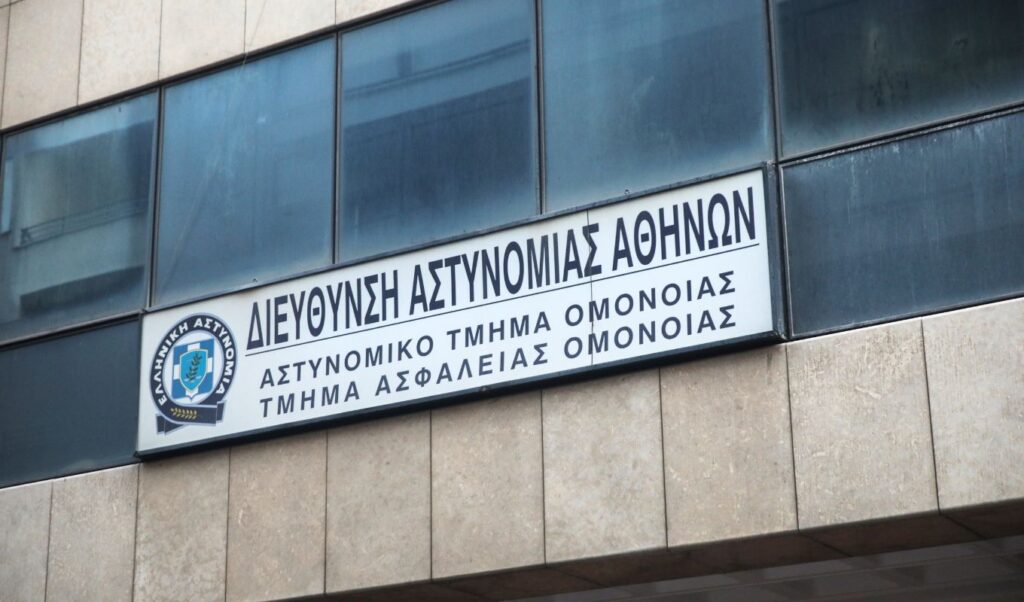
The prosecutor at the Mixed Jury Court recommended the acquittal — due to reasonable doubt — of the three police officers standing trial over the alleged rape of a 19-year-old woman inside the Omonia Police Station in October 2022. For one of the defendants, however, the prosecutor recommended a guilty verdict on charges of unlawful recording and personal data violation.
Read also: Omonia Police Station rape trial: Defendants claim the encounter was consensual but “a mistake”
Three police officers are seated in the dock of the Mixed Jury Court. Two of them face charges of gang rape, while the third is accused of aiding and abetting the same act. Additionally, one of the defendants faces a separate charge of personal data violation, as he allegedly filmed what took place in the locker room of the police station using his mobile phone.
According to testimony the complainant gave before the court, on the evening of October 11, 2022, she encountered the officers while they were on patrol in the Thissio area of Athens, seeking their help with an issue that had arisen at the restaurant where she worked.
As she testified, the officers told her they were unable to assist her and suggested she go to the Omonia Police Station to speak with the duty officer. Upon arriving at the station, she said two of the defendants led her to a locker room, where they raped her, while one of them filmed the acts on his mobile phone.
The prosecutor’s recommendation in the Omonia Police Station rape trial
During their defense statements, the accused acknowledged that sexual contact had taken place inside the police station, but denied it constituted rape, claiming the sexual acts were consensual. They described their conduct as wrong and unprofessional, while insisting that no coercion had occurred.
In his closing argument today, the prosecutor recommended the acquittal of the two defendants on the gang rape charge due to reasonable doubt, as well as the acquittal of the third officer on the charge of aiding and abetting. He did, however, recommend that the second defendant be found guilty of the personal data violation charge, concluding that it had been proven he filmed the events that took place in the police station locker room.
During his address, the prosecutor examined in detail the evidence that emerged during the trial proceedings, noting that in his assessment, the complainant’s testimony contained serious contradictions, gaps, and inconsistencies.
He argued that the evidence was insufficient to conclude, beyond reasonable doubt, that the sexual contact with the two officers was non-consensual. He also noted that, in his view, any subsequent change in the complainant’s account of events did not in itself constitute a withdrawal of consent that, as he assessed, had been given at the time.
Tension in the courtroom following the prosecutor’s recommendation — trial continues
The prosecutor’s recommendation provoked an intense reaction from those present in the courtroom. In response, the prosecutor stressed that the court was not being asked to evaluate the moral dimension of the defendants’ conduct, but solely whether sufficient evidence existed to establish the charges beyond reasonable doubt.
He stated that while it had been proven that sexual contact occurred, the absence of consent had not, in his assessment, been established with the required certainty.
Despite recommending acquittal on the more serious charges, the prosecutor delivered a sharp rebuke of the two officers’ conduct. He emphasized that their actions constituted extremely serious disciplinary offenses, as they had disgraced the force, damaged the reputation of the Hellenic Police, and had utterly failed to act in accordance with the responsibilities of their role.
He further noted that even if the sexual contact had been consensual, the officers had a duty to protect the young woman and to uphold the integrity of their service. He added that the moral reprehensibility of their conduct was beyond question — even if, in his judgment, their criminal liability for the offense of rape could not be established with certainty.
The proceedings continue with closing arguments from both defense and prosecution support counsel, before the court retires to deliberate and deliver its verdict.