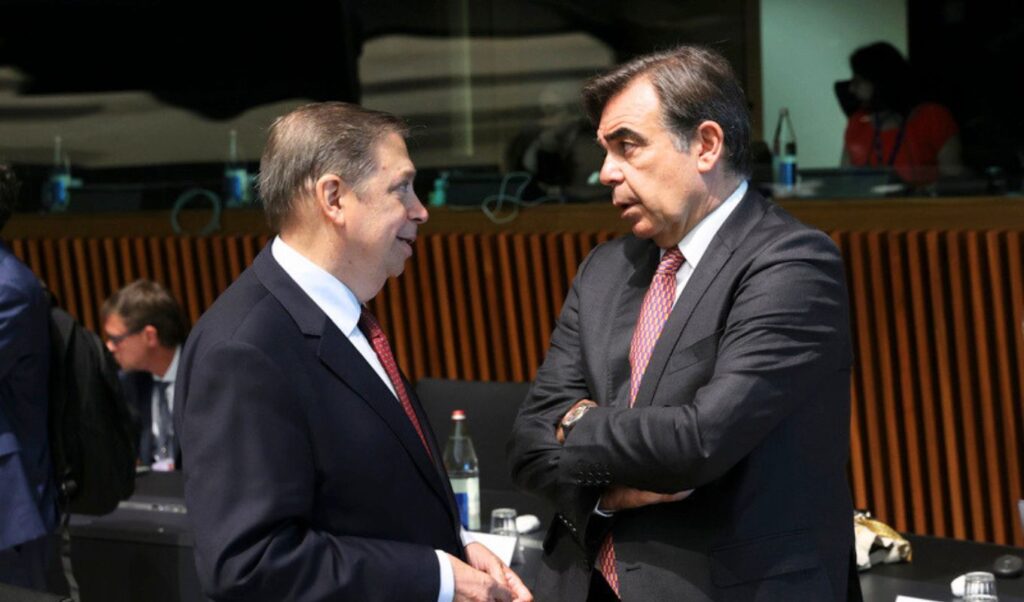
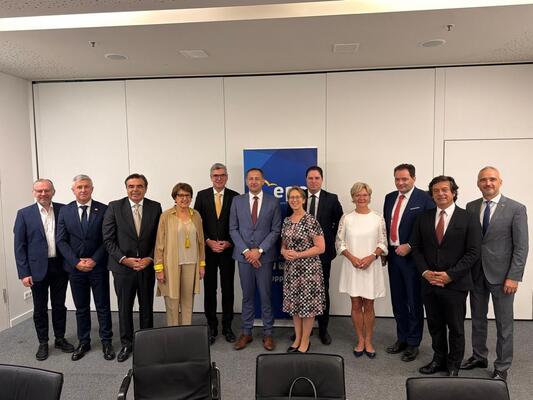
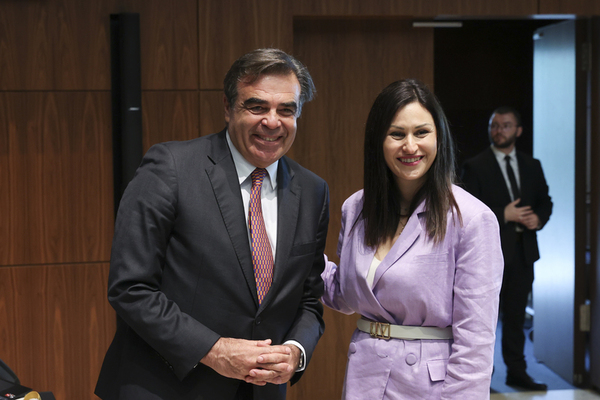
The future of the Common Agricultural Policy (CAP) beyond 2028, market resilience, and the future of fisheries took center stage during the interventions of Greece’s Minister of Rural Development and Food, Margaritis Schiinas, at the EU Agriculture and Fisheries Council in Luxembourg. According to the minister, the new CAP must be able to simultaneously support farm income and the investments that will define the future and competitiveness of the European agri-food sector.
Schiinas in Luxembourg: CAP takes center stage
The Greek minister placed the preservation of a strong and genuinely European Common Agricultural Policy at the heart of the debate — one capable of meeting new challenges without losing its European character. He stressed that the current discussion concerns whether a policy that has served as a cornerstone of European integration for more than sixty years will remain truly common, or will gradually transform into a collection of national policies with limited European backing.
“More flexibility cannot mean less Europe,” Schiinas emphasized, noting that flexibility is a tool, not an end in itself, and that increased subsidiarity must be accompanied by a strong common European core — with shared objectives, common basic rules, consistent principles of implementation, and joint accountability.
He placed particular emphasis on the funding of the next CAP, pointing out that Europe cannot demand greater resilience, more investment, and higher ambition with fewer resources. As he stated, the new CAP must be able to simultaneously support farm income and the investments that will shape the future and competitiveness of Europe’s agri-food sector.
The minister also underlined that the transition to the new framework requires continuity, predictability, and the avoidance of funding gaps, as no reform can succeed without adequate resources and security for producers. He made a special reference to generational renewal, stressing that the future of European agriculture will not be decided solely by the rules that are adopted, but by whether there are young people willing to stay, invest, and build a life in rural areas.
New pressures on markets
During discussions on market conditions, Schiinas noted that European markets are showing overall resilience, yet producers continue to operate in an environment of multiple pressures — shaped by extreme weather events, animal disease outbreaks, rising input costs, and ongoing geopolitical uncertainty.
He specifically addressed developments in the fertilizer market, welcoming the Commission’s proposals aimed at providing immediate support to producers to help them cope with rising costs resulting from conditions in the global fertilizer sector. He also presented an overview of the Greek agri-food sector, noting that major export industries continue to demonstrate the dynamism and outward orientation of Greece’s primary sector.
Feta cheese maintains a strong presence in international markets, citrus fruits continue to record high export performance, and Greek wine is showing remarkable resilience despite the broader difficulties facing the European wine sector. At the same time, he highlighted the challenges facing specific sectors, such as the rice market and livestock farming, which continues to be burdened by high energy, feed, and transport costs, as well as animal disease outbreaks affecting many European countries.
Fisheries: Simpler rules needed
In the context of discussions on the future of the Common Fisheries Policy, Greece argued that the objectives of European fisheries policy remain fully relevant, but that the tools must be adapted to the real conditions faced by fishermen and national administrations.
Schiinas highlighted the need to simplify procedures and reduce administrative burdens, pointing out that the success of the policy cannot be assessed exclusively through biological indicators, but must also take into account the social and economic dimensions of sustainability. He placed particular emphasis on small-scale coastal fishing, describing it as a strategic priority for Greece, as it forms an integral part of the identity and viability of the country’s coastal and island communities.
He also stressed that the sustainable management of shared Mediterranean fish stocks requires strong regional cooperation and a common commitment from all countries active in the region. The minister placed significant weight on the issue of a level playing field, emphasizing that it is neither sustainable nor fair for EU fishermen to bear the full burden of restrictions and management obligations when the same stocks are also exploited by fleets from third countries that do not apply equivalent standards and rules.
He further reaffirmed Greece’s firm commitment to the goals of the MedFish4Ever Declaration and to joint efforts for sustainable fisheries and aquaculture in the Mediterranean, while underlining the country’s active role in protecting the seas and marine biodiversity.