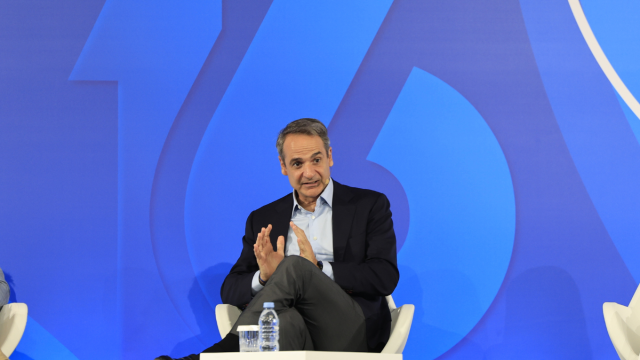
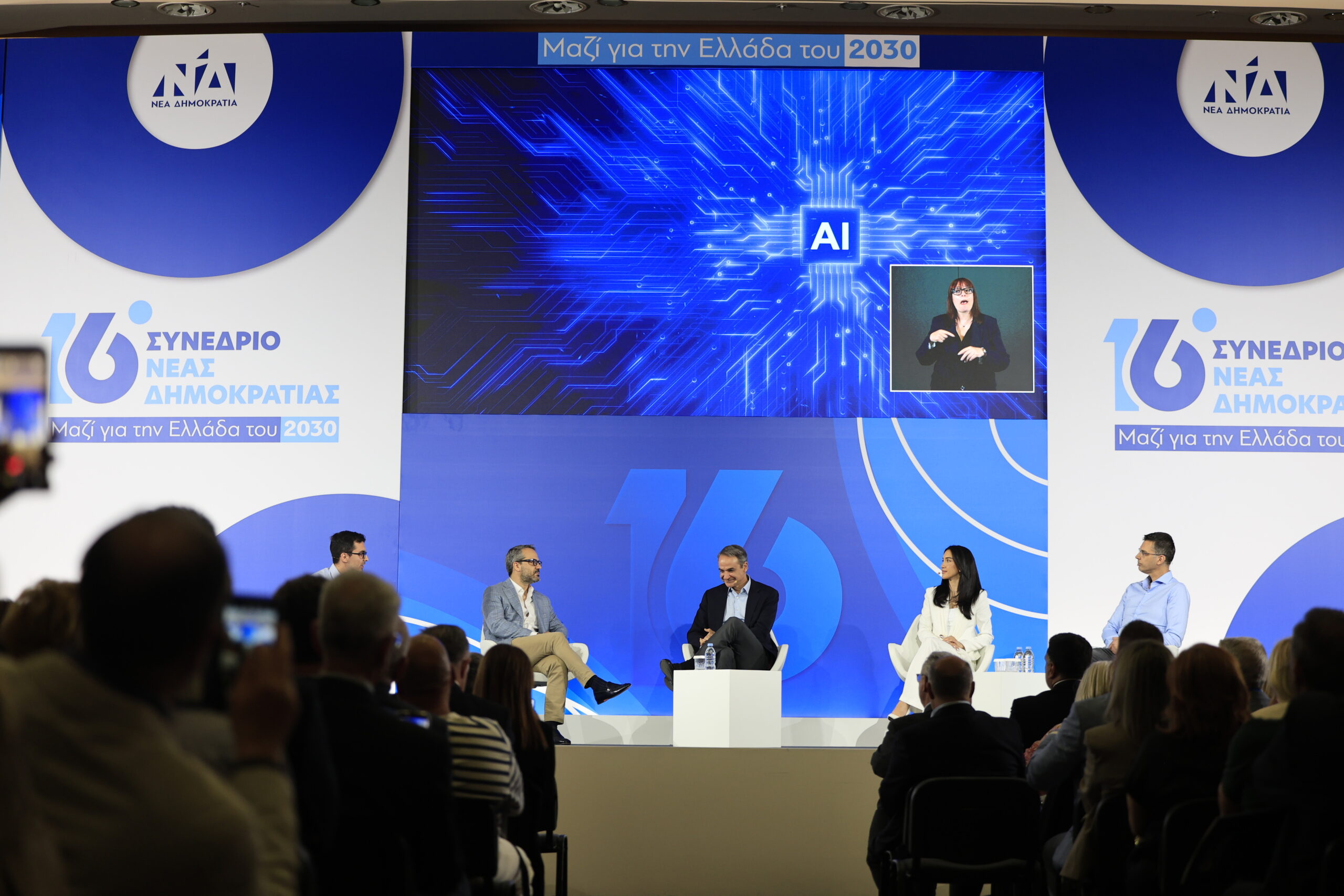
Prime Minister Kyriakos Mitsotakis sent a clear message that the next four years will be determined by Greece’s ability to harness Artificial Intelligence, speaking at New Democracy’s AI Conference panel and referring to “world-historic changes” by 2030. The Prime Minister highlighted AI’s role in transforming public administration, the labor market, education, and defense, while focusing particularly on challenges for young people and the impact of social media. He emphasized that Greece can lead in the digital age, provided it moves quickly against international competition from the US and China. Mitsotakis sounded the alarm for Europe, saying it has fallen behind technologically. “We’re lagging in Europe while America is running faster. And China is running much faster in many sectors,” he said characteristically.

Full statement by Kyriakos Mitsotakis
First of all, good morning and allow me to start by repeating what was said by our Ministers in their very interesting speeches as a rhetorical question: Is there any other party in Greece today that could or would hold, within the framework of a conference dialogue, a discussion equivalent to the one New Democracy is having today?
Because New Democracy’s vision is focused on the future, on challenges, opportunities, and the great difficulties we will face, not only as a country but also as Europe, in managing an unprecedented technological revolution that is artificial intelligence.
Indeed, you heard from our Ministers and I think you realized that the country has a specific and structured strategy for how it can leverage artificial intelligence to provide better, faster, cheaper, more user-friendly services to citizens and businesses.
And I believe the examples you saw essentially represent just the beginning of a major effort to completely change the culture of the broader public sector. Whether we’re talking about healthcare applications, where AI’s impact will be absolutely groundbreaking and fundamentally positive. Whether we’re talking about education applications, where we’re at the forefront of introducing AI tools to help, for example, our teachers better plan their work, spend less time on bureaucratic tasks and more time in the classroom.
Whether we’re talking about the core AI infrastructure that Dimitris told us about, how we’re evolving gov.gr, the major infrastructure we’re building nearby in Lavrio – a state-of-the-art supercomputer that can be made available not only to the public but also the private sector, which needs computational power today. Whether we’re talking about the impressive applications Konstantinos told us about, how artificial intelligence can facilitate us, make us better, detect human errors and intervene preventively.
All of this is the picture of a world that is already here. The question is which party, which government, which country will be able to harness this power of artificial intelligence for the benefit of citizens and collective prosperity. While simultaneously ensuring control over the negative effects of a revolution that will certainly change everything.
Whether we’re talking about labor market impacts, how we’ll discuss – and this is very important – in our schools the professions of the future, what new professions will be required to leverage this technology, how we’ll direct – and I won’t tire of saying this – our children more toward technical education, because technical education professions are less exposed to AI risks. Whether we’ll discuss critical issues like the mental health of our children and adolescents. I’m proud that Greece is at the forefront of banning social media use for children under 15. It’s a basic obligation we have to protect our children from the negative effects of technologies that today essentially exploit their attention and make money from the fact that our children spend too much time in front of mobile screens.
And to bridge to the discussion we’ll have, how we’ll give space to new Greek companies leveraging artificial intelligence to grow in Greece, in Europe I would say, because this is a European challenge. You know, we often hear that Greek and European companies reach a certain size and then big American companies come and buy them.
We want Greek companies to be able to grow, get funded here, bring back people from abroad who can work for them. And there I think we’ve undertaken very significant initiatives to create an ecosystem of companies – you’ll hear from three of them today – that can create good jobs, produce products and services that are absolutely useful – some particularly in the defense sector – and critical for the country’s future and for defending this concept of strategic autonomy, how we can be secure on our own without depending on others.
So I conclude this introductory statement by saying this is a crucial strategy for our next governmental term. I said it yesterday too. The next period, until 2030, is a period of world-historic changes and a critical period for whether Greece will be able to be a protagonist of developments. Whether it will be able to make a leap and leverage this technology to surpass other countries that may be ahead of us, and we’ve succeeded in many sectors.
I was in Germany a few days ago and I must tell you there’s tremendous respect and admiration, I dare say, from Germany for the digital leap Greece has achieved. Because many of the digital applications we have and now consider obvious don’t exist in many European countries. This government and this political movement gets credit for that.
Referring to Greece’s excellent human resources and brain gain, Kyriakos Mitsotakis noted:
Two observations on what was said.
First, human talent. Whatever large foreign company you talk to, whatever Greek startup founder you ask why they operate in Greece, they’ll tell you, first and foremost: the human resources produced by Greek public universities. And soon also by non-state universities operating in Greece.
Indeed, we have exceptionally capable people. These young people went through a crisis, lived through the crisis of the last decade, don’t want to go back there, have ambitions, have visions, see that today they can play a creative and substantial role by participating in companies that in turn have their own ambitions.
And we have another very big advantage: We still have, because many have returned, hundreds of thousands of Greeks abroad, many of whom left during the crisis years and are now interested in returning for the first time.
One of the successes, dear New Democracy members, that we don’t talk about enough, is the fact that we managed to reverse the brain drain. More young people are returning to Greece today than are leaving, precisely because they can see in our homeland a future that, despite difficulties, is certainly more optimistic than it was some years ago.
On the second point, let me also emphasize the sense of urgency. This doesn’t concern only Greece, it concerns Europe. I was at Mario Draghi’s award ceremony two days ago, where he was honored with the “Charlemagne” prize, the most important award recognizing European contribution to the European Union. We’re lagging in Europe while America is running faster. And China is running much faster in many sectors.
This sense of urgency that should characterize the European Union overall, but also Greece I would say, I think is something that should concern us both as a party and as a government. And what the Ministers know I constantly ask of them, if today we’re running at speed X, in the next term, if Greeks entrust us with the good, we’ll need to run at speed 2X. We cannot delay or watch opportunities pass by.
And this means a different mindset, different logic, a different war against what we call the “deep state,” Greek bureaucracy.
We’ve made steps but we have much more to do.
On public-private cooperation and attracting new talent to the public sector, as well as government policies in defense, housing, and startups, the Prime Minister emphasized:
First, taking inspiration from what you both said, today the state must see the private sector as an ally, partner and supporter in implementing public policies that in the past we might have considered the exclusive prerogative of the state itself.
Let me reference what’s happening in the broader defense ecosystem. Until recently we considered that defense equipment programs should be limited to buying very expensive equipment systems from abroad, large platforms, ships, planes, missile systems, usually with minimal Greek added value.
This is changing dramatically, on two levels. First, because we’re no longer willing to spend Greek taxpayers’ money on such large platforms without Greek added value, which means all major programs must now have at least 25% added value.
Opening a parenthesis, I don’t know how many of you know that two of the eight sections composing a Belharra frigate – imagine it as a large lego where one section comes and connects with another, the Belharra frigate has eight such blocks – two of the eight are manufactured in Greece, at Salamis shipyards. And they’re not manufacturing only sections for Greek Belharras, they’re manufacturing sections that go into French Belharras too.
Scale this up, project it to 2030, to understand how the Greek defense industry can acquire a very substantial role of real added value, covering not only Greece’s needs but also Europe’s needs and – why not? – other countries overall.
The second major revolution concerns startup companies, small companies that come and provide technological solutions to the Armed Forces, not only Greek ones, the Greek state, but it’s certainly much easier for a new company to first test a system in Greece if the Greek Armed Forces are willing to experiment and give opportunities and take risks to test such systems.
So we come and say: “we don’t want a specific product, we have a problem and come give us a solution.” And through the Hellenic Innovation Center now, we ourselves can give opportunities to Greek companies to manufacture quickly and cheaply, let me emphasize this, products that will be absolutely useful to us if we want to imagine 2030 as a country that will be technologically autonomous and able to coordinate with the challenges of the times and with a theater of operations that is changing dramatically.
Look at what’s happening in Ukraine. For those who don’t know, in Ukraine there’s now a zone extending 30 to 50 kilometers where essentially no human can enter. It’s a zone where war is conducted with drones or automatic vehicles, because anything entering this zone will automatically be detected and neutralized. This isn’t a science fiction image from the future, it’s what’s happening today. And we must be ready for this possibility.
That’s why companies that can offer innovative products that can be relatively quickly integrated and tested by the Armed Forces, we can then sell these products abroad too.
Because if the Greek Armed Forces come and say, “I like this and I’m giving a first contract,” then it’s much easier for these companies to sell corresponding products in Europe. And that’s what we want ultimately: to be able to leverage a European market overall.
Let me take a second example: we referred briefly to the major housing problem. For the next term, the affordable housing problem will be a central priority for our movement.
However, we are a liberal movement that doesn’t believe the state can and should do everything. If someone in the country today believes the solution to the housing problem is for the state to come build workers’ housing, as it used to years ago, alone, without private sector participation, I think they’re thinking in 20th rather than 21st century terms.
But we can, as a state, come and say, we have real estate, a lot of it. We have military camps, for example. Come here, private sector. Do a kind of exchange, to put it simply. Take the land, which would cost you dearly to buy. Build what you’re supposed to build, with rules we’ll set, and let us keep part of the building stock for what we call “social housing.” This is a solution that brings the state and private sector closer together.
These are solutions that have been tested and companies like yours, what can they do? Allow a market to function better.
If today there are problems in the real estate market – we have, say, many closed apartments that we need to find ways to put on the market – any private intermediary can help a market work better, with the rules we’ve set, with issues we know we have, still delays in property transfers. This essentially facilitates the housing problem because it simply helps increase supply.
Because today our problem isn’t only supporting our young people with demand-support policies. Yes, this government, first in Europe, remember this, returned one month’s rent to all tenants. And we’ll do it every year. When I tell my European colleagues this, they’re surprised.
This government launched the “My Home I” and “My Home II” programs, 22,000 is not a small number. Think about it, 22,000 of our fellow citizens acquire their own home, essentially paying a housing loan of lower monthly value than they would pay if they rented a house of corresponding level. And these are “pilot” policies and we might possibly be able to do even more in this direction.
So, Greece of 2030, primarily, to conclude, presupposes a smart state. A state that won’t run behind the private sector, sometimes it can itself innovate and lead.
I want to say a big thank you here to the services of the relevant Ministry of Digital Governance, because many of the applications you see, gov.gr, were built by engineers working for the Greek public sector. Public employees built all this. Obviously we seek support from companies too.
And let me say something final, it matters: In Greece of 2030, being able to attract capable and worthy young people to the broader public sector is very important. We have a problem today attracting engineers, IT specialists. Simply put, we can’t easily pay competitive salaries. It’s something we need to look at.
Certainly the public sector won’t always be able to compete with the private sector in terms of salaries. But if it provides good work quality and mainly a sense of purpose, because I assure you that our engineers who worked to develop these applications may be paid – and are paid – less than they would earn if they went to a private sector company. They would be hired tomorrow, have no doubt.
But they feel within themselves something that isn’t easily valued in money, and that’s the pride of doing something good for their homeland and changing the image of the public sector.
These are the new public employees in Greece of 2030, who will be able to communicate on equal terms with the private sector and who will have been trained. Our teachers, our professors who will have been trained in artificial intelligence matters, staff here from the Coast Guard or Armed Forces, who will truly be staff that in terms of their technology knowledge have nothing to envy from the best private sector staff.
And let me close with an image, again connecting what we said with human resources and defense. If you entered the heart of a Belharra frigate – you won’t enter because it’s not allowed for obvious reasons, nor will you ever see many images – but I’ll describe an image of an operations center, fully digitized, with young Navy staff, men and women, operating the most modern communication systems, weapons systems, submarine detection systems and truly feeling that, yes, it’s not only the weapons, it’s also the people who coordinate with their times.
So as much importance as we give to systems, we must give equal importance to the human factor, to a “smart” public sector, to trained staff.
I dare say to MPs and ministers – we’ve done AI seminars for all our Ministers – I’ve asked all our Ministers, they haven’t all implemented it yet, that