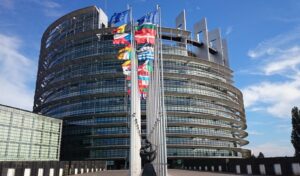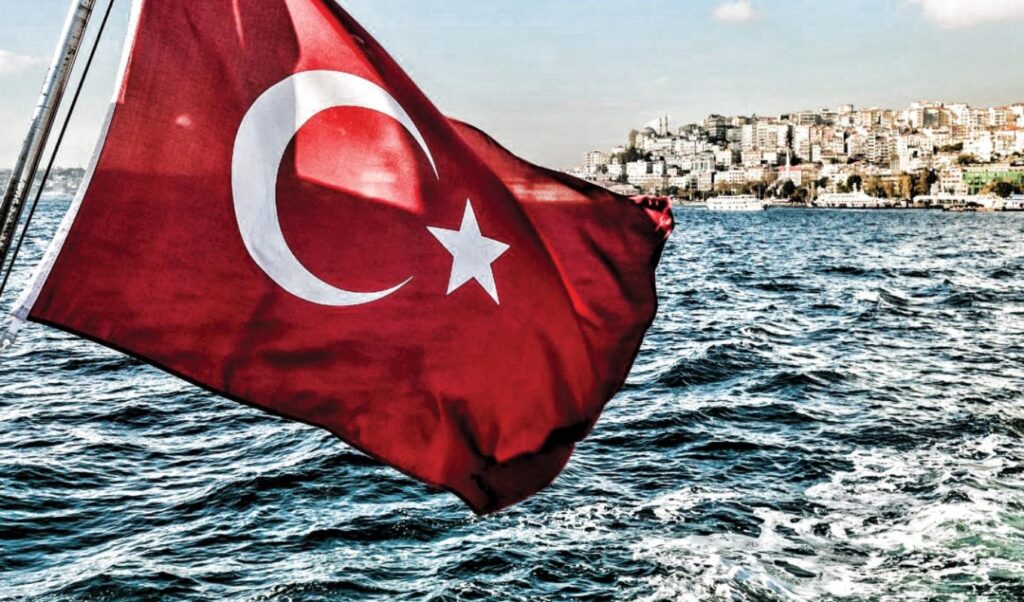
As Turkey dangerously escalates tensions with Greece through leaks to Turkish and international media, including Bloomberg, even discussing unilateral declaration of a 200 nautical mile EEZ, Greek MEPs are in a state of heightened diplomatic readiness, aiming to prevent Turkey from transforming its “Blue Homeland” doctrine from rhetorical provocation into official state law. MEPs from New Democracy and PASOK have already launched a marathon briefing campaign with their partners in the European Union, demanding substantial pressure to halt a move that directly threatens Greece’s sovereign rights.
What Vozemberg and Farantouris tell parapolitika.gr about Greece-Turkey relations
The head of New Democracy’s European group, Eliza Vozemberg, took immediate initiative by submitting an urgent question to EU High Representative Kaja Kallas. In her intervention, she emphasizes that Ankara is attempting, through special legislation, to legitimize illegal claims in the Aegean and Eastern Mediterranean, provocatively ignoring International Law.
Ms. Vozemberg, speaking to parapolitika.gr, stated that “President Erdogan has announced his intention to legally define how the Turkish coast guard and Turkey in general will exercise rights in Aegean areas that have not yet been recognized by EEZ. With nothing less than domestic law, they interfere and violate International Law with the aim and purpose of creating fait accompli. Given that Turkey is considered a strategic partner and the European Union, either within the framework of negotiations and processes for Turkey’s accession, provides very significant funds, and generally the commercial and other relations of EU member states with Turkey are of high economic, political and broader interest, we must hold it accountable. First, to react immediately by examining how domestic legislation can directly violate International Law and the Law of the Sea, which we always remind that Turkey has not signed, and second, what actions, recommendations or measures it intends to take to show that it is in complete opposition to this unilateral action by the Turks.”
However, when the head of New Democracy’s European group was asked to comment on the pro-Turkish disposition of EU member states like Germany and Spain, she pointed out that there is no fair European policy. As she argues, “there is a substantial pro-Turkish stance from these states, found exclusively in economic interests. If you consider, for example, Spain’s sale of its entire defense and military equipment mechanism to Turkey, as well as a large part of German businesses and trade to and from the European Union amounting annually to many billions of euros, you understand that there is no objective European fair policy. This is what we react to. We have been reacting for years. We have managed to reduce many funds that Turkey receives within the framework of pre-accession negotiations as a punitive policy, if you will. We have achieved this and we are talking exclusively about these funds, not the enormous amounts it receives for refugees and migration because you understand that it hosts over 4.5 million and must be paid. But for the others, some sanctions have been imposed, but not those that should have been. Europe is accused by us of having double standards, when we saw immediate reactions against Russia when it invaded Ukraine, something we don’t see, neither for violations nor especially regarding the occupation in Cyprus.”
In the same vein, PASOK MEPs submitted a question-intervention to the Commission, demanding not only preventive measures but also the imposition of sanctions. As MEP Nikolaos Farantouris argued, the passage of this law constitutes “institutional and legal internalization of Turkish claims” and informs the Commission that this development transforms Turkish claims into “permanent and mandatory policy.” He also particularly emphasizes that it creates a legal basis for the involvement of the Turkish navy and energy entities in disputed areas, adding that domestic legislation of a state cannot in any case override International Law.
At the same time, in Turkey, preparations for submitting the bill are in the final stretch. According to a report by “Haber Turk,” the bill is expected to be voted on in June, immediately after Bayram. In the public discourse of the neighboring country, extreme voices dominate, such as that of retired rear admiral Deniz Kutluk, who in his article in the nationalist newspaper “Aydinlik” demands explicit reference to limiting maritime zones to 3 nautical miles in the Aegean. Mr. Kutluk stated that “it is necessary to give special emphasis to defining the 3 miles in the Aegean provided by Lausanne. This will mitigate the effects of discussions caused by decisions for 6 miles in 1964 and 1982.”
Against these challenges, the Greek response is clear. From the border region of Evros, Parliament Speaker Konstantinos Tasoulas sent a stern message to Ankara, emphasizing the country’s readiness. “Greek borders are in good hands. And no one, absolutely no one can challenge them. We proved it in the crisis of February-March 2020. And we are certain that whenever needed again, we will prove it just as effectively,” Mr. Tasoulas declared, underlining national unity against any challenge to Greek sovereignty.