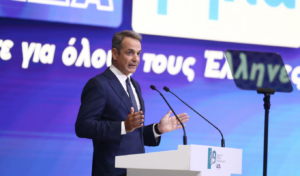
Today’s parliamentary debate on the rule of law is expected to be heated, with Kyriakos Mitsotakis sending a message of institutional progress. The prime minister, unveiling New Democracy’s proposal for constitutional revision, will respond to the opposition with specific institutional reforms aimed at restructuring the political system’s functioning, ultimately giving the “signal” for the start of the pre-revision process while demonstrating the opposition’s inability to produce policy and respond with comprehensive proposals to the country’s needs.
Mitsotakis will address all claims made by the opposition regarding wiretapping and OPEKEPE scandals, but the focus of his speech will be summarizing changes to the country’s constitutional framework. The Prime Minister’s Office is investing in this reform initiative with the goal of completing the first phase of the process before national elections.
Notably, 50 New Democracy MPs responded to the prime minister’s letter and have submitted proposals for the process. The procedure begins internally with dialogue in the “blue” Parliamentary Group, while New Democracy’s comprehensive proposal is expected to be presented after the party’s congress scheduled for May 15-17. Kyriakos Mitsotakis will refer to proposals for changing how judicial leadership is elected, with greater and more substantial participation of judges themselves in selecting leadership of supreme courts, as additional protection for judicial independence.
The focus of changes will be Article 86 on ministerial responsibility, public sector evaluation and tenure issues, Article 16 on private universities, presidential elections, constitutional guarantee of deficit and debt limitation obligations to prevent burden shifting to future generations, and incompatibility between ministerial and parliamentary positions. According to sources from the prime ministerial environment, Kyriakos Mitsotakis, by choosing to highlight institutional and reform impact, responds to the opposition’s intention to trap the government in closed, toxic discussions about recent cases, such as OPEKEPE case files and the academic credentials controversy surrounding Deputy Minister of Agricultural Development Makarios Lazaridis.
He will also seek to demonstrate the distance between government and opposition. “This choice by Kyriakos Mitsotakis is not a tactical move, but a substantive initiative,” his associates emphasized yesterday. The prime minister will point out that all pathologies from the past are due to a state unwilling to adapt to contemporary needs, maintaining old-party elements and clientelistic relationships. In this context, he will emphasize that confronting the so-called deep state and eliminating chronic pathologies can only be addressed by eliminating human factor mediation through digital modernization that reduces human contact and deep institutional reforms including constitutional regulations. Government officials focus on reform initiatives for changes that correct decades-old mentalities on various issues, from road safety (for example, eliminating traffic fines) to clientelistic state and favoritism.
The Prime Minister’s Office believes the government produces results, in contrast to opposition parties that limit themselves to investing in scandals and criminalizing political life. Unable to articulate programmatic discourse amid international crisis and submit alternative proposals from everyday issues like road safety to complex ones like addressing war’s economic and social impacts. “When you don’t have positions, you simply try to ‘unravel your political opponent’s sweater,'” government spokesman Pavlos Marinakis noted. “The political substance is that we have an opposition of despair, because they grab an issue that has whatever value it has. I don’t underestimate any issue, they issue 5, 6, 7, 8 announcements about this topic and conduct monotonous, single-issue opposition to create impressions. Why? Because they cannot produce policy themselves,” the government spokesman added, speaking on Blue Sky’s “Interventions” program.