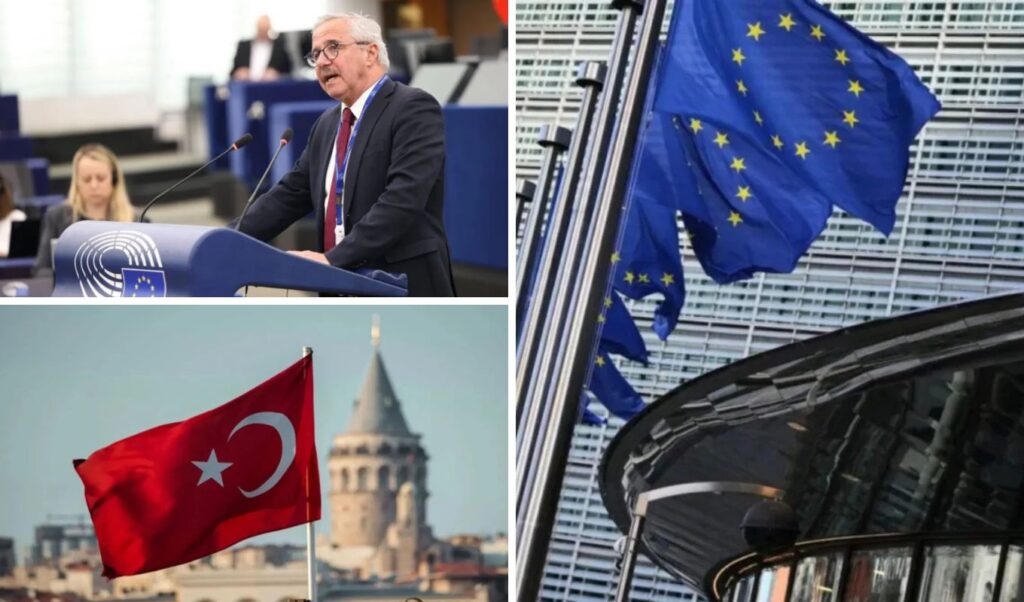
Clear references to Turkey’s relations with Greece and Cyprus are included in the European Parliament’s Foreign Affairs Committee report on Turkey’s EU accession conditions. The MEPs who drafted the report, led by Spanish Socialist Nacho Sanchez Amor, found that Turkey’s accession process remains inextricably linked to its behavior towards Greece and Cyprus, but primarily to establishing a rule of law internally, human rights, and full alignment with international law and European values.
Giannis Maniatis: European Parliament report highly critical of Turkey, almost all Greek positions included
PASOK MEP Giannis Maniatis expresses satisfaction to parapolitika.gr about the inclusion of almost all Greek positions in the report. As he states: “For another year, the European Parliament’s report on Turkey’s accession process is highly critical. It could not be different given the situation prevailing inside Turkey, the imprisonment of Istanbul’s mayor, political persecutions and violations of the rule of law, and regarding neighborly relations, one of the basic accession criteria. In the report, we managed to include, after many efforts, the majority of amendments I had submitted regarding continued violations in the Aegean and Eastern Mediterranean, maintaining the casus belli, protection and respect for the Ecumenical Patriarchate and the Greek minority in Constantinople, Imbros and Tenedos, the need to protect and respect the history of Hagia Sophia and Chora Monastery, UNESCO World Cultural Heritage Monuments that Erdogan converted into mosques, and of course Panagia Soumela in Pontus, challenges and obstacles regarding the implementation of the Greece-Cyprus underwater electrical cable and much more. Of course, until the vote in the European Parliament plenary, I will continue efforts so that the text reflects Greek positions as well as possible and we have the best possible result.”
The report’s reference to Greek-Turkish relations and Cyprus
Regarding relations with Greece, the Committee recommends that Turkey adopt a non-aggressive stance, which is necessary for stability in the Eastern Mediterranean. This involves immediately ceasing violations of Greek sovereignty, Greek EEZ and abuse of the NAVTEX system. Additionally, Turkey must abandon the revisionist “Blue Homeland” doctrine and fully respect the United Nations Convention on the Law of the Sea (UNCLOS). Particular reference is made to withdrawing the invalid Turkish-Libyan memorandum, and ending the obstruction of EU energy projects, such as the EastMed pipeline and the Great Sea Interconnector cable, for which Turkey has raised objections and led to the “freezing” of cable laying works.
The report includes almost all Greek-Cypriot positions for resolving the Cyprus issue. As stated, Turkey is called to contribute constructively to a just and sustainable settlement within the United Nations framework, and it is noted that the only acceptable solution remains the bicommunal, bizonal federation with single sovereignty, citizenship and international legal personality.
Theodoros Tsikas: “The European Parliament report is an advisory resolution – Important whether Turkey has EU accession as a priority”
Political scientist and international relations expert Theodoros Tsikas clarifies to parapolitika.gr that the report constitutes an “advisory resolution” and notes that “regarding Greece and Cyprus, it incorporates many of the observations, findings, and objections that both official Greek foreign policy and Cypriot foreign policy have regarding Turkey’s behavior. Naturally, it welcomes as positive the fact that Greek-Turkish relations have improved through dialogue. However, it gives the greatest weight to rule of law issues within Turkey. That is perhaps the strictest part of the report. Turkey, although it continues to be officially a candidate for accession, has not progressed on these issues in order to conduct negotiations in the Euro-Turkish dialogue.”
According to Mr. Tsikas, the recommendations made to Turkey by the European Parliament through this report can minimally function as leverage to change its policy. As he emphasizes: “It matters how much importance Turkey itself gives to its European perspective. If it values its European perspective, the report could have a positive influence. In the sense that it could progress positively both in its internal democratization and naturally push it toward better practices in relations with Greece and its stance on Cyprus. But if Turkey does not have European integration as a priority, at least during this period, the possibility of pressure is very small.”
The committee’s report was approved with 44 votes, 10 MEPs voted against and 17 abstained, while it will soon be submitted for voting in the Parliament’s plenary session.