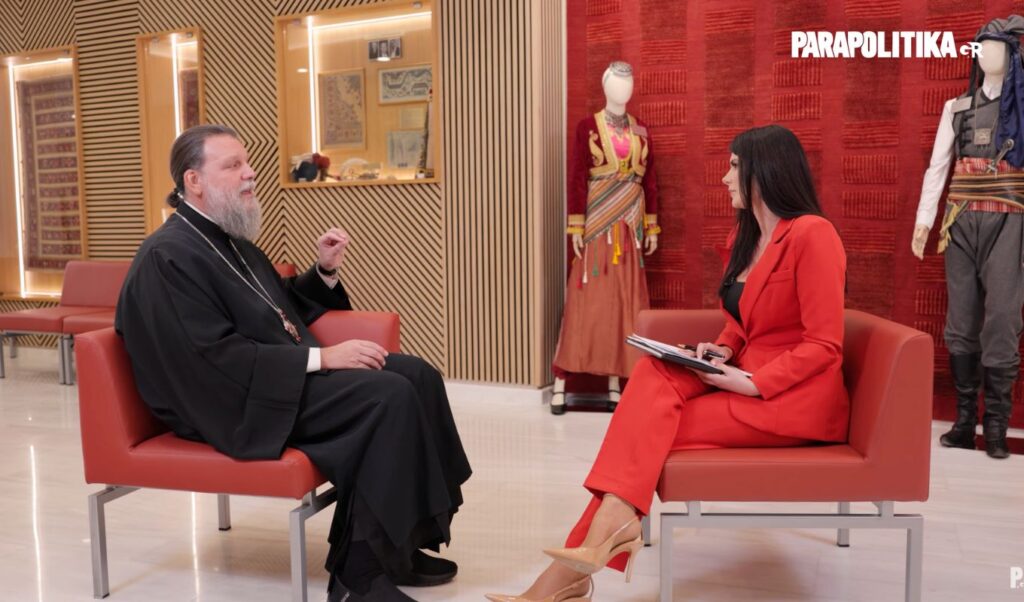
In a substantive interview with His Eminence Metropolitan Gabriel of Nea Ionia, journalist Christiana Maniati opens a dialogue on the most pivotal issues facing the Church and society today. From the fragile geopolitical balance between the Ecumenical Patriarchate and Moscow, to the persecution of millions of Orthodox Christians worldwide and new family models in school textbooks — to the thorny debate over Church property and the faithful who have turned away from the Church, disillusioned by scandal. His Eminence speaks to parapolitika.gr about everything: from fees charged at the Metropolis’s camps and social services, to the operation of the Ionic Centre, the Archbishop’s public tribute to the late Giorgos Mazonakis, and his own acquaintance with him. An interview that sheds light on the truth behind institutions and everyday life.
The interview with Metropolitan Gabriel of Nea Ionia
Your Eminence, thank you very much for welcoming us to the Ionic Centre and for the precious time you are giving us.
Thank you, and welcome.
Your Eminence, let us begin with recent events. We had the death of Giorgos Mazonakis, and also the Archbishop’s public statement in which he spoke about the singer’s unseen philanthropic work. Did you have a personal or pastoral acquaintance with him, and how do you assess this special relationship and the love he received both from the Church and from the public?
Well, I had the honour of serving alongside the Archbishop for more than seven years, when I was his close associate — first as Protosyncellus and then as Secretary General of the Holy Synod. The Archbishop was elected in 2008 and has always been a man deeply connected to the people, close to individuals and to every aspect of our lives. And so I came to know Mr. Mazonakis — the late Mazonakis — whom the Archbishop had received at the Archdiocese of Athens on several occasions. When that man passed away, when God called him home, the Archbishop felt the need to say a few words — naturally, to offer his prayer that God may grant him rest — and to share all that he said publicly.
I therefore consider it a very meaningful gesture on the Archbishop’s part, expressing what he would express for any person — his prayer that God may give rest to the departed. As for myself, I did not personally know the late Mazonakis; I knew him the way all of Greece knew him — through his songs, through his performances. It is a sorrowful event. May God grant him rest, for he left us far too soon, unexpectedly, in a very strange manner — one that I believe will bring to light a serious problem in our healthcare system. Nothing more than to ask God to bring comfort to his loved ones, and for all of us to remember him always through his songs, as we do so many others who contributed to the world of art. May God grant rest to Giorgos — I have nothing more to add.
Your Eminence, staying with current affairs — the strain in relations between the Ecumenical Patriarchate and the Moscow Patriarchate remains an open wound for Orthodoxy. The recent visit of the Metropolitan of Corfu to Russia for the transfer of the right hand of Saint Spyridon showed a Church that builds bridges. How do you assess this initiative, and what is the substantive diplomatic role that the Church of Greece is called to play at this particularly delicate moment?
I would like to speak more broadly about the crisis in relations between the Ecumenical Patriarchate and the Russian Church that you mentioned at the outset. This crisis began following the Holy and Great Council held in Crete in 2016, when the Russian Church decided not to attend — despite every effort made by the Ecumenical Patriarchate, and specifically by the Ecumenical Patriarch, to reassure the Russian side that all the issues they had raised and requested would be discussed, that there would be full access and full opportunity to express the Russian Church’s positions. In the end, the Russian Church, disregarding the conciliar governance of the Church, did not attend the Holy and Great Council. From that moment, a period of strain began, because the Ecumenical Patriarchate felt that the Moscow Patriarchate was showing disrespect — both to the institution and to the Ecumenical Patriarch personally.
Although everything had been discussed — I personally recall participating in the gathering of Primates held in Constantinople in 2014, where both the venue for the Holy and Great Council and the entire agenda were finalised — the Moscow Patriarchate was present; the Patriarch of Moscow himself was present, and all his positions were accepted by the Ecumenical Patriarch. I therefore consider that the entire policy of the Moscow Patriarchate toward the Ecumenical Patriarchate was — to put it very plainly — not honest. When we agree on something, Mrs. Maniati, we must also honour that agreement. Otherwise, when we are public figures — and especially in the realm of the Church, a space that above all is a space of truth, a space where we must respect principles and values — it is of the utmost importance that the Moscow Patriarchate respects what has been agreed upon.
This fracture was then compounded by Russia’s invasion of Ukrainian territory and everything that followed, which we all know well. What I can say, as a hierarch of the Church of Greece, is that we always desire unity, we will always pursue unity, and we will always stand by the Ecumenical Patriarchate on all pan-Orthodox matters — because that is the Ecumenical Patriarchate’s responsibility and its role.
And may God enlighten our Russian brethren — whom we love, and for whom we have sincere and very great esteem. We share so many saints, whom we venerate and to whom we pray as intercessors for all of us — Saint Seraphim of Sarov, a great saint and particularly beloved by the Greek people; Saint Matrona of Moscow, the Blind One; and so many other figures. I therefore believe that what we as humans cannot achieve, God may accomplish — may He enlighten our Russian brethren to understand that Greece both loves them and genuinely desires communication and unity, but above all desires honesty. We cannot agree on five things and then unilaterally fail to honour them. We must all respect this, and understand that when matters have been resolved on a rational basis, they must be accepted and respected by all.
Many people today say they are distancing themselves from the Church because of the behaviour of those who wear the cassock — phenomena of power appropriation, scandals, and misconduct within the Church. What do you say directly to those who have turned their backs on the Church? And how can we return to the apostolic spirit expressed in the words “Who is weak, and I am not weak?” — which ought to characterise the ethos of the clergy?
I firmly believe that the Church is a space that encompasses everything. It has people who all struggle to save their souls — but it also has people who, whether intentionally or not, will provide cause for criticism and will scandalise fellow believers, becoming the occasion and the reason for others to distance themselves from the Church. That is the human dimension. The theological dimension is this: we must never tie ourselves to individuals and personalities. We are in the Church because of Christ — because Christ is the one for whom we sacrifice everything, the one in whom we believe and with whom we seek a relationship of prayer and unity through our participation in the mystery of mysteries, which is the Divine Eucharist.
What must lead us to the Church is, exclusively, our relationship with Christ. People can help us, but we must all understand that people will also disappoint us. We do not believe in people — we believe in Christ. And people should inspire our trust only when they lead us toward Christ, not toward themselves. In the Church, we often have clergy who seek a personal relationship with the faithful as though they themselves are the ones to be revered — rather than God. That is a grave error, a great delusion, a great heresy. We are all sinners — including myself, as I speak to you now — and I believe that every person who truly understands what the Church is must also have knowledge of their own sinfulness.
What we must say to every person is: do not dwell on human failings and the pettiness we sometimes witness in clergy, because the greater truth is that all of us — clergy and laity alike — are in the Church in order to save our souls. No one within the Church will cause me to abandon my faith if I truly believe in Christ and I am in the Church for God — not for any person. That must be the clear message: we are here for Christ, and for him alone. Beyond that, the Church in our age must, in my humble view, return to the spirit described in the Book of Acts — the twenty-seventh book of the New Testament, which follows the four Gospels and describes the first years, the first moments from the Resurrection of the God-Man through to Pentecost, when the Apostles began to spread throughout the entire world, proclaiming the Gospel. That era of the Acts of the Apostles should be our goal today — our longing, the struggle we as clergy must undertake — to return to that era of simplicity, sincerity, and transparency.
The Church must, under no circumstances, be identified with any form of worldly power. We hold no such power. Our authority is spiritual — spiritual and nothing more. And we clergy are within the Church in order to save ourselves and our souls — not to gain any office or anything else.
We are also in a space that embraces children. Recently, a heated debate arose over primary school textbooks and the models of family they present. What is the Church’s position, and how can education promote traditional family values without, of course, leading to exclusion or discrimination in the classroom?
The Church’s position on this entire debate that has emerged around “new types of families” is absolute and clear. We operate on the basis of Holy Scripture — what we call the biblical tradition. In Holy Scripture, God created human beings male and female — man and woman. There is nothing beyond that. And the relationship between people, the family, comes into being through the blessing of the Church — between a man and a woman who are blessed within the Church and go on to share a common journey with Christ at the centre. So our view and our position are perfectly clear, whatever form this debate takes as it continues to unfold.
At the same time, the Church approaches every individual pastorally. The Church’s pastoral ministry is personalised. The way I listen to your confession, to your question addressed to the Church, is personal — it is for you, for your own individuality, for what you carry within you and wish to share with me, a sinner, before God. This does not mean that the Church excludes anyone who carries any sin in their life. Because homosexuality and everything related to it is, in the eyes of the Church, nothing other than sin — a sin that does not lead you to death. No sin leads to true death if you repent. Let us recall the words of Saint Basil the Great, who states clearly that there is no sin that can overcome the mercy and loving-kindness of God.
Except the blasphemy against the Holy Spirit.
Do you know what the blasphemy of the Holy Spirit is? It is refusing to function within the Church. Because the Holy Spirit operates within the Church. It does not mean what many ordinary people take it to mean — uttering words against the Holy Spirit. It means refusing to live and act within the Church. Very simply: when the Church, through the Ecumenical Councils of the first millennium, issues a decision, you cannot refuse to accept those decisions and refuse to submit to the Church. When you choose that, then you blaspheme against the Holy Spirit — you are outside the Church.
So, returning to the issue: everything that began with the textbooks, and more broadly all these matters that I believe will continue to come up in public discourse, must lead us to understand that we cannot alter the image the Church holds regarding the family, nor the image our country holds regarding the family. Any new form or type of family cannot be accepted by the Church. On the other hand, every person is free to do as they see fit. But they cannot change the Church, nor what the Church believes and proclaims through its biblical tradition.
And every soul has different needs.
That is precisely why I framed it pastorally. You cannot imagine how many young people — boys and girls — will come to the Church and speak about the issue that troubles them, their sexuality. You do not turn a person away because they have made a particular choice. On the contrary, you try to speak to them, to help them, and then, if they wish, they will continue to follow what you propose. But let us not imagine that Christ is somewhere waiting to point his finger at a person who has committed any sin and say: “Get out of the Church — I do not want you.” God forbid. Christ came for every sinner — above all for sinful people. Who am I, within the Church, to cast out any sinner? I will condemn the sin — not the sinner.
How do you ensure the moral balance between the standing of a Metropolitan and the Gospel spirit of simplicity and detachment from material things?
The answer is very simple. Just as we call the faithful through our preaching to apply the Gospel to their lives, we must first apply it ourselves. So when I call people to fulfil the demands of the Gospel without observing and putting them into practice in my own life — and you know, Christ himself tells us that the one who will be called great is not the one who speaks beautifully about these things, but the one who puts them into practice — we too must first practise what we preach, and only then ask others to do the same.
Our era, and every era — because we must place the Church exactly where she is within her historical context, with a two-thousand-year journey now entering its third millennium — has always seen the Church subjected to this particular criticism, precisely because the life of the clergy cannot be incompatible with that of people who face financial hardship and suffering. The Church must always be the one who leads the way in social work and in helping one’s neighbour — quietly, without show. We have no need to display it, nor to be congratulated for it. It is — to put it simply — in our DNA. You cannot be a person of God and remain indifferent to a fellow human being who is suffering.
Beyond that, living within society, what we as clergy must do — and I say this to myself first — is not to provoke through the way we live. And not provoking in our age means, I believe, living exactly as the average Greek lives. We must not — even if some are in a position to — give the impression that we can live beyond what the average Greek can afford. You rightly raised this and asked about it earlier: the Greek family is suffering, people are struggling, families cannot afford school fees, cannot even manage basic school supplies. We know many such cases. I won’t even mention rent — I cannot tell you how often we need to help families pay electricity and water bills, especially electricity, which has become extraordinarily expensive as things stand.
We simply cannot be a provocation. So first and foremost, the clergy — and especially the Bishop — must understand that he must set an example through his own life. And if he falls into any sin or makes any mistake, he must have the courage to repent and offer a sincere apology — first before God, and then before those who look to him. I believe it is far worse to be a hypocrite than to be honest — even if you have sinned. I think that — God of course forgives every sin when we repent — even the world, which does not forgive easily, will forgive more readily the person who is sincere than the one who is a hypocrite.
Your Eminence, since we are here at the Ionic Centre — a multifunctional project realised through the collaboration of European funding and significant philanthropic contributions — I would like to ask how you respond to the persistent criticism about the Church being wealthy.
What has been accomplished here by the grace of God — and I say with great joy — is that everyone is welcome here, and will always be welcome. This space is an open space for all, freely accessible to everyone, so that people may