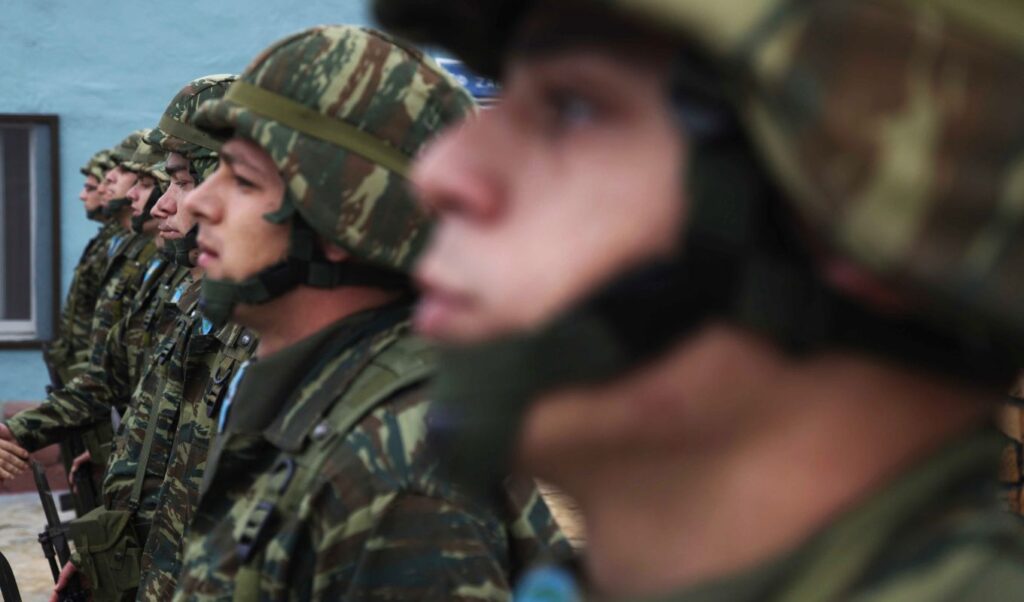
Widespread concern has been sparked by the mass sending of thousands of SMS messages through the gov.gr platform, delivering mobilization orders to military reservists. Many recipients have been posting these messages on social media — inadvertently making their personal details public in the process. The images triggered alarm among social media users, with many speculating about war and general mobilization. However, sources from the Greek Ministry of Defence have confirmed that no such scenario is in play.
Why reservists are receiving mobilization SMS messages through gov.gr
According to Ministry of Defence sources, the messages are part of an update to the mobilization records of individuals who have completed their military service in the Greek Armed Forces. Communications are now being conducted digitally, as part of a broader reform of the military reserve system. As part of this initiative, approximately 100,000 SMS messages and emails have been sent to corresponding recipients by the Mobilization Directorate of the Hellenic Army General Staff (HAGS), directing them to their personal inbox on gov.gr, where they can receive updates, notices, and mobilization documents.
Any reservist who receives such a notification should check the document uploaded to their personal digital inbox, verify their personal details, and review their mobilization status. The HAGS also notes that reservists are required to inform their Mobilization Unit whenever their residential address changes. Registration with the National Communications Registry is required in order to receive electronic notifications.
What is the Special Movement Order (SMO)?
It should be noted that, as has been the case for decades, the Special Movement Order (SMO) does not constitute an immediate call-up order. Instead, it defines a reservist’s mobilization status and — depending on the case — the specific unit or procedure the reservist would be required to follow if called upon in the future.
Specifically:
A green SMO indicates that the reservist has been assigned to a specific unit, typically with duties and a specialty related to their military training.
A white SMO indicates that the reservist is on standby, awaiting future assignment to a unit based on needs as they arise. This is the official description currently provided by the HAGS.
The shift to digital delivery of SMOs resolves a long-standing problem: previously, these documents were sent by post, meaning that anyone who had changed address was often left uninformed of their mobilization status.
Some of the newly issued documents also reflect changes in status — from white to green SMO or vice versa. Of particular significance is the reintegration of suitably trained reservists into specific units, as the new structure aims to make use of specializations and training that had previously gone unutilized.
Notably, on 29 July 2026, the Ministry of National Defence announced the formation of three new Special Operations Units in Attica, Central Macedonia, and northern Evros, with two of the three composed entirely of reservists. The Ministry had previously highlighted that a large number of Special Forces reservists had until now remained without a specific mobilization assignment.
Even more significant is the change in the age limit for reserve service. Under Law 5265/2026, enlisted reservists now remain in the reserve until the age of 60. For career non-commissioned officers, the limit extends to 65, and for officers to 68. A transitional exception does apply, however: those who had already been removed from the reserve rolls by 10 January 2026 — having reached the previous age limit — will not be automatically reinstated.
This also explains why the new digital mobilization documents may now be reaching individuals in older age brackets than many citizens had previously associated with active reserve duty.
What changes under the Agenda 2030 plan
The renewal of the reserve model, as outlined in the “Agenda 2030” framework, envisions a “citizens’ army” — with the goal of establishing a fully trained and combat-ready reserve force of 150,000 active reservists by 2030. This represents the overarching objective of the radical restructuring of Greece’s reserve system. A central role in this effort is played by the Reserve Retraining Centers (KEMEF), where reservists based in major urban centers — far from the units to which they have been assigned — will be called for refresher training.
Recently, speaking from Prague, the Chief of the Hellenic National Defence General Staff, General D. Houpis, addressed the need to reassess how Europe approaches military mobilization and conscription in light of modern threats and technological developments.
Among other points, he outlined the three core principles of the ongoing reserve reform, framed around geographic placement of conscripts based on their place of origin or permanent residence, training in new technologies equivalent to that received by professional soldiers, and an accelerated integration into service — with 70% of reservists becoming operationally ready within 14 weeks.