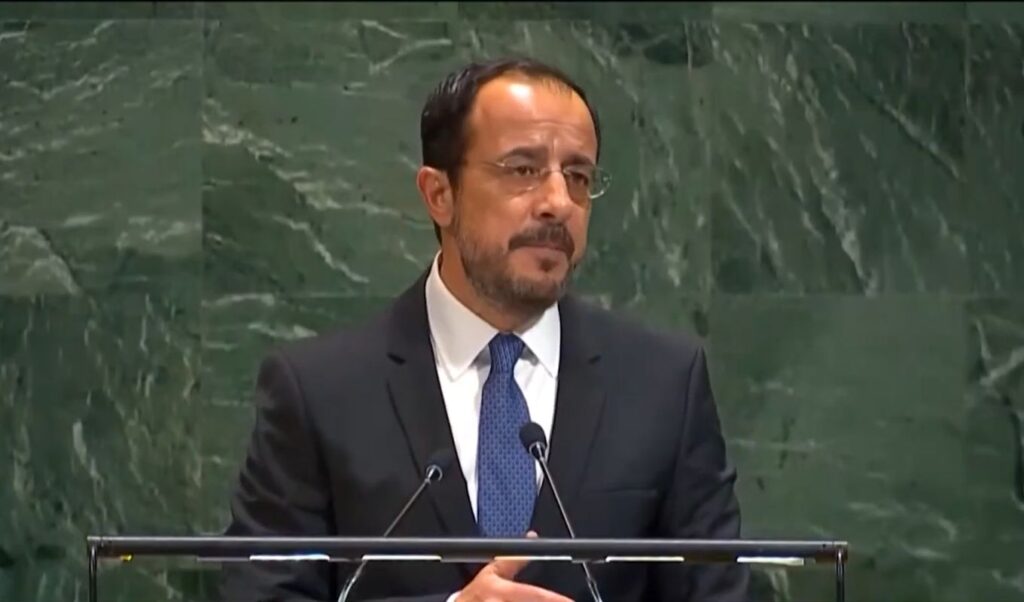
The President of the Republic of Cyprus, Nikos Christodoulides, called on Turkish President Recep Tayyip Erdogan from the podium of the UN General Assembly to allow substantive negotiations on the Cyprus issue within the framework agreed upon by the United Nations, while firmly rejecting the prospect of partition. Addressing the 81st Session of the United Nations General Assembly, the President underlined his full commitment to achieving a comprehensive solution, expressing readiness to resume negotiations from the point where they were interrupted in 2017, building upon the substantial work already accomplished within the agreed UN framework.
Christodoulides: “Monumental hypocrisy from Turkey”
Responding to the Turkish President’s address to the UN General Assembly, Christodoulides stated: “I listened very carefully to President Erdogan’s speech yesterday (September 22nd): references to international law, respect for the sovereignty and territorial integrity of all states, illegal occupation, the plight of refugees. Yet, when it comes to Cyprus, Turkey does the exact opposite. Monumental hypocrisy.”
President Erdogan, said President Christodoulides, “also made extensive reference to the United Nations Charter. But politicians are judged not by their words but by their actions. And if Mr. Erdogan wishes to invoke the Charter, he must first implement the Charter.” The UN Security Council, President Christodoulides stressed, has defined the framework for resolving the Cyprus problem. That framework, he said — a Bizonal, Bicommunal Federation with political equality — remains the only basis upon which a comprehensive solution must be achieved.
“I remain fully committed to achieving a functional and viable solution. I am ready to resume negotiations from the point where they were interrupted in 2017, building on the substantial work already accomplished. The common ground exists: the relevant UN Security Council resolutions, international law, and the law, values and principles of the European Union,” the President continued.
“Genuine willingness is required”
What is needed now, he stressed, is political will from all parties. “A genuine willingness to return to substantive negotiations. To engage seriously. To build upon the work already achieved. And to reach a solution that will reunify our country and our people.” A solution, he noted, that would allow Greek Cypriots, Turkish Cypriots, Maronites, Armenians, and Latins to live together in peace, security, and prosperity. “On my part, let me repeat, I declare myself absolutely committed. Because partition will not be accepted. It cannot and will not be the future of my homeland and my people. Never. Our determination to reunify our island is unwavering,” he emphasized.
Therefore, he added, “I call on my Turkish Cypriot compatriots to see our shared future as a unique opportunity for prosperity. And I call on President Erdogan to allow substantive negotiations within the framework agreed upon by the UN.”
He also underlined that the credibility of the UN must be upheld, noting that credibility requires consistency in the application of international law. “For my country, Cyprus, this is not an abstract principle. It is a painful, existential reality,” the President of the Republic of Cyprus continued, noting that 52 years have passed since the illegal Turkish invasion of Cyprus — an act of aggression that violates the fundamental principles of the UN Charter. “A continuing, flagrant violation of international law, with more than one-third of the territory of the Republic of Cyprus remaining under Turkish occupation. For 52 years, tens of thousands of displaced persons and their descendants have been prevented from returning to their homes.”
“For 52 years…”
“For 52 years,” he said, referring to Famagusta (Varosha), it “remains fenced off, with Turkey still defying its clear and very specific obligations set out in the relevant UN Security Council resolutions.” “For 52 years, we have been experiencing violations of fundamental human rights; the destruction of religious and cultural heritage; and the organized transfer of settlers constituting demographic alteration.”
He spoke of the pain and immense suffering that form the daily reality of the relatives of missing persons, who to this day demand answers about the fate of their loved ones. “And for 52 years, the principles at stake remain the same. Respect for sovereignty and territorial integrity are not rhetorical devices. Nor should they be applied selectively, depending on who the perpetrator is.”
He stressed that these principles do not become less important with the passage of time, nor do UN resolutions. “UN resolutions cannot be applied in one case and completely ignored in another. And the sovereignty and territorial integrity of a state cannot depend on its size, its power, or the passage of time. This is not only a matter concerning Cyprus. It concerns the credibility of the international system itself,” the President pointed out.
Operation Amalthea
Turning to today’s global challenges, he said they require cooperation and partnerships grounded in knowledge of regions and their realities. “The Republic of Cyprus consistently seeks to do exactly that. And it has developed the necessary capabilities required to do so,” he said, going on to speak extensively about Cyprus’s actions following the Hamas terrorist attack on October 7, 2023, and the devastating humanitarian situation in Gaza, noting that Cyprus has activated the Maritime Humanitarian Corridor, Amalthea. “Cyprus could offer something concrete: its geographic location, its infrastructure, its excellent relations with all countries in the region, and the willingness to cooperate with international partners,” he stressed.
He said that through cooperation, including with the UN Mechanism 2720, this idea became a proposal and evolved into an operational humanitarian route — a route that continues to deliver results even now. He also referred to Cyprus’s role in the evacuation of civilians, stating that “in the last three years alone, we have helped evacuate thousands of civilians from 70 different countries.” President Christodoulides also highlighted the role of the Cyprus Regional Initiative on Climate Change, aimed at bringing regional countries closer together, thereby strengthening collective adaptation, mitigation, and resilience capacity, as well as the Cyprus Regional Aerial Firefighting Base.
He noted that the commitment to active regional cooperation is also demonstrated through CYCLOPS, established jointly with the United States. Over its four years of operation, it has provided specialized training to thousands of government officials from more than 50 countries across the Middle East, Africa, and Europe, he emphasized.
“An active and responsible actor”
Referring to the Cypriot Presidency of the EU Council, he said that the ability to bridge divergent interests was also at the heart of the Presidency. “Cyprus has proven itself to be an active and responsible actor in the international community. It has contributed to crisis management, humanitarian assistance, regional synergies, the protection of human rights, and multilateralism,” he stressed.
Marking the completion of a decade at the helm of the UN by António Guterres, the President said that Cyprus commends his leadership during a period of unprecedented global developments, his unwavering commitment to multilateralism, and his efforts to strengthen and reform the United Nations.
Cyprus, said the President, believes in a United Nations that upholds the principles of its Charter and has the capacity to act in accordance with them, and that small states have a particular role to play — not on the sidelines of international affairs, but as active participants in shaping our common future.
“For the Republic of Cyprus, this means defending the principles upon which we rely, contributing to the institutions in which we believe, building partnerships for the common good, taking initiatives to create useful synergies, and acting responsibly wherever we can make a difference.” “Despite the challenges posed by the Turkish occupation, we remain resilient and unwavering in our faith in the multilateral system,” the President concluded.