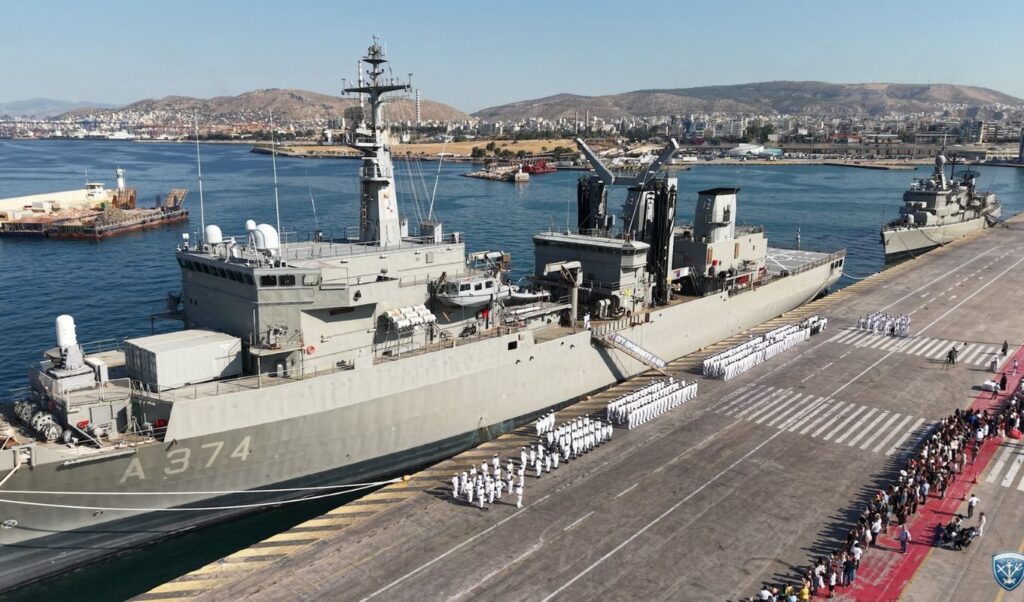
The intergovernmental agreement between Greece and Italy for the purchase of two frigates of the FREMM type, Bergamini class, by the Hellenic Navy reinforces Greece’s ongoing efforts in recent years to establish itself as a front-line naval power and a regional security pillar in the Mediterranean.
Read also: The DEI Group inspected the new FDI frigates of the Hellenic Navy
This move comes at a time of escalating war rhetoric from Turkey in the region, and coincides with the anticipated delivery of the new Greek frigate “Nearhos” — the second FDI HN/Belharra — which is scheduled to be handed over to the Hellenic Navy on October 30, 2026, in Lorient, France, before sailing to Greece in late October to early November 2026.
Which frigates will reinforce the Greek fleet
The two Italian vessels set to join the Hellenic Fleet are the Carlo Bergamini (F-590) and the Virginio Fasan (F-591): battle-tested, reliable, and heavily armed ships that will rank among the most powerful in the Greek fleet. The acquisition of the two FREMM frigates is part of a broader plan to modernize and strengthen the Hellenic Fleet, with the option to acquire additional vessels of the same class in the future.
The objective
Combined with the four FDI frigates and the MEKO frigate modernization program, the addition of the Italian ships is expected to significantly enhance the Hellenic Navy’s operational capabilities. The goal is to build a fleet of high-performance strike units capable of operating both in the Aegean and the Eastern Mediterranean, in order to defend Greece, Cyprus, and the European Union.
When will the agreement be signed
The Implementing Arrangement between Greece and Italy is set to be signed on Tuesday, September 8, 2026, in Rome, with the participation of Greek Minister of National Defence Nikos Dendias, his Italian counterpart Guido Crosetto, and the chiefs of the naval forces of both countries. The agreement follows the Memorandum of Cooperation and the Letter of Intent signed on September 29, 2025, in La Spezia, during a meeting between Nikos Dendias and Guido Crosetto.
Just days earlier, the frigate Carlo Bergamini — one of the two vessels Greece will acquire — docked at the Salamis Naval Base, where Hellenic Navy officers inspected the ship and concluded that it was a used vessel in like-new condition. This assessment gave the green light for Dendias’s visit to Italy and the subsequent agreement with his Italian counterpart.
The timeline
Regarding the transfer and integration schedule into the Hellenic Navy, the Carlo Bergamini frigate is expected to be sold and transferred to Greece within the first half of 2028, while the Virginio Fasan is scheduled for transfer within the first half of 2029. The agreement also includes initial and ongoing support for the vessels, aimed at maintaining a high level of operational availability. Special provisions have also been made for the domestic defense industry.
What the agreement entails
Under the terms of the agreement, Greek shipyards will participate in maintenance work on the frigates, as well as in the adaptation and installation of new systems aboard the vessels. In this way, a portion of the technical support for the FREMM frigates is intended to be carried out in Greece, simultaneously boosting domestic capabilities in the shipbuilding and defense sectors. It is worth noting that the Carlo Bergamini is a general-purpose frigate with a displacement of 6,700 tons, a length of 144 meters, a beam of 19.7 meters, and a maximum speed exceeding 27 knots, powered by a CODLAG (Combined Diesel-Electric and Gas) propulsion system.
Technical specifications
The vessel is equipped with Leonardo’s ATHENA CMS combat management system and a Kronos Grand Naval AESA-technology radar. It carries an OTO Melara 127/64 LW Vulcano main gun and two Sylver A50 vertical launch systems with a total of 16 cells for Aster 15 or Aster 30 missiles, along with Otomat Teseo anti-ship missiles and MU90 torpedoes for anti-submarine warfare. It can also accommodate two helicopters (NH90 or MH-60R) in its hangar and on deck. The Virginio Fasan, on the other hand, is designed for anti-submarine warfare (ASW). While its general characteristics remain the same, it features some key differences — most notably the CAPTAS-4 towed array sonar, which provides submarine detection at very long ranges, and four MILAS anti-submarine rockets, though these reduce the number of available anti-ship missile cells to four.