The government is placing strong emphasis on fulfilling all of its commitments to citizens before the end of its second term, aiming to reinforce its credibility and build a narrative that, unlike the hollow promises of opposition forces, it delivers results and fully implements its announcements.
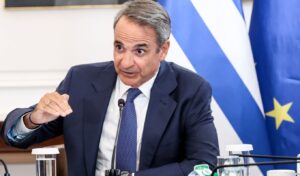
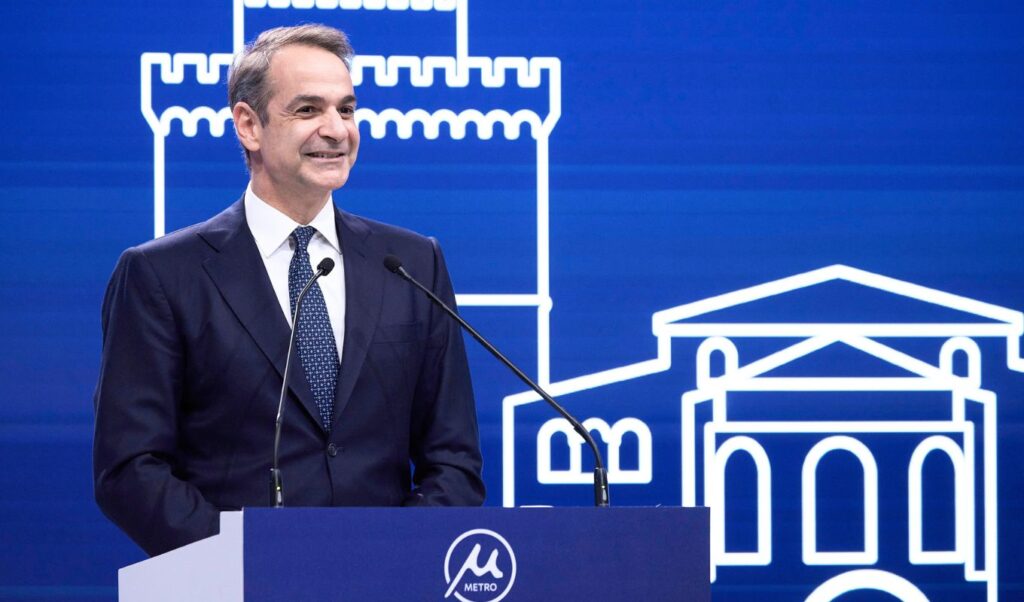
In this context, the Prime Minister will attend today’s inauguration of the Thessaloniki Metro extension. The project’s delivery fits into the broader strategy of the Maximos Mansion, which seeks to convey the message that during its first term, the Mitsotakis government transformed Greece into one vast construction site — and that in its second term, these projects are now being completed and making a tangible difference in citizens’ daily lives. The slogan “we said it, we’re doing it” remains central to New Democracy’s strategy on the road to the next elections.
Thessaloniki Metro: Mitsotakis attends inauguration of Kalamaria extension
In the infrastructure sector specifically, the delivery of the Thessaloniki Metro extension — featuring five new stations towards Kalamaria — stands as one of the flagship projects completed during Kyriakos Mitsotakis’ second term. Other major completions include the E65 motorway, the Patras–Pyrgos highway, the main Thessaloniki Metro line, and more recently the Rovies–Ilia road network in northern Evia, as well as the signing of the Skaramangas Triple Junction project. The government is leveraging this infrastructure output as a key pillar of its political messaging.
The message from Pavlos Marinakis
“We are moving from banners and big words to big projects. For many decades, citizens had grown tired of grand promises. Less than a decade ago, they were watching inauguration ceremonies with nothing but canvas backdrops. This is an era of accountability, honesty, and deliverables,” said government spokesperson Pavlos Marinakis at yesterday’s press briefing for political correspondents. At the same time, the government is working to communicate to the public that over its seven years in office, it has delivered on more than 90% of the commitments made in its 2023 pre-election programme.
Delivering on pre-election promises
Notably, the Centre for Liberal Studies (KEFIM) recently recorded that 91.6% of the Mitsotakis government’s pre-election pledges have either already been implemented or are currently in progress. More specifically, the Electoral Programme Implementation Index shows that 49.3% of commitments have been fully or partially fulfilled, while a further 42.3% are underway — bringing the total share of pledges with meaningful implementation steps to 91.6%.
The Thessaloniki International Fair is approaching
In a similar vein, government officials are cultivating the message ahead of the upcoming Thessaloniki International Fair (TIF) that “whatever Kyriakos Mitsotakis announces, citizens will see it happen.” They point out that the Prime Minister’s commitments from last year’s TIF were implemented within six months of being announced. In this spirit, government officials are previewing a wide-ranging package with broad social and economic impact, expected to be presented in detail by the Prime Minister on September 5th.
What measures are being planned
Regarding this year’s TIF package, the government is signalling tax rate reductions, support for the middle class, businesses — and small and medium-sized enterprises in particular — as well as further assistance for families. “The cost of the measures is tied to the fiscal space we have, based on expenditure ceilings. Finance Minister and Eurogroup President Kyriakos Pierrakakis has already stated that it will certainly be at least one billion euros, and possibly a little more,” said Pavlos Marinakis at the briefing for political correspondents ahead of the Prime Minister’s TIF announcements. However, on the question of reinstating the 13th and 14th salary payments in the public sector — a measure blocked by a negative ruling from the Council of State — Marinakis ruled out the possibility, stating that the government will direct its available resources to society as a whole, with a focus on the middle class, families, and businesses.
Targeting specific social groups
In any case, the government’s attention remains fixed on reconnecting with social and professional groups that have drifted away from it. The upcoming prime ministerial announcements are set to address a broad cross-section of society: pensioners, public and private sector employees, the self-employed, and farmers. The Maximos Mansion’s goal is both to provide relief to citizens and to rebuild New Democracy’s ties with professional groups that have distanced themselves from the party and expressed dissatisfaction with government policies.
A tax relief package is on the way
In this context, the economic team is preparing a tax relief package targeting the self-employed, small and medium-sized enterprises, and the middle class. The aim is to ease the discontent triggered among the self-employed by the introduction of the presumptive taxation system. On the table are plans to reform the presumptive taxation framework and reduce advance tax payments. Also under consideration is the complete abolition of the business licence fee, as well as a reduction in the corporate profit tax rate.
In the same vein, a further reduction in employer social security contributions by half a percentage point is being examined, as a continuation of the non-wage cost reduction policy that has been in place in recent years. Additionally, across the business sector, the establishment of a protected professional bank account — exempt from seizure — is also under discussion.
Scenarios under consideration for pensioners
For pensioners, one of the scenarios being considered is increasing the annual November bonus payment from €300 to €400, or alternatively expanding the pool of eligible recipients. Farmers are another group expected to feature prominently in the announcements, with the economic team working on targeted measures for the agricultural sector — a professional group that, like the self-employed, has traditionally been a core constituency for New Democracy.
Against this backdrop, reconnecting with the farming community — which has distanced itself from the centre-right following the OPEKEPE affair — is a critical objective for the ruling party. On the road to the next elections, Prime Minister Kyriakos Mitsotakis is signalling a renewed outreach to the agricultural world, placing interventions in the primary sector high on his party’s pre-election agenda.