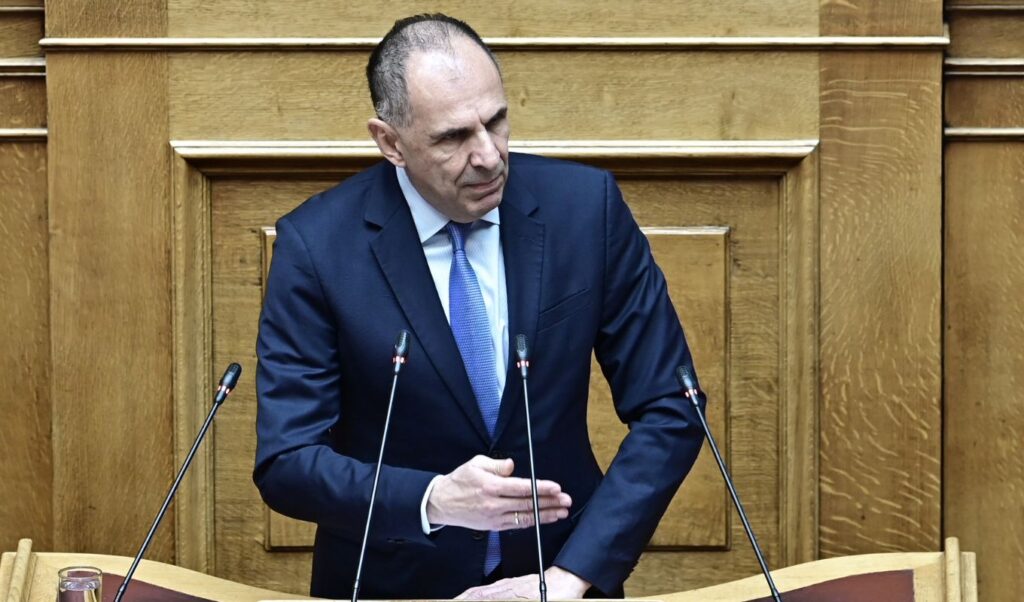
Greek diplomacy is immediately activating all available diplomatic and military tools to respond decisively to Ankara’s ongoing provocations. Athens’ moves are swift and are escalating at the highest European and international levels. Greek Foreign Minister Georgios Gerapetritis is expected to take the necessary steps at next week’s Foreign Affairs Council meeting.
As he stated in a television interview on OPEN, the Greek government — and he personally — have already formally communicated Turkey’s provocative actions to all European authorities since last week. At the same time, Athens is aiming to brief the United Nations (UN), while a formal protest directly to Turkey over its illegal actions is also expected in the coming days.
Gerapetritis responds to Turkish escalation
This intense diplomatic activity comes as a direct response to Turkey’s latest escalation, as Ankara shows no signs of backing down from its provocations. Notably, Turkey’s official Anadolu Agency published a map depicting the precise boundaries of the maritime zones Ankara declared ten days ago, bearing the signature of President Recep Tayyip Erdoğan.
According to a post on X accompanying the map, a Presidential Decree established the country’s first national marine parks: the Fethiye-Kaş National Marine Park (covering 2,170,603 hectares) and the North Aegean National Marine Park (covering 174,214 hectares). Turkish analysts note that these parks reflect Ankara’s stated priority of protecting the marine environment, both within its territorial waters and across its claimed maritime jurisdiction zones.
Turkey decides to end its “calm waters” policy
However, Greek analysts largely agree that Turkey has decided to bring an end to its “calm waters” policy in the Aegean, driven primarily by its deep concern over the significant military capabilities Greece has acquired in recent years through modern weaponry. Among these, the new French Belharra frigates, the upcoming purchase of American F-35 fighter jets, and Greece’s defense cooperation with Israel — which has secured the country its own “defense dome” — stand out as key factors.
In this context, Athens is further strengthening its deterrent posture in the Aegean by responding to Turkish provocations at the operational level. A new agreement to incorporate two Italian frigates — the Carlo Bergamini (F-590) and the Virginio Fasan (F-591) — into the Hellenic Navy is being interpreted as a clear answer to Ankara’s challenges. These vessels are considered among the most battle-tested and reliable in the world, carry heavy armaments, and are expected to significantly boost the Navy’s operational strength.
Papafloratos tells parapolitika.gr: “Greece’s top priority is securing the Aegean and defending its sovereign rights”
International relations scholar and military academy professor Yannis Papafloratos told parapolitika.gr that Greece’s foremost concern is securing the Aegean and reinforcing its sovereign rights in practice. However, he made a pointed clarification: “We are not defined by others — we define ourselves. Our armaments program is being implemented within the broader framework of defending our sovereign rights. We don’t look at what Turkey does, and we shouldn’t look at what any other state does. Turkey has its own program; we have our own program and our own priorities. We don’t react to Turkey’s moves — we act on our own terms. Greece’s top priority is securing the Aegean and defending Greek sovereign rights.”
Referring specifically to the two frigates, he described them as “two very significant vessels which, as part of our naval reinforcement program — alongside the acquisition of other warships such as the French frigates — strengthen the Aegean’s defenses and enhance our deterrent capability against any hostile intent.”
What is certain is that Athens, based on all official statements, is expected in the near future to move forward — with the involvement of French company Meridian — in resuming seabed surveys for the laying of the undersea electricity cable connecting Crete with Cyprus. Despite Turkish government leaks suggesting Greece should first notify Ankara before proceeding, government spokesperson Pavlos Marinakis again sent a clear message to Turkey, stating that “Cyprus, Greece, and France have an expressed will: for the cable project to move forward.” The development of this issue is considered pivotal for Greek-Turkish relations.