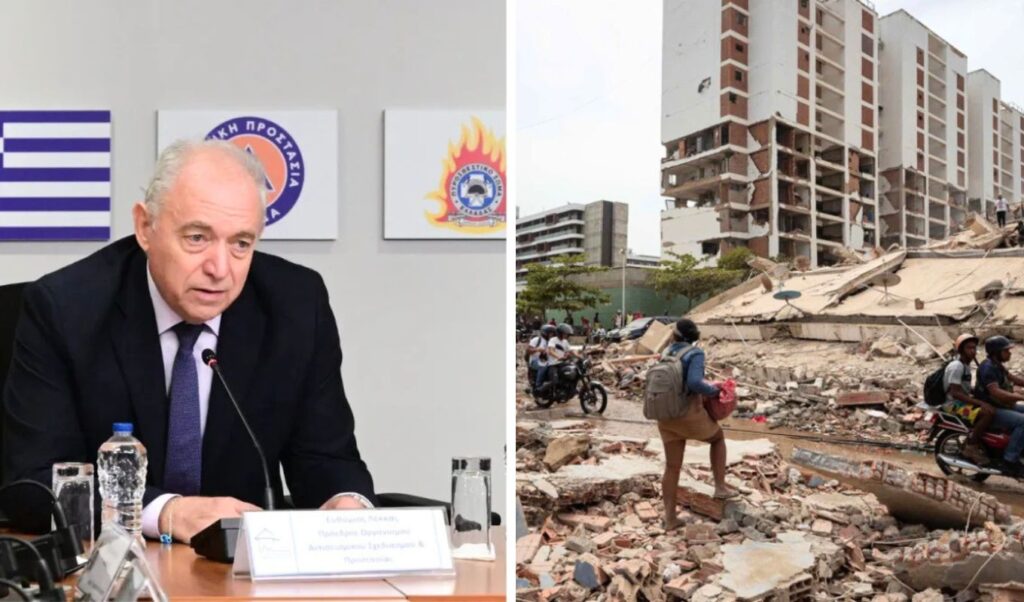
Greek seismologist Efthymis Lekkas has described the geological and operational findings left behind by the two powerful earthquakes — measuring 7.2 and 7.5 on the Richter scale — that struck Venezuela as “unprecedented.” The twin tremors caused biblical devastation, leaving thousands dead, injured, and displaced.
Read more: Venezuela: Death toll reaches 2,595 from deadly double earthquake — Search for missing persons continues (Images & Video)
These findings are based on on-site assessments carried out by a Greek scientific mission led by Professor Lekkas — Emeritus Professor of Dynamic, Tectonic and Applied Geology and Natural Disaster Management at the National and Kapodistrian University of Athens (NKUA), and President of the Earthquake Planning and Protection Organization (EPPO). The team also included Panagiotis Karydis, Emeritus Professor of Earthquake Engineering at the National Technical University of Athens, with the shared mission of providing scientific, technical, operational, and humanitarian assistance to the Latin American country.
Venezuela earthquakes: A timeline of destruction and a devastating economic blow
The disaster struck on June 24, when Venezuela’s coastal zone was hit by the two major tremors in rapid succession. Beyond the heavy human toll, the earthquakes caused sweeping damage to the country’s built environment and infrastructure networks.
The social consequences of the disaster are considered disproportionately severe for the local population, while the economic cost of recovery is enormous — initial estimates suggest that damages amount to approximately 5% of Venezuela’s total GDP.
A geological paradox in Venezuela: Zero damage at the epicenter, biblical destruction 200 kilometers away
The unprecedented phenomena observed by the Greek mission — representing unique geodynamic events — are as follows:
The two earthquakes struck just 39 seconds apart, a time interval that has never been recorded before and represents a new benchmark in seismicity. Other major twin earthquakes, such as the 2023 Turkey earthquakes near Antakya, had a time window of at least 6 hours between strikes. In other cases, the interval is typically several days.
The fault zone that was activated, triggering both major earthquakes, spans at least 300 km in length (the San Sebastián Fault). Running in a general east-west direction along Venezuela’s northern coastline, it marks the boundary between the South American Plate and the Caribbean Plate. The fault is classified as a pure right-lateral strike-slip fault system.
Remarkably, no damage whatsoever was observed in the immediate epicentral area of the earthquakes (San Felipe, Morón, Valencia). Even older, non-earthquake-resistant structures in the epicentral zone sustained zero damage.
In stark contrast, hundreds of collapses and significant structural damage were recorded 200 km east of the epicenter, in the coastal areas of La Guaira — near the international airport — Catia La Mar, and Caraballeda. These areas constitute the macroseismic epicenter of the disaster’s impact.
Venezuela: The secret behind the destruction — How a 39-second gap between two earthquakes brought down 30-story buildings
The damage in the aforementioned areas affected both low-rise buildings and massive high-rise structures of 20 and 30 floors.
In the Caracas area, by contrast, no significant damage was observed — only around 10 collapses of tall, high-volume buildings were recorded, a relatively small number given the hundreds of thousands of structures that make up the capital’s urban fabric. It is estimated that the fault zones running through Caracas belong to fault structures parallel to the northern zone, which were not activated during the event.
The accumulated thousands of collapses of tall buildings — founded on loose coastal and fluvio-torrential sedimentary deposits along the shoreline (characterized by long natural periods) — resonated with the long-period seismic waves generated at a great distance from the epicenter. This created a catastrophic resonance scenario that neither older nor newer constructions were able to withstand. Contributing to the destruction was the fact that buildings were subjected to sustained oscillation lasting several minutes due to the extremely short interval between the two earthquakes. Specifically, before the vibrations from the first earthquake had subsided, structures were struck by the second wave of shaking — which was even more intense and of longer duration.
Also notable is the fact that outside the narrow coastal strip — where the specific geological, geotechnical, and soil mechanics conditions developed — no systematic collapses or damage were observed in adjacent areas underlain by metamorphic rock formations, as an entirely different geodynamic framework prevailed there. Even in areas with very poor construction quality and high building and population density (favelas), zero structural damage was recorded.
The analysis of data collected by the Greek mission will continue in the coming period and will be presented through the specialized scientific publication Newsletter of Environmental, Disaster, and Crises Management Strategies, issued under the auspices of the Postgraduate Program “Environmental, Disaster and Crisis Management Strategies” at the National and Kapodistrian University of Athens.