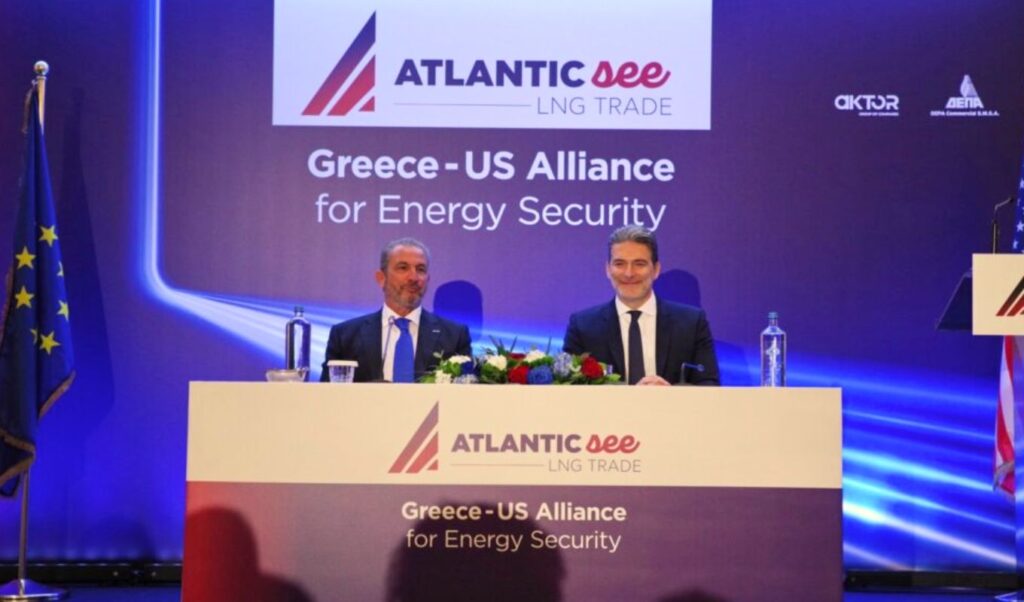
DEPA Commercial, in coordination with Atlantic SEE LNG Trade — the joint venture between AKTOR Group and DEPA Commercial — successfully participated in today’s annual capacity booking auctions for 2026–2027 on the Vertical Corridor, securing capacity of approximately 13,000 MWh/day, or 4.7 TWh on an annual basis. The consortium’s participation sends a strong positive signal, reinforcing the Vertical Corridor’s commercial attractiveness and operational effectiveness.
It is also a clear message from the joint venture that it intends to pursue short-term agreements to supply the wider region with American LNG, leveraging the Vertical Corridor before 2030 — as announced at the press conference held just days ago by Atlantic SEE LNG Trade CEO Alexandros Exarchou and company Chairman Konstantinos Xififaras. As powergame.gr reported earlier, with today marking the first auction under the new capacity booking products for the Vertical Corridor, the involved Transmission System Operators (TSOs) have already launched a new round of consultations under the coordination of the European Commission, aimed at further improving the capacity booking framework. The goal is to offer greater flexibility to Corridor users, thereby enhancing the project’s commercial appeal and making it accessible to a broader range of market participants.
According to sources, discussions are still at an early stage and no specific changes have been finalized. However, it is clear that the proposed adjustments will not involve further reductions in transmission tariffs — a target that market players say has already been largely achieved.
Thanks to the new products — which include targeted discounts across individual transmission systems — the Vertical Corridor has now become the fourth most cost-effective gas transmission route to Ukraine. Until recently, its cost was nearly three times higher than the route via Poland. As a result, attention has now shifted toward reducing commercial risk for users. The improvements under consideration are expected to focus on greater security and predictability, limiting users’ exposure to risks associated with transporting gas through multiple interconnected systems.
An antidote to Russian gas
The active involvement of the European Commission in these processes carries particular significance. On one hand, it ensures that any modifications will be fully compliant with the European regulatory framework, providing institutional certainty for the new products. On the other, it reflects Brussels’ growing interest in the further development of the Vertical Corridor, which is emerging as a key instrument for diversifying natural gas supply sources in the European market. This importance is further amplified when one considers that the Corridor runs through countries that remain heavily dependent on Russian pipeline gas via TurkStream.
Its geopolitical dimension is expected to grow even further from 2027, when the Corridor is set to be extended westward into the Western Balkans. As powergame.gr has previously reported, the relevant processes have already begun to integrate the markets of Serbia and North Macedonia into the new Vertical Corridor products, strengthening the project’s role in supply diversification.
These developments confirm that the Vertical Corridor is gradually transitioning from an ambitious plan into a project with genuine commercial and geopolitical substance. This shift was highlighted by Atlantic SEE LNG Trade CEO and AKTOR Group Chairman and CEO Alexandros Exarchou at a recent event titled “The Vertical Corridor: Europe’s New Gateway to Energy Security,” where he noted that the initiative is now acquiring a tangible foundation — both in market terms and in terms of strategic significance.
The role of Atlantic SEE LNG Trade
Atlantic SEE LNG Trade — the joint venture between AKTOR Group and DEPA Commercial — has played a pivotal role in this development. A key indicator is the fact that it has already secured a 20-year booking of the Western Corridor toward the Western Balkans from 2030, in order to transport 1 billion cubic meters of American LNG per year from Venture Global to Albania.
At the same time, the company is working to convert into binding contracts the memoranda of understanding it has already signed with Bulgaria, Romania, and Ukraine regarding the 20-year supply of American LNG from 2030. Talks are continuing with other markets in Central and Southeastern Europe — including Hungary. Atlantic SEE LNG Trade also intends to use the Vertical Corridor to supply regional countries with American LNG before 2030, with short-term gas sales deals expected to boost the Corridor’s utilization within the current decade.
Today’s test
At the same time, the improvements under discussion for the new products will largely depend on how the market responds to the new capacity allocation framework. In this context, today’s annual auction is not only the first application of the new products — it is also a critical test for their further development. The process covers annual capacity bookings across all interconnection points within European natural gas transmission systems, allowing participants to secure capacity for the next gas year, which in most countries begins in October 2026 and in others in January 2027.
Particular attention is focused on the auction at the Sidirokastro interconnection point, where 100 GWh of export capacity will be on offer. In coordination with Atlantic SEE LNG Trade, DEPA Commercial’s participation is considered a given — as confirmed at the same event by company CEO Konstantinos Xififaras. Bulgargaz’s presence is also expected, as it traditionally books around 25% of available capacity. Market players therefore estimate that between 30% and 50% of the capacity offered through Sidirokastro could be covered as early as this first auction.
Barometers for the Vertical Corridor
An important feature of the new products is that the volumes exiting Greece are not required to have Ukraine as their final destination. However, for the route to Kyiv, the special products established in Romania and Moldova — which provide discounts on gas transmission to the Ukrainian market via the Vertical Corridor — continue to play a decisive role.
This is the primary reason why the Greece-to-Ukraine route has now become cost-competitive. Today’s auction results will therefore serve as an additional indicator of market confidence. The outlook for the auction is further supported by the completion of investments that will increase Bulgarian system transmission capacity by 50% within the new gas year — meaning a positive surprise in terms of even larger capacity bookings cannot be ruled out.
A milestone on the path to maturity
As market executives note, the full commercial utilization of the Vertical Corridor is a marathon, not a sprint. This year’s auction essentially serves as preparation for the next cycle — one year from now — when the European Union will be one step away from completely halting Russian natural gas imports. By then, additional upgrades to the Vertical Corridor — specifically to Romania’s transmission system — will also have been completed.
Viewed through this lens, today’s process will not by itself determine the success or failure of the initiative. Rather, it represents yet another milestone in the maturation of a project that aspires to transform Southeastern and Central Europe into a unified natural gas trading area. This means that the Vertical Corridor’s prospects will be judged over a medium-term horizon — and will strengthen in tandem with Europe’s ongoing energy decoupling from Russia.