Two earthquakes measuring 4.7 and 5.3 on the Richter scale struck within six minutes of each other on Saturday, June 20, 2026, off the coast of Gavdos, sending shockwaves of alarm across the region. The tremors were felt across several areas of Crete, though no damage has been reported so far. According to the revised assessment by the Geodynamic Institute, the first earthquake — measuring 4.7 on the Richter scale — struck at 12:31, with its epicenter located 5 kilometers east of Gavdos and a focal depth of 13.4 kilometers.
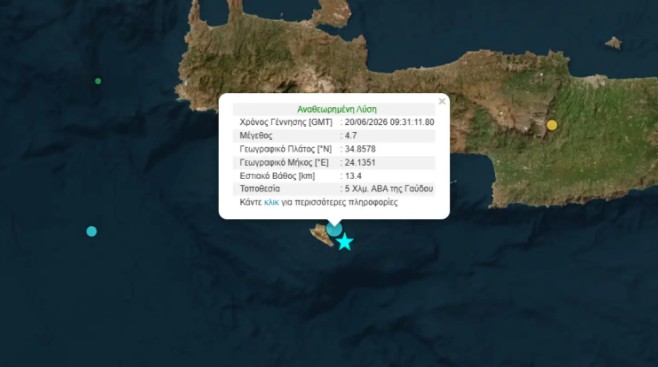
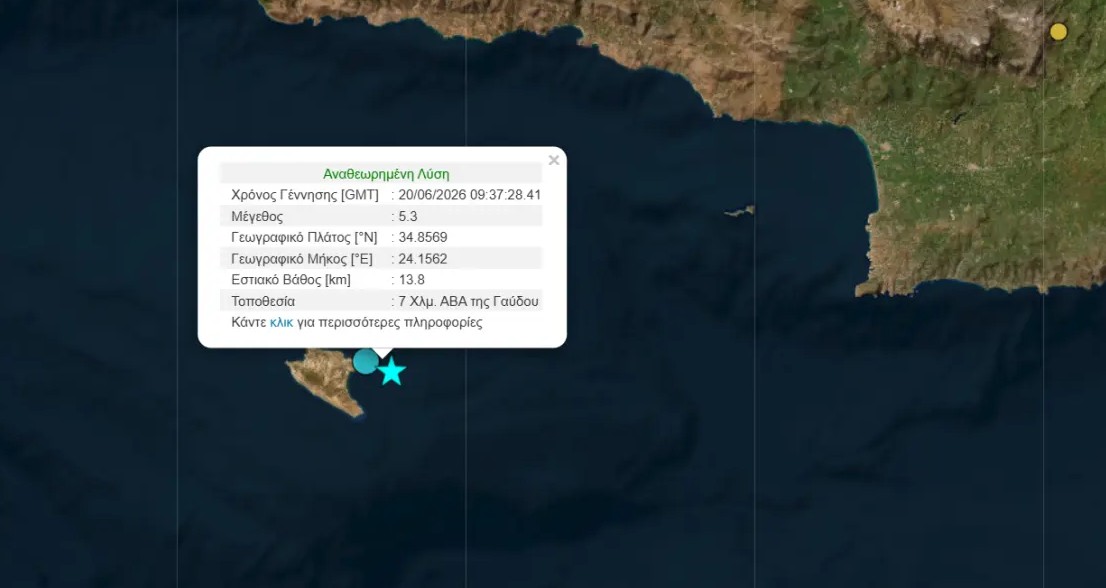
Just minutes later, a second earthquake measuring 5.3 on the Richter scale struck the same area. According to the Geodynamic Institute’s revised solution, this second quake had its epicenter 7 km east-northeast of Gavdos, with a focal depth of 13.8 km. Both earthquakes were felt across several parts of the island and throughout Crete, and no damage reports have been received at this time.
Read also: Successive 4.7 and 5.3 magnitude earthquakes off Gavdos felt across southern Crete
Earthquakes off Gavdos: Emergency patrols deployed across southern Crete — Samaria Gorge closed
Firefighters stationed on Gavdos are currently conducting patrols across the island, while precautionary patrols are also underway throughout the southern part of Crete, covering the regional units of Chania, Rethymno, and Heraklion — areas where the seismic activity was particularly strongly felt.
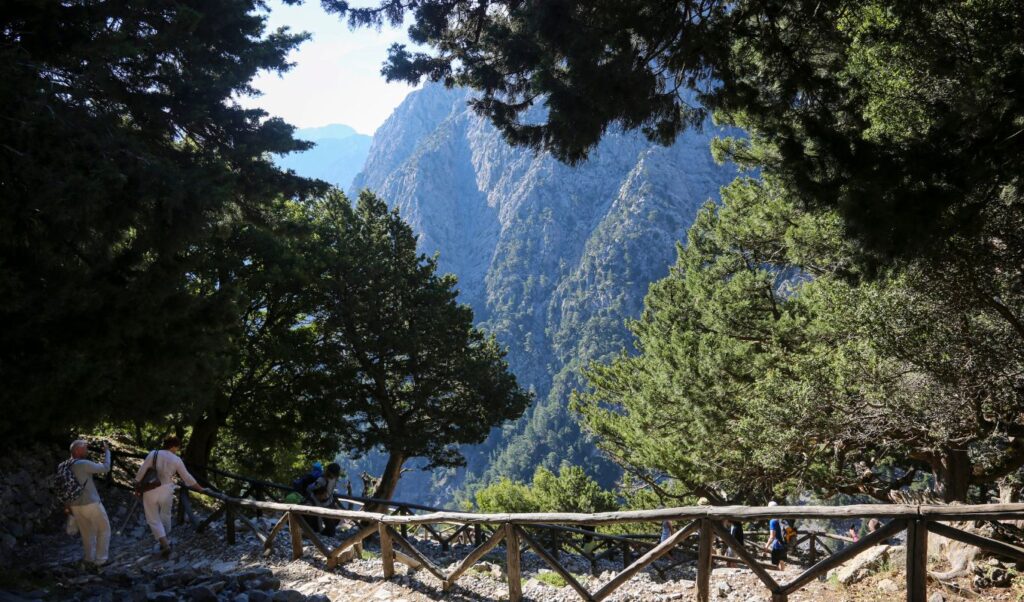
Following the earthquakes, OFYPEKA (the Natural Environment and Climate Change Organization) announced the precautionary closure of the Samaria Gorge. At the time of the tremors, 566 visitors were inside the gorge. Staff responded quickly and calmly: approximately 100 visitors who had reached the 6th kilometer mark were immediately turned back, while the remaining visitors — who were near the settlement of Samaria — are being guided toward the southern exit at Agia Roumeli by National Park personnel.
Seismologist Efthymis Lekkas reassures public: Both earthquakes on the same fault
Speaking to Flashnews.gr about the earthquakes, seismologist Efthymis Lekkas stated: “The two earthquakes that occurred close to Gavdos were strongly felt on the island and in parts of Crete. They are on the same fault. But because they occurred offshore, I don’t think there is any particular cause for concern. So far, no impact from the earthquakes has been recorded. The second earthquake was particularly noticeable in Crete, but beyond that, there is nothing unusual. As things stand, there is no reason for alarm.”
Gerasimos Papadopoulos: Too early to tell whether the 5.3-magnitude quake was the main event
“It is too early to determine whether this was the main earthquake,” seismologist Gerasimos Papadopoulos wrote in a post regarding the successive tremors of 4.6 and 5.3 magnitude that struck off the coast of Gavdos on Saturday morning (20/06). His assessment focused specifically on the 5.3-magnitude quake, noting that the area falls within the central section of the Greek seismic arc and carries significant seismic potential.
Gerasimos Papadopoulos’ full post
A strong shallow earthquake of preliminary magnitude M=5.3 occurred in the sea area east of Gavdos a short time ago. It was preceded by a strong foreshock of M4.6. It is too early to determine whether this was the main earthquake. The area lies within the central section of the Greek seismic arc and has significant seismic potential. On May 14, 1959, a powerful M6.3 earthquake struck slightly further to the east — and it too was preceded by a strong foreshock (M4.9) just minutes before.
Athanasios Ganas: Precautionary inspections recommended for older buildings in Gavdos, Sfakia, and southern Rethymno
“The second tremor, measuring 5.3 on the Richter scale, was the stronger of the two — and for this reason, precautionary inspections should be carried out on older buildings in Gavdos, Sfakia, and the areas of southern Rethymno,” Athanasios Ganas, Director of Research at the Geodynamic Institute, told ERTnews. Speaking on the current affairs program about the two strong tremors near Gavdos, he confirmed that both occurred on the same fault and measured 4.7 and 5.3 on the Richter scale respectively.
“At this point, we have no reports of damage or injuries — the recommendation for inspections is purely precautionary,” he told ERTnews. “We had two seismic events east of Gavdos. The first earthquake occurred at 12:31 Greek time and measured 4.7 on the Richter scale. Six minutes later, the 5.3-magnitude earthquake followed, occurring on the same fault,” he noted.
Both tremors on the same fault and epicenter — “We cannot say with certainty that the 5.3-magnitude quake was the main earthquake”
When asked about the epicenter of the seismic events, Ganas confirmed that both originated from the same fault and the same epicenter, with a focal depth estimated at approximately 15 km — placing them in the category of relatively shallow earthquakes.
“Near Gavdos, there are active faults capable of producing earthquakes of this magnitude. The major Ptolemy Trough fault lies approximately 25 kilometers to the south,” he noted. When asked whether there had been any prior warning signs, he stated that the previous week had shown no indications of increased seismic activity in the Gavdos area.
As for whether a larger earthquake could follow, Ganas was cautious: “We cannot yet say with certainty that the 5.3-magnitude earthquake was the main event. We need more data.” However, he sought to reassure residents, emphasizing that “earthquakes of similar magnitude have been recorded in this area before. Magnitudes around 5 on the Richter scale are not unusual for this particular region and are not cause for alarm.”