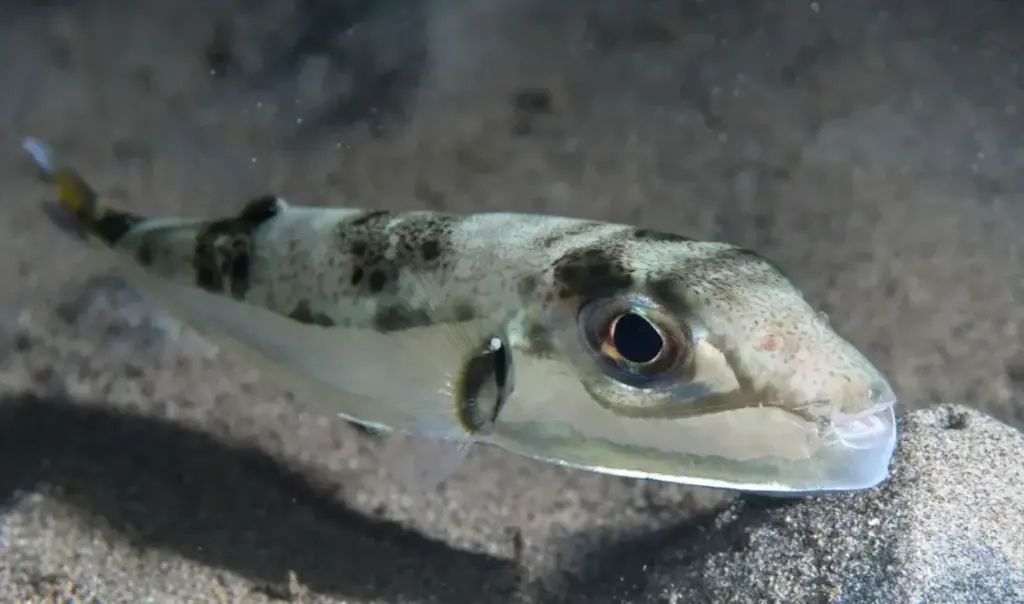
Recent publications and social media posts have sparked growing concern about the pufferfish, the toxic fish that has been established in Greek waters for years. Reports of attacks on swimmers, videos circulating online, and warnings about its presence have led many people to question whether it is safe to swim in Greek waters.
Read: What to do if you are injured by a pufferfish: Athanasia Zaga explains on Parapolitika 90.1 (Audio)
However, according to Paraskevi Karachle, Director of Research at the Institute of Marine Biological Resources and Inland Waters of HCMR (Hellenic Centre for Marine Research), the public debate surrounding the species has taken on proportions that do not reflect the available scientific evidence. “A panic has been created for no reason,” she told parapolitika.gr, explaining that the recorded cases of attacks or poisonings are extremely few.
She notes that scientists from Eastern Mediterranean countries searched for data on pufferfish-related incidents, without finding a picture that would justify the current level of concern.
“In 2024, a scientific paper was published by a team of researchers from the Eastern Mediterranean, which attempted to gather data on attacks, poisonings, and deaths from pufferfish consumption. There is no official recording system either in Greece or in other countries, and the cases identified were very, very few,” Ms. Karachle clarifies.
In fact, she recently reached out again to scientists from other countries in the region to determine whether similar concerns were being observed. “Everyone I contacted, without exception, told me that no attack incidents have been recorded in their countries. Only a very small number of injury cases involving professional fishermen during the process of removing fish from nets.”
Pufferfish: who do they actually pose a threat to?
According to Ms. Karachle, the greatest threat associated with the pufferfish does not concern swimmers, but rather the marine environment and professional fishermen. “The most significant impacts of the pufferfish relate to biodiversity and fisheries. It is an invasive species that affects ecosystems. At the same time, it causes enormous problems for coastal fishermen, particularly in Crete and the Dodecanese, but now also in areas of the Eastern Peloponnese.”
As she explains, the fish destroy nets, eat catches, and cause significant financial losses. “There are cases where brand-new nets have been completely destroyed. Fishermen lose bait, longlines, and catches, while in several areas they report a noticeable decline in octopus populations. According to research, the annual cost for a small-scale fisherman can reach up to €8,500.”
Why should pufferfish never be eaten?
The scientist emphasizes that the greatest danger to humans comes from consuming the fish. “The pufferfish is extremely toxic. It contains the neurotoxin tetrodotoxin, which can cause paralysis and, in severe cases, death within 24 hours. That is why it is very important for people to know that you should never eat a fish unless you are absolutely certain of its identity and safety.”
Where is the pufferfish found in Greece?
The largest pufferfish populations are recorded in Crete and the Dodecanese, though in recent years their presence has expanded significantly. “We are seeing more and more sightings in the Saronic Gulf, in the Eastern Peloponnese, and in other areas. There are even sporadic appearances in Northern Greece and the Ionian Sea.”
“The fish does not come to bite you”
Addressing the reports of attacks on swimmers, Ms. Karachle makes it clear that such incidents are rare and are usually linked to human interference. “The fish does not come to bite you. It swims in its natural environment. There are some videos where swimmers try to catch it or pet it, and then it reacts. It is not the fish’s fault. We should not disturb or feed wildlife.”
She also recalls an incident in Rhodes, where tourists were feeding pufferfish on a beach. “The sea is nature. We have associated it with carefree relaxation, but it remains a natural environment. Like any animal, a fish can defend itself when it feels threatened.”
Is its bite venomous?
Contrary to what many people believe, the pufferfish’s bite is not venomous. “The toxin is found in the fish’s organs, not in its teeth. Its bite does not transmit poison. However, because it has very powerful teeth, it can cause serious injury.”
In closing, Ms. Karachle stresses that there is no reason for swimmers to panic, as long as basic rules of behavior toward wildlife are observed. “I cannot rule out that an incident may occur, just as no one can rule out being stung by a jellyfish. But the chances are extremely small.”