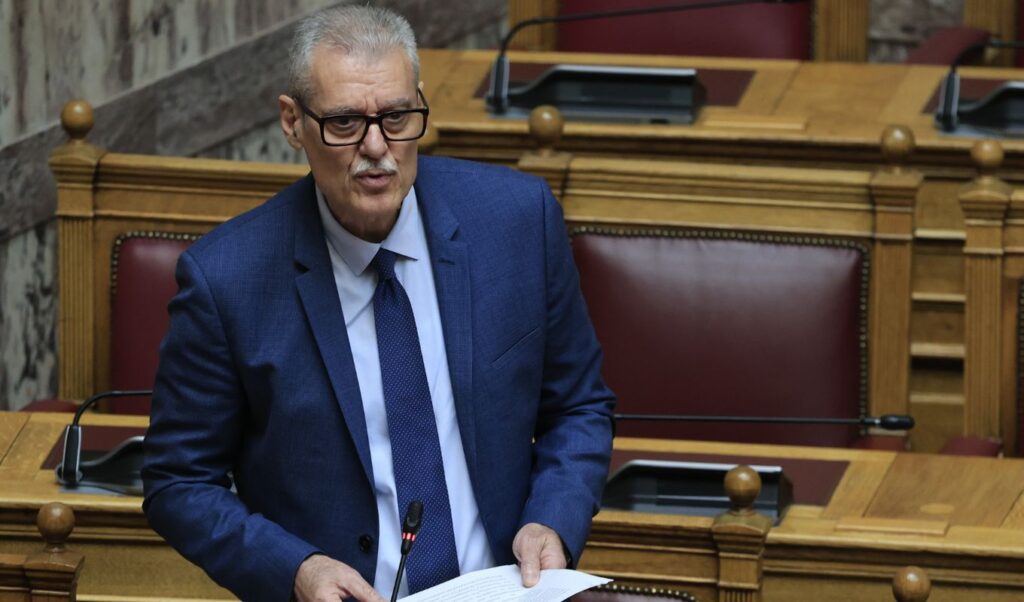
Greece’s Minister of Climate Crisis and Civil Protection, Evangelos Tournas, outlines the country’s defenses heading into a hot summer, addressing the growing threat of wildfires and revealing the new framework for compensating victims of natural disasters in an exclusive interview with Parapolitika.
Temperatures are already unusually high for June, and the UN is warning of an El Niño phenomenon this year with serious consequences. Is Greece ready to meet these new challenges when it comes to wildfires?
The climate crisis has fundamentally changed the dynamics of wildfires. High temperatures, drought, and strong winds are creating increasingly difficult conditions, and this year we’re also dealing with a higher fuel load due to the abundant vegetation spurred by the heavy rainfall of recent months. Faced with this new reality, we have focused on prevention and strengthening our response mechanisms. In terms of the Fire Service’s capabilities, by the end of 2026 we will have 18,804 firefighters, approximately 80 aerial assets operating daily — depending on daily availability — 108 surveillance drones operating around the clock, and 21 Special Forest Operations Units — known as “forest commandos” — deployed across the country. Extensive clearance operations are also continuing through the “Antinero” program and local municipalities. However, the biggest challenge in major crises is the dispersal of forces. No mechanism can respond with equal effectiveness when multiple large fires break out simultaneously in different regions. That is why we place particular emphasis on prevention and reducing the number of fire ignitions, in order to build greater resilience.
How many plots of land have been cleared based on the declarations submitted? Could the branches and debris left over from clearances create new potential ignition points?
The deadline for clearing and declaring plots of land was extended to June 22nd, in line with the recommendation of the Risk Assessment Committee, giving citizens additional time to fulfill this critical prevention obligation. To date, 520,000 clearance declarations have been submitted, and our goal is to increase that number further. The importance of these clearances cannot be overstated. In practice, we see that where plots are cleared, fires slow down or stop altogether, while in areas that remain uncleared, fires spread far more rapidly. Clearance is not a bureaucratic formality — it is an essential measure for protecting lives, property, and the natural environment. Of course, the debris resulting from clearances must be properly removed and managed. The goal is to reduce fuel load, not simply relocate it.
520,000 clearance declarations have been submitted to date, and our goal is to increase that number further. The importance of clearances is decisive.
You have announced a digital State Aid hub. What will change in the way compensation is calculated for disaster victims?
The digital State Aid hub will fundamentally transform the way the government manages compensation following a natural disaster. A unified digital environment will be created, where the necessary data will be drawn automatically through interoperability with public information systems. This means faster processes, less bureaucracy, greater transparency, and better service for citizens. At the same time, eligible beneficiaries will be able to track the progress of their application in real time, along with the next steps until the aid payment is made.
What is the plan for expanding the aerial firefighting fleet? When will the new Canadair aircraft arrive?
Expanding the aerial firefighting fleet is a core pillar of the “AEGIS” program and forms part of a long-term plan to renew and upgrade the country’s aerial assets. We are increasing the number of state-owned aircraft that are permanently integrated into the Fire Service’s operational planning, boosting its autonomy and operational readiness. We have already received three new Intelligence, Surveillance, and Reconnaissance (ISR) aircraft, and three new Leonardo AW139 helicopters have also arrived for coordination, search and rescue, personnel transport, and medical evacuation missions. In addition, the procurement of eight new Super Puma helicopters is moving forward, with the first deliveries set to begin in 2026, while two existing aircraft are also being upgraded. Regarding the Canadair fleet specifically, seven new DHC-515 aircraft are scheduled for delivery between 2028 and 2031, with Greece set to be the first country in the world to receive this new-generation aircraft. We are also implementing a modernization program for the seven existing CL-415s, further strengthening the country’s aerial firefighting capabilities. Today, Greece operates one of the largest aerial firefighting fleets in the world — a reflection of the importance we place on protecting human lives, property, and the natural environment. Our goal is a modern, reliable, and continuously renewed fleet that can meet the demands of the climate crisis and the ever-growing operational needs we face.
Is the pre-earthquake inspection program for buildings progressing? What are the results so far?
The pre-earthquake inspection of public buildings is one of the most significant prevention initiatives we are implementing to strengthen the resilience of the country’s infrastructure. To date, pre-earthquake inspections have been completed on 22,698 buildings, surpassing the program’s original target. These inspections cover more than 42,000 individual building sections and structures that were assessed separately by engineers. In addition, 2,793 sports facilities have been inspected, with more than 12,000 individual structures examined — including grandstands, canopies, and lighting pylons. For the first time, we have a comprehensive picture of the condition of thousands of public buildings and facilities across the country. This allows us to move forward in a targeted manner with the next rounds of inspections and necessary interventions, guided by the safety of citizens.
On a personal note — are you considering running as a parliamentary candidate for New Democracy in the upcoming elections?
No, I will not be a candidate. My priority is the work ahead of us at the Ministry of Climate Crisis and Civil Protection, and the successful management of a particularly demanding wildfire season. Citizens expect results, readiness, and accountability from us. That is where I am fully focused, and that is where my complete attention lies.
Published in Parapolitika