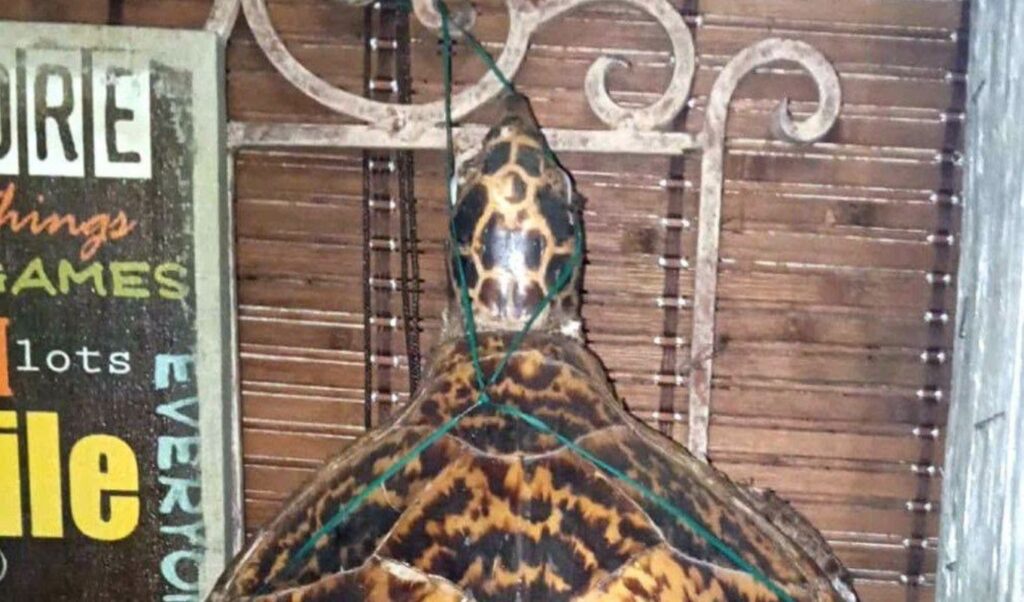
An shocking discovery has come to light after a visitor to Paros found a dead sea turtle hanging outside the door of a private home, apparently used as a “decoration.” Greek Police seized the animal and criminal charges were filed against the homeowner, as legislation strictly prohibits the possession, trade, or transport of protected wildlife species — including parts of their bodies. What makes this case even more alarming is that the turtle was identified as a Hawksbill sea turtle (Eretmochelys imbricata), one of the rarest species in the world, recorded only a handful of times in the Mediterranean and classified as “Critically Endangered.”
Read also: Crete: Sea turtle bites tourist — images of her injured foot go viral
How the incident unfolded on Paros
The incident was brought to public attention through a Facebook post by the NGO Naxos Island Wildlife Protection. The organization shared the following account: “An incident that left us truly speechless occurred on Paros.
A visitor to the island informed us that a local resident had hung a dead sea turtle outside their front door. When we received the photographs, we struggled to believe what we were seeing: not only had someone considered a dead animal a suitable ‘decoration,’ but the turtle in question was a Hawksbill (Eretmochelys imbricata) — one of the rarest species on the planet, recorded only a handful of times in the Mediterranean and listed as Critically Endangered.
Police were notified immediately, responded to the scene, seized the turtle, and summoned the homeowner for questioning. The man initially told officers he had found it on a beach on Paros, then later claimed it had been given to him by a person who has since passed away. However, according to witness accounts, the turtle had been hanging at the entrance of his home for a considerable period of time — raising the obvious question of why no competent authority had been informed sooner.
Criminal charges have been filed in connection with the case, as the law explicitly prohibits the possession, trade, distribution, or transport of protected wild fauna species — including any parts thereof. Possessing such species cannot be considered normal or acceptable under any circumstances. Turning a rare, protected animal into a “display piece” is not only morally reprehensible — it is illegal. We hope that the investigation will shed light on all aspects of this case and help raise public awareness, so that similar incidents do not go unnoticed.”