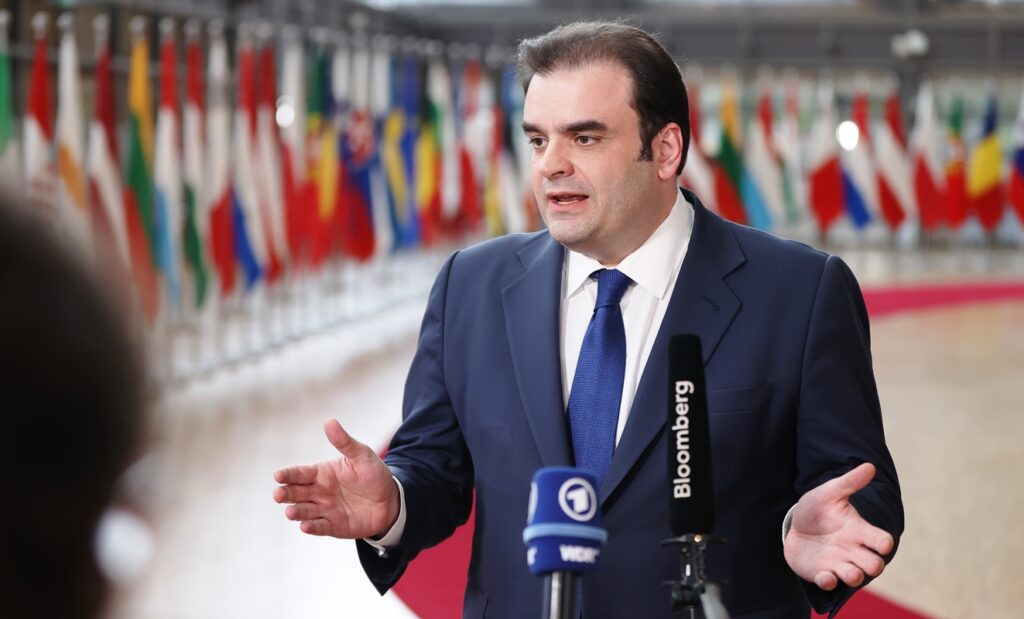
A strong message in favor of a stronger European Union was delivered from Berlin by Kyriakos Pierrakakis. Speaking about the future of Europe, the Minister of National Economy and Finance and President of the Eurogroup stressed the need to reduce barriers between member states so that the EU can better unlock its growth potential. He also noted that “the cost of ‘Non-Europe’ is higher,” highlighted technology as a key pillar of any modern policy, and — referring to Greece’s “success story” — emphasized that “reforms deliver results.” He also sent a clear message about Berlin’s role in the European project, stating that “the European Union needs Germany, and Germany needs the European Union.”
Read also: EU “bridges” to Canada: The European Parliament opens an office in Ottawa
Kyriakos Pierrakakis: “The cost of ‘Non-Europe’ is higher”
Speaking at an event co-organized by the Hertie School in Berlin and the Jacques Delors Foundation, titled “Where will Europe’s future growth come from?”, the minister underlined the need to unlock the EU’s growth potential and overcome the national constraints that continue to surface in critical sectors. “We agreed that it would help Europe if we achieved greater scale and removed barriers. But at some point in the individual policy discussions — whether on energy, banking, or capital markets — a ‘but’ would appear. And that ‘but’ was the national asterisk,” he noted. While acknowledging that national concerns are legitimate, he pointed out that shifts in the international environment have also altered the calculations of member states. “There is now a perception that the cost of ‘non-Europe’ is higher,” he said, expressing optimism that progress can be made through the implementation of the recommendations set out in the Draghi and Letta Reports.
The “hidden” barriers in services and manufacturing
Pierrakakis paid particular attention to the Savings and Investments Union and the need for greater harmonization of capital market supervision. To illustrate the scale of the barriers that continue to divide European economies, he cited IMF data: “The IMF has calculated that the barriers between member states in the services sector are equivalent to hidden tariffs of 110%. In manufacturing, the corresponding figure is 44%. Therefore, not having an equivalent level of common supervisory capacity is like having the euro without having a strong ECB.” He further stressed that progress cannot be limited to capital markets alone, but must cover all the issues outlined in the Draghi Report, from the integration of energy markets to telecommunications and technology.
Technology as the common thread across all policies
The Eurogroup President placed particular emphasis on technology, noting that technological developments affect both national budgets and societies at large. “Technology is the foundation in every sector for the 21st century (…) Technology is the central, horizontal, binding element of all policies,” he underlined.
When asked about rising debt levels — for example in France — he responded that the issue concerns him, but does not cause him panic. He referred to conjunctural external factors, such as the crisis in the Strait of Hormuz, which are weighing on the European situation, while also noting the stronger performance of European markets compared to those outside Europe. He further stressed that the institutions created in the aftermath of the euro crisis cannot substitute for national strategies. Fiscal stability, targeted fiscal policies, and growth strategies remain essential, he said, emphasizing that “every euro must count.”
The Greek example and the message to Germany
When asked what a country like Germany could draw from Greece’s “success story,” he made clear that he does not believe one country can teach another — but it can inspire it. Referring to the package of reforms being pursued by Berlin, he stated: “If there is one point of inspiration from Greece, it is that reforms deliver results.” He also argued against the old distinctions between “frugal” and “spendthrift” member states, adding: “We actually have a very strong example of this — the Greek budget.”
Along the same lines, he highlighted the need to address major challenges at a European rather than purely national scale, particularly in the area of investment. “It would not make much sense to talk about, say, a Greek startup investment ecosystem. It would make far more sense to have a pan-European one,” he explained. On the topic of European public goods, he referenced defence and energy, and stressed that savings and innovation must go hand in hand, citing the European Space Agency as an example of effective pan-European cooperation.
“Either you own something or you regulate it”
The Eurogroup chief also argued that the European Union does not need to direct investment into sectors where it lacks a competitive edge, but can instead leverage its regulatory power. Rather than attempting to compete head-on with major corporations — for example from the United States — Europe can assert its sovereignty by setting the rules under which they operate on European soil. “Either you own something or you regulate it,” he said, adding that Europe also has its own strong players, who must be equipped and supported to lead in areas where they hold a comparative advantage.
During his visit to Berlin, Kyriakos Pierrakakis is scheduled to meet with Chancellor Friedrich Merz and Deputy Chancellor and counterpart Lars Klingbeil. The agenda includes the state and outlook of the European economy, challenges to growth and competitiveness, fiscal coordination among Eurozone countries, and the further financial integration of Europe — with a focus on deepening the Banking Union and advancing the Savings and Investments Union.