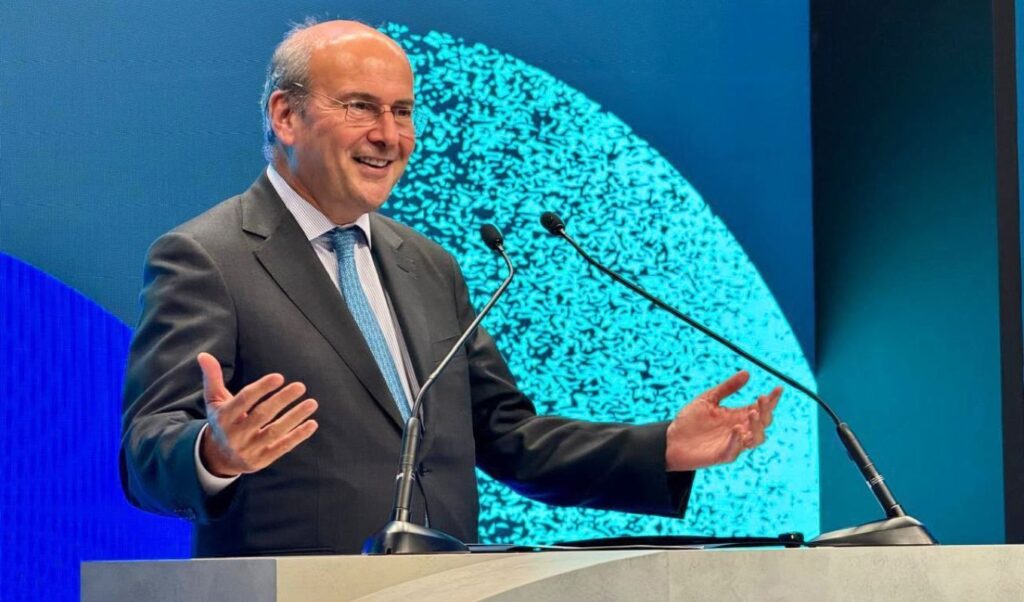
“The Greek stock exchange has turned a new page. Greece is returning to developed markets, joining Europe’s largest exchange group and once again attracting the interest of major international investors.” These were the words of Deputy Prime Minister Kostis Hatzidakis speaking at an event celebrating the 150th anniversary of the Athens Stock Exchange, highlighting two major developments that mark the entry of the Greek capital market into a new era:
- The integration of the Athens Stock Exchange into the Euronext group. “Into the largest European capital market infrastructure: with approximately 1,800 listed companies, a total market capitalization of around €7 trillion, and nearly one third of transparent equity trading in Europe.”
- The return of the Greek market to developed market status by international indices STOXX, S&P Dow Jones Indices and FTSE Russell. “A development that will be formally confirmed on September 21, while the next significant step in MSCI’s market classification process is expected in May 2027.”
“None of this happened because someone decided to do us a favor,” Hatzidakis stressed. “International markets don’t operate on goodwill. They assess data. They see that the Greek economy is growing consistently faster than the European average. They see a country that operates with fiscal discipline, doesn’t spend beyond its means, and has long since regained its investment-grade credit rating. They recognize a government that consistently pursues pro-investment policies. And of course, they are watching the strong performance of the Athens Stock Exchange itself — one of only two markets globally to have recorded positive returns for five consecutive years. That momentum is carrying into 2026, with the General Index up approximately 26.2% so far, average daily trading value rising 51.6% year-on-year, and foreign investors increasing their total trading activity to 70%, up from 64% at the end of 2025.”
The Deputy Prime Minister also noted that total capital raised so far in 2026 stands at €7.9 billion, while cash distributions to shareholders by listed companies remain at historically high levels.
“Returning to developed market status increases Greece’s visibility within the international investment community. It broadens the pool of investors who can allocate capital to Greece. And over time, it could contribute to greater liquidity, a wider investment base and improved valuations,” he said. “This is directly linked to one of the key national goals for the next four years: to increase annual investment in Greece from €45 billion today to €65 billion — surpassing 20% of GDP and reaching the European average. Let’s be clear: European funds have been and remain invaluable. But no economy can base its growth exclusively on EU subsidies.”
He was careful to add: “In citing these figures, I am not attempting to forecast the future trajectory of the stock exchange, nor — even less so — to make predictions about share prices in the coming period. The government’s job is not to make stock market predictions. It is to create a stable, credible and investment-friendly environment.” He also recalled the initiatives the government has taken in recent years to strengthen the Greek capital market, which include:
- Reducing taxation on corporate profits, dividends and capital raising.
- Targeted tax incentives making stock exchange financing more attractive — such as cutting the withholding tax on interest from listed corporate bonds from 15% to 5%, doubling the deduction for expenses related to SME listings, and expanding tax exemptions for investors in the alternative market.
- Modernizing the regulatory framework governing the stock exchange, including the ability to transfer securities from the Main Market to the Alternative Market, and the introduction of shares with multiple voting rights.
- Strengthening the supervisory mechanisms of the Hellenic Capital Market Commission and the Bank of Greece.
“This is the path we will continue to follow in the years ahead — with further incentives for companies to list on the exchange, measures to broaden the participation of Greek savers in capital markets, enhanced financial literacy, and even greater use of new investment and financing tools so that more Greek businesses can fund their growth through the market,” Hatzidakis emphasized.
Turning to the broader European context, the Deputy Prime Minister noted:
European households hold €33 trillion in savings. Yet a large share of this wealth remains trapped in low-yield deposits. At the same time, European businesses with strong ideas struggle to raise the capital they need and are forced to seek financing on the other side of the Atlantic. That is why Greece has consistently and unequivocally supported a genuine Savings and Investments Union. An European economy of 450 million people cannot compete with the United States and China while operating through 27 fragmented capital markets.
“The next step,” Hatzidakis concluded, “is to have more listed companies in sectors where the Greek economy has tradition and competitive advantages. More Greek businesses using the capital market to grow. More Greek citizens participating responsibly and informedly in investment opportunities. And more international capital finding reasons to stay and invest in Greece. Our ambition is for the Athens Stock Exchange to sit at the heart of a Greece that is more productive, more outward-looking and more competitive. A Greece that will not merely seek capital for its growth — but will itself be one of Europe’s most attractive investment destinations.”