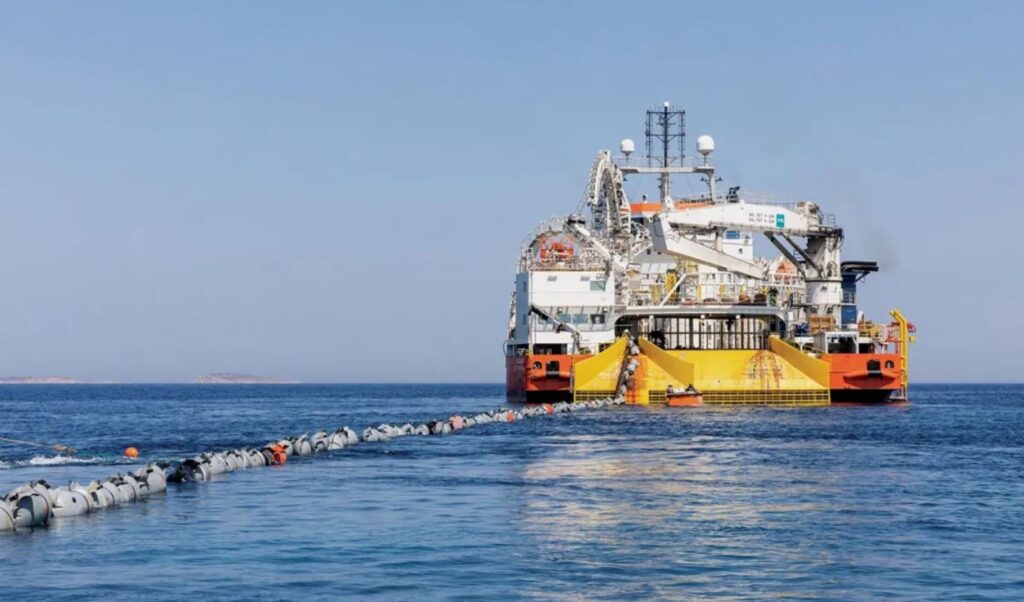
The Great Sea Interconnector (GSI) energy cable project is once again moving toward implementation, following the latest statements by Cypriot President Nikos Christodoulides. Athens and Nicosia are moving in a coordinated manner, with the Cypriot side making it clear that it has no objection to paying IPTO (ADMIE) the annual contribution of €25 million, as soon as the Greek side proceeds with the issuance of a NAVTEX to designate the maritime survey area. According to reliable sources, the decision on the Greek side has already been made, and the issuance of the relevant NAVTEX from the Heraklion naval station is expected possibly within the coming weeks.
The demanding scope of the GSI project and Turkey’s reaction
This is one of the most technically demanding infrastructure projects in the world, as the cable stretches over 1,200 kilometers. The route it will follow passes through Cypriot territorial waters and the demarcated Exclusive Economic Zone (EEZ) between Cyprus and Egypt. From there, it will cross international waters before entering the EEZ demarcated in 2020 between Greece and Egypt, east of Crete. At this point, the route overlaps with the maritime area covered by the illegal and legally void Turkey-Libya maritime memorandum — the basis on which Turkey is objecting — an agreement that holds no standing under international law. It is considered likely that Turkey may attempt to obstruct the survey operations, either through radio interference or physical presence in the field, potentially triggering serious tensions.
AKP spokesperson Ömer Çelik left no room for misinterpretation regarding Turkey’s intentions in his statements yesterday. “In the midst of so much turbulence, what must not happen under any circumstances is the emergence of provocative approaches in the Aegean and Eastern Mediterranean,” he said. Against this backdrop, Turkey’s intention to assert its claimed sovereign rights over the cable-laying area is considered a given. It is quite likely that it will attempt to obstruct operations, either through radio harassment or even physical intervention in the field — a scenario expected to generate significant tension.
Angelos Syrigos: “The chances of reaching a solution through dialogue are extremely slim”
Commenting on Turkey’s stance and Çelik’s statements, Professor of International Law Angelos Syrigos believes there is no room for dialogue between Greece and Turkey on this matter. As he told parapolitika.gr, “it is interesting that Turkey believes it holds rights in the Eastern Mediterranean based on the Turkey-Libya memorandum, which is, on the other hand, entirely illegal. This also illustrates the vast gulf that separates the two sides on many issues, and the extremely slim chances of finding any solution through mutual agreement.”
The role of France and the European Union in the GSI project
A pivotal role in how events unfold is expected to be played by France’s stance and the backing it provides to the French giant Meridian, which has undertaken the execution of the project. It is worth recalling that at the Mitsotakis–Macron meeting in Paris on September 9th, French support in the face of Turkish provocations was agreed upon. Furthermore, the role of the EU, which is co-funding the project, should not be underestimated. For Europe, the project goes beyond providing energy security for Cyprus — it also reflects the EU’s broader ambitions for energy interconnections in the Eastern Mediterranean, as European Energy Commissioner Dan Jørgensen has previously stated. For this reason, the EU has exerted pressure on all parties involved to see the project through to completion.
Haris Tzimitras: Geopolitical importance does not guarantee the GSI’s viability
Despite the project’s geopolitical momentum, Professor of International Law Haris Tzimitras points out to parapolitika.gr that geopolitical significance does not automatically translate into economic viability. As he argues, “we need to discuss many things — regulatory, economic, national, legal, and of course geopolitical. The geopolitical importance of a project does not automatically mean the project is viable. Viability requires the convergence of a number of factors. It must be technically mature in its design. Financing must be secured. Risk must be manageable. There must be regulatory clarity. There must be documented, clear-cut benefit for the consumer. All of these factors must be present simultaneously for a project to be considered viable. And of course, geopolitical importance and cost are not the same thing.”
Mr. Tzimitras also criticizes the lack of a unified position within the Cypriot government: “I don’t think Nicosia has yet sent a clear message. In the Cypriot press, I read that there is currently a four-way divergence among the various actors. The President of the Republic is broadly reassuring that the project will be implemented, without however taking a clear stance on the terms of financing. At the same time, we have the Finance Minister, Mr. Keravnos, who has frozen payments to IPTO until he is convinced of the project’s viability, and the Energy Minister who supports the project but acknowledges that from an economic standpoint it will not reduce the electricity bill — it will in fact increase it,” he notes pointedly.
Despite the reservations he expresses, Mr. Tzimitras comes out in favor of the project’s implementation, noting that the interconnection is considered of existential importance for the island, as Cyprus remains the last non-interconnected EU member state, enduring serious energy isolation.