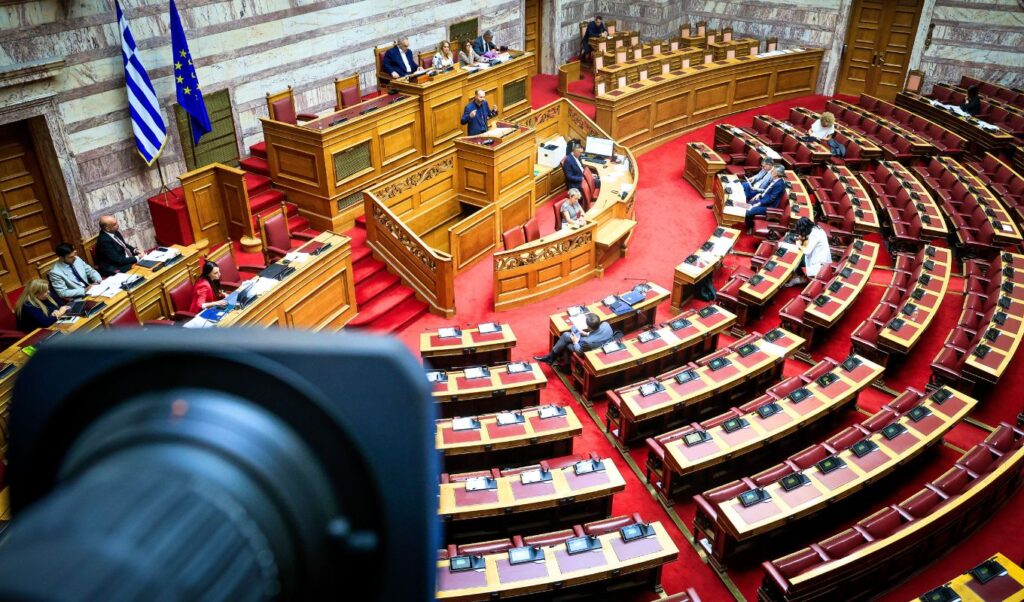
The government and opposition are gearing up for their first major parliamentary showdown since the resumption of parliamentary session, with constitutional revision taking center stage. Wednesday’s vote will mark the second — and final — battle for the current parliament, as the next parliament to emerge after elections will be the one responsible for enacting the actual revisions. The debate will take place at party leaders’ level, with the Prime Minister scheduled to take the floor on Wednesday afternoon, followed by opposition leader Nikos Androulakis and the heads of the remaining opposition parties. This first major debate since the Thessaloniki International Fair (TIF) is widely expected to revolve around the government’s announcements, PASOK’s own policy proposals, and the statements made by government spokesperson Pavlos Marinakis — an issue the opposition has been quick to seize upon.
Read: “Constitutional Revision: For future generations, not future elections” — Article by Sevi Voloudaki
Constitutional revision: PASOK’s symbolic vote and the opposition’s stance
It is worth recalling that the first vote, held in late July, made clear there is little room for broad consensus, as the ruling New Democracy (ND) party’s proposals were supported only by its own MPs and a handful of independents. Opposition parties had already signaled during committee proceedings that they would not back the ND proposals, while PASOK chose to vote “present” — a symbolic abstention — on those articles it believes warrant revision. Notably, there were also individual departures from the party line, most prominently that of former Foreign Minister and current MP for Chania, Dora Bakoyannis, who voted “present” on the article concerning the government’s proposal to limit the President of the Republic to a single six-year term.
It should be noted that the final say on which provisions will actually be revised lies with the next parliament. In the third and decisive vote, any articles that secured the required majority in the current parliament — at least 151 votes in favor — will need 180 votes to be formally revised. The articles put forward for revision include Article 86, where ND proposes abolishing parliament’s authority to conduct preliminary judicial inquiries; a revision of Article 16 governing education; changes to the selection process for senior judges; the removal of civil servants’ permanent tenure; and the proposal for a single, non-renewable six-year presidential term. On the appointment of senior judges, the proposal includes, among other measures, a promotion process overseen by a special parliamentary committee, free from government interference.