Athens is calling on Libya to enter into direct negotiations over the delimitation of maritime zones, seeking to bring bilateral resolution of outstanding issues back to the forefront — in the wake of the ratification of the Turkey-Libya memorandum by the Libyan House of Representatives. At the same time, the diplomatic confrontation between Greece and Turkey has moved to the United Nations Security Council, while the Greek government is also closely monitoring the stance of Libyan authorities on curbing migrant flows toward Crete.
Read: Gerapetritis’ message on Turkey’s “bargaining” with Egypt: “Maritime zones are not an auction floor”
Mitsotakis to Libya: direct talks on maritime zones must be taken “very, very seriously”
The message to Libya came from Kyriakos Mitsotakis, who, in an interview with Reuters, called on the Libyan side to approach the relevant talks “very, very seriously.” The Prime Minister stressed that Greece and Libya are natural neighbors with opposite coastlines, and that the delimitation of their maritime zones must result from direct negotiations grounded in international law. He also characterized the Turkey-Libya memorandum as “flagrantly illegal, null, and void,” noting that it completely disregards the geographic reality of the Greek islands. He was categorical that energy exploration activities south of Crete will not be called into question on account of Turkish-Libyan claims.
Turkey-Libya memorandum: the Greece-Turkey confrontation peaks at the UN
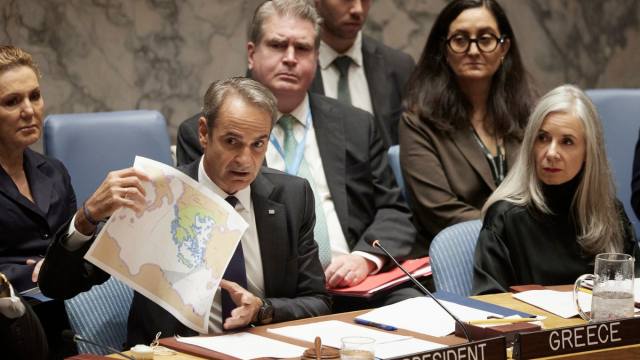
Greek diplomacy is working to keep channels open with both the Tripoli-based government and eastern Libya, despite the latter’s recent shift in position on the memorandum. The House of Representatives’ decision — which until recently opposed the 2019 agreement — creates new dynamics, as it provides Ankara with additional political leverage in advancing its claims in the Eastern Mediterranean. The confrontation reached its peak at the UN Security Council, where Kyriakos Mitsotakis presented a map of the Eastern Mediterranean, highlighting that the Turkish-Libyan delimitation ignores Crete, Rhodes, Karpathos, and Kasos.
Athens responds to Turkey’s claims over the Greek islands
The Prime Minister argued that Turkey and Libya are attempting to draw maritime boundaries as though the Greek islands do not exist, stressing that no bilateral agreement can strip a third state of its sovereign rights. Ankara’s response came from Turkey’s Permanent Representative to the UN, Ahmet Yildiz, who defended the legitimacy of the memorandum. “This Council is not a jurisdictional body for maritime delimitation. A map may illustrate a claim, but it cannot adjudicate it legally,” he stated pointedly. The Turkish diplomat further argued that the agreement concerns only the two signatory states and does not affect the rights of third countries, insisting that disputes must be resolved through dialogue and negotiation.
Joint intervention by six countries and the EU against the Turkey-Libya memorandum
Greece’s Permanent Representative to the UN, Aglaia Balta, responded to Turkey’s arguments, underscoring that the memorandum’s ratification by the Libyan parliament does not alter its illegal nature nor does it produce legal effects against Greece. She also noted that geography cannot be changed, and that agreements between two states may not violate the sovereign rights of third parties. Athens considers significant the joint intervention at the UN by Greece, Cyprus, Egypt, the United Arab Emirates, Bahrain, and the European Union, which collectively rejected the Turkey-Libya memorandum — demonstrating that Greek objections are not merely an isolated bilateral disagreement with Ankara.
Migration: Athens expresses concern over the Libyan coast guard’s stance
Regarding migration flows, the competent minister Thanos Plevris, speaking on Open TV, described Libya as the main entry gateway. According to Minister Plevris, there is operational contact with the Libyan coast guard, including the presence of a Greek coastguard officer and guidance through surveillance systems — however, the Libyan side frequently cites its inability to act due to extensive coastlines, limited resources, and corruption. The Minister of Migration and Asylum voiced Athens’ concern, stating that “any potential abandonment of surveillance by the Libyan coast guard would constitute instrumentalization,” while also emphasizing that in such a scenario, Greece is prepared to impose “an alternative management model” involving suspension of asylum procedures and enhanced border surveillance.
Published in Apogevmatini