A case of fraud that began with citizens donating to save children with cancer and other serious illnesses ultimately unraveled into a complex investigation involving money laundering, luxury living, and match-fixing. Evidence gathered by the Organized Crime Division reveals that behind the dismantling of a six-member criminal organization — for which arrests have already been made — lies a financial network worth millions of euros, with victims being families who were desperately trying to raise money for their children’s medical treatment.
Read also: NGO Fraud: “Paidiki Hara” at the center of the sick children donations and match-fixing scandal — Artists, athletes and businesspeople among donors
According to information from the police investigation, the accused reportedly created a donation-collection mechanism through which a significant portion of the funds never reached the people it was intended for. Instead, authorities believe the money was used for personal expenses, luxury purchases, gambling, and funding football clubs.
NGO: The 92 fundraising campaigns and the millions that never reached sick children
The first group’s activities are estimated to have begun at least as far back as October 2018, when the NGO that was used as a vehicle for collecting funds was established. Through posts on Facebook and Instagram, those involved would present cases of children with serious illnesses, describing their needs for treatments, hospitalization, transportation, temporary housing, and living expenses. They frequently published photographs of the children in an effort to appeal to the public’s compassion.
The organization had built such a level of recognition that its donors included well-known artists, athletes, and businesspeople. These donations were publicly promoted, reinforcing a sense of trustworthiness and attracting new donors. However, the picture that emerged from the police investigation told a very different story.
Officers managed to identify 92 fundraising campaigns for 74 beneficiaries, of whom 55 were positively identified. The investigation was hampered by the fact that a large number of posts had been deleted from social media platforms. To date, evidence and testimonies relating to 34 children have been examined. For these specific cases, it was established that donations totaled €3,940,692, while the families had collectively received approximately €1,111,176.
The difference — amounting to approximately €2,829,516 — represents, according to the police investigation, the estimated illegal proceeds from these specific campaigns. The total amount credited between 2018 and 2026 to the NGO’s bank accounts and to personal accounts belonging to the principal suspect exceeds €5.8 million. This figure does not necessarily include all funds collected in cash at events and collection boxes held across various parts of the country, as the exact amount remains undetermined.
Swapping children’s photos and soliciting donations for already-covered treatments
Particularly striking are the methods allegedly used to deceive donors. According to the findings, in some cases the suspects used different photographs and details for children who had already been the subject of previous fundraising campaigns. Investigators believe this was done to conceal the fact that money had already been collected for the same child on earlier occasions.
In other cases, donations were solicited for medical procedures and hospital care, even though those costs were already covered by public health insurance. Investigators also identified instances where the actual cost of treatment was significantly lower than the amount presented in the fundraising posts.
Furthermore, certain campaigns had publicly announced that a portion of the funds raised would be donated to medical institutions — yet according to the investigation, those transfers never actually took place.
The bank complaint used to block a cancer child’s mother
One of the most disturbing aspects of the case involves the treatment of a mother whose child was battling cancer. The woman had previously worked with the organization to raise funds, but at some point decided to act independently, using her own bank account to collect donations for her child’s needs. According to the police investigation, members of the organization allegedly tried to obstruct her efforts in order to force her back into their operation.
As described by police sources, a deposit was made into her account, followed by a complaint filed with the bank alleging fraud. As a result, the account through which the mother was collecting donations for her child was deactivated. What followed was perhaps the most telling detail of all. The very same individuals allegedly behind the scheme then contacted the mother and offered to help her, concealing their actual role according to investigators. Their goal, authorities believe, was to bring the fundraising back under the organization’s control.
From charitable donations to designer luxury goods
The financial investigation, which was supported by the Anti-Money Laundering Authority, involved the examination of 29 bank accounts and payment accounts held in Greece and abroad. In total, more than 246,000 banking transactions were analyzed in order to map the flow of funds.
Officers established that donations were flowing into both the organization’s accounts and personal accounts via IRIS transfers. From there, according to the findings, significant sums were transferred to other accounts, withdrawn as cash, or funneled into business activities.
At the same time, investigators identified expenditures on luxury accommodation, high-end consumer goods, upscale restaurants, and personal purchases, as well as operating expenses for a food and beverage business linked to key figures in the case.
The lavish lifestyle of one of the principal suspects was, in fact, on open display through his personal social media accounts. According to police assessment, these expenditures could not be justified by the income officially declared to tax authorities.
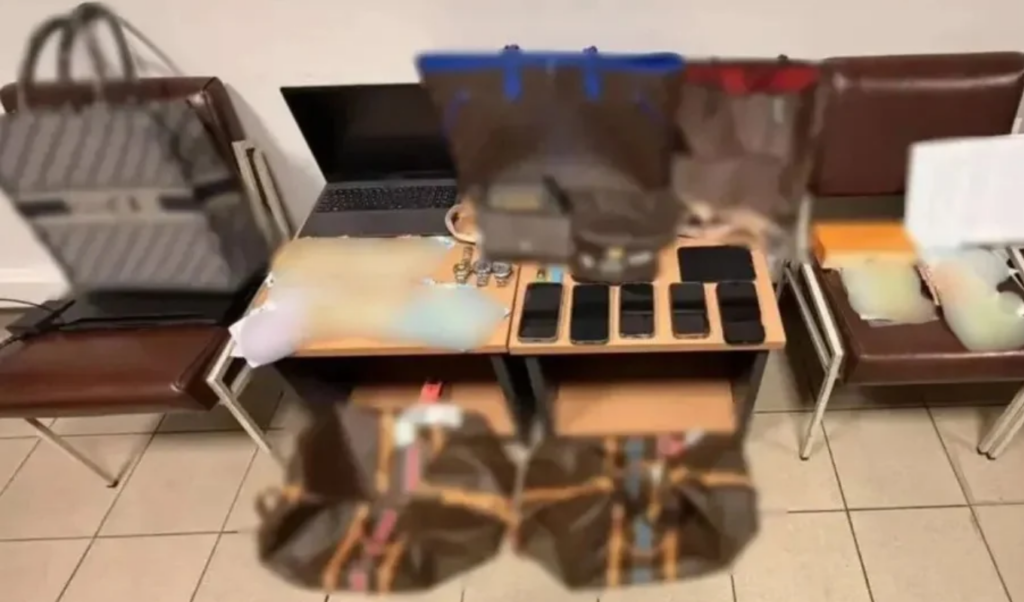
During searches, seized items included, among other things, two vehicles being examined as proceeds of money laundering, seven designer handbags and two luxury wallets, three high-end watches, and €18,330 in cash.
The “fake” divorce and the shell companies
Another unusual detail of the investigation concerns the divorce of two of the principal suspects. According to police assessment, the couple proceeded with a sham divorce shortly before establishing two new companies in April 2026.
Despite the legal dissolution of their marriage, officers found that the two continued to maintain a relationship and were living at the same address. This move is being examined as part of a broader scheme to conceal the real connections between the organization, the individuals managing it, and the businesses through which financial transactions were conducted. The two companies, nominally operating in the fields of advertising and health services, are described in police materials as shell companies.
Through these entities, as well as through a sole trader business, the suspects allegedly issued invoices for transactions that did not correspond to any actual economic activity.
In total, nine fictitious tax documents worth €149,700 were identified. According to investigators, the goal was to make money derived from illegal activities appear as legitimate corporate income.
The €2.6 million deposited into betting accounts
The element connecting the fundraising fraud to football is the suspects’ extensive online sports betting activity. According to the financial analysis, one of the principal suspects had deposited amounts exceeding €2,600,000 into betting accounts, while withdrawals from those same accounts exceeded €2,000,000.
The use of betting companies is being examined by authorities as one of the money laundering methods employed, as funds of questionable origin could be made to appear — after passing through gambling accounts — as legitimate winnings from betting activity. The same individual also allegedly channeled more than €250,000 into funding two football clubs, operating as a behind-the-scenes administrative figure. According to the police investigation, some of these funds were used to pay athletes, technical staff, and suppliers without any official documentation.
Investigators believe that through this activity, the aim was not only to move money outside the banking system, but also to secure social influence within the world of amateur football.
Betting on the defeat of the very team he was bankrolling
One of the most remarkable findings concerns the principal suspect’s prior involvement with a football club in northern Greece. During the period in which he allegedly operated as the club’s shadow financier — when the team was competing in the third division of the national league — officers identified 62 bets placed on the club’s matches. Strikingly, according to the investigation’s findings, several of those bets were placed on the defeat of the very team he was funding, and some of those wagers returned a profit. This activity was among the elements examined as part of the broader investigation into how football clubs and betting accounts were being exploited.
Payments for referee influence and bets on youth matches
The organization’s second group allegedly focused on manipulating football matches, using — according to police — money derived from the first group and the fundraising operation. At the center of this strand of the investigation is an amateur league match in the Pieria region, played in September 2026.
During the inquiry, evidence emerged pointing to a payment of €1,000 made to individuals with the ability to influence refereeing decisions, with the aim of favoring a specific team. In the match under examination, the team reportedly being backed won 2-1, with two penalties awarded in their favor and one opposing player sent off.
Officers also investigated information pointing to a broader agreement involving payments per match in exchange for favorable refereeing decisions. A separate section of the case file concerns an under-19 fixture, in which a principal suspect allegedly placed live bets after receiving advance information about the outcome. He reportedly also passed that information on to associates, encouraging them to place corresponding bets. It should be noted that, based on evidence gathered so far, there is no indication that either of the two under-19 teams was involved in the alleged manipulation.
The investigation continues to determine the true scale of the fraud
The case remains open as investigators work to establish the full extent of the financial damage. Police continue to track down families who were presented as beneficiaries of the fundraising campaigns, in order to verify how much money was collected in their name and how much they actually received.
Particular attention is being paid to funds that may have been collected in cash, as well as to transactions conducted through personal accounts and business structures.
The critical question for investigators is how much of the millions of euros raised in the name of seriously ill children actually reached their families — and how much was diverted for other purposes.
As the findings gathered so far make clear, the financial gap between what was donated and what reached those it was meant for is not measured in thousands of euros. It is measured in millions.