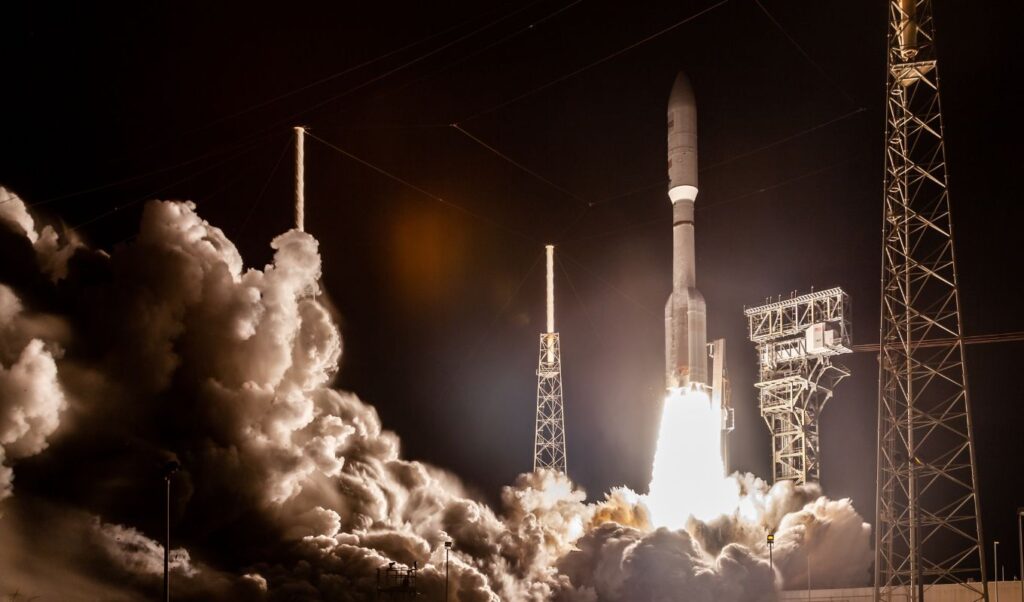
A new arms race — this time with outer space as its battleground — may have been ignited by an official announcement from the United States, which for the first time publicly confirmed what had long been an open secret: that it has a weapon in orbit around Earth. The admission came from U.S. Secretary of the Air Force Troy Meink, speaking at a military conference in Maryland. “Today we continue to ensure we remain ready to meet the challenges of evolving threats, wherever they may exist,” Meink stated, adding: “This is why the United States now has space control weapons on orbit” — with the stated aim of defending American armed forces against “hostile actions.”
Meanwhile, “China is developing and fielding space and counterspace capabilities as part of a military modernization strategy,” according to the U.S. Space Force’s official website, while “Russia views space as a warfighting domain and believes that supremacy in space will be a decisive factor in future conflicts,” according to the same source. Washington has attempted to frame its moves in space as a balancing act. Notably, Space Force was established in 2019 as the first new branch of the U.S. armed forces in more than seven decades. Its original mission was to protect American space infrastructure, including hundreds of satellites used for communications and surveillance.
Read more: The U.S. admitted it has a weapon in space: The first official disclosure and the message to Russia and China
Warnings over Russia and China’s moves
As CNN has noted, American military officials have repeatedly warned that both countries are testing new offensive space capabilities. Examples cited include Russian satellite formation training missions — which Washington says could demonstrate “attack and defense tactics” for future battles — as well as China’s development of a hypersonic fractional orbital bombardment missile capable of carrying nuclear warheads.
As the same U.S. outlet reported in 2024, American intelligence assessments also suggest that Russia has been working to develop a space-based nuclear weapon that would deploy a massive energy burst known as an electromagnetic pulse (EMP), designed to knock out a large portion of commercial and government satellites — an allegation Moscow has denied.
Such a weapon could have sweeping and catastrophic consequences — for example, disabling the satellites the world depends on for weather forecasting and disaster response, or disrupting global navigation systems used for everything from banking and cargo shipping to ride-hailing and emergency dispatch.
Washington’s strategic objective
“Space Force strategy describes ‘space control’ as resulting in space superiority, which they define as the ability to act whenever and wherever they choose, while simultaneously denying that same ability to an adversary,” Victoria Samson, head of the Space Security and Stability program at the Secure World Foundation — a private non-profit focused on military space and security issues — told Al Jazeera. She also highlighted the significance of the terminology shift: “This is the first time an official has acknowledged that a weapon specifically designed for this purpose has been placed in space,” she said. “Until now, it was always referred to as ‘systems with certain capabilities’ — a rather vague reference — without explicitly using the word ‘weapon.'”
What we know about the U.S. space weapon — the focus on “blinding” satellites
The specific capabilities of the weapons the U.S. has placed in orbit remain largely unknown, which is unsurprising given the classified nature of military technology. “Space control encompasses the mission areas required to achieve and maintain space superiority — using kinetic and non-kinetic means to affect adversary capabilities,” the official statement noted. “These capabilities can be used for both offensive and defensive purposes,” it added. Non-kinetic means could include lasers designed to blind satellites, or even electromagnetic and cyber jamming of their data links — reflecting the growing importance of satellites in modern warfare and in everyday life, an importance that cannot be understated.
Experts broadly agree that these weapons are likely space-based communications jammers rather than kinetic weapons designed to physically strike targets. Kinetic weapons — such as a kamikaze satellite designed to collide with an adversary’s satellite — would almost certainly generate dangerous clouds of fast-moving debris in orbit. Bleddyn Bowen, associate professor of astropolitics at the University of Durham in the United Kingdom, told BBC Radio 4’s Today programme: “We don’t know exactly what the mechanism of the weapon is. I would expect it to be some kind of electronic warfare or radio signal jamming platform. It would be a non-destructive type of anti-satellite weapon, and variants of these already exist on the ground.”
“Less likely would be some kind of kinetic kill vehicle — a vehicle that would fire a projectile that would collide with and destroy a satellite,” he added.
The U.S. administration has incorporated space capabilities and interceptor missiles into the planning for the Golden Dome — a missile defense system intended to protect the United States from ballistic missiles and other aerial threats. When announced in May 2025, the project was described as costing $175 billion and aimed at protecting the U.S. “from threats posed by Russia and China.” While the White House initially cited a price tag of $175–185 billion, an official Congressional Budget Office (CBO) report sent shockwaves through Washington, estimating the actual cost could reach or exceed $1.2 trillion over a 20-year period — triggering a fierce political backlash.
Beijing and Moscow’s response to the U.S. announcement
China’s Ministry of Foreign Affairs voiced strong opposition, warning against “turning space into a battlefield and triggering an arms race.” “We urge the U.S. side to stop expanding its military capabilities and preparing for war in space,” said ministry spokesperson Guo Jiakun.
Russia, for its part, called for space to remain “free of all types of weapons.” “We look forward to broad international solidarity to continue efforts toward the complete demilitarization of space,” said Kremlin spokesperson Dmitry Peskov.
An “open secret” — and Germany joins the race
Analysts note that the development of space weapons by Washington, Beijing, and Moscow has long been an open secret. However, they warn that the first public confirmation of this could accelerate an arms race — a concern echoed in Beijing’s official response. In any case, the U.S., China, and Russia are not the only powers maneuvering on the space chessboard.
Other countries are also seeking to develop weapons capable of countering space-based threats. Among them is Germany, which has allocated a €35 billion military space spending program aimed at addressing growing threats from adversaries, according to Reuters.
Major General Michael Traut, head of the German Space Command, has previously stated that under this plan, Germany will direct funding toward intelligence-gathering satellites, sensors, and systems designed to disrupt adversaries’ spacecraft operations. Traut indicated that Germany would not place destructive weapons in orbit that could generate space debris, but stressed that a range of non-kinetic options exist for disrupting hostile satellites — including signal jamming, lasers, and operations targeting ground control stations.
The exercise that sent a message — orbital dogfighting, the future of space warfare, and fears of a Chinese lead
It is hardly a coincidence that just days before the announcement, the United States conducted a large-scale live-fly exercise during the first week of September — an “orbital dogfighting” drill designed to demonstrate dynamic space operations, involving satellites across multiple orbits as well as international and commercial partners. The exercise, named “Apollo Maneuvers,” was the largest of its kind ever conducted by U.S. Space Command, both in terms of the number of spacecraft involved and the complexity of the maneuvers performed, according to a Space Command spokesperson cited by Reuters.
It was the first exercise of this nature carried out by Washington, with the concept of “orbital dogfighting” having been a focus of interest for the U.S. armed forces for years. In military parlance, a “dogfight” refers to close-range aerial combat between fighter aircraft, with two or more pilots testing each other’s flying skill and firepower. In the space context, this translates to “objects in space maneuvering in, out, and around one another in a synchronized and controlled manner,” according to Vice Admiral Michael A. Guetlein, Deputy Chief of Space Operations of the U.S. Space Force. The key concept is clearly coordination — under pressure and in scenarios involving potential weapons fire. The exercise serves as a test that is unlikely to go unnoticed, even as questions arise over whether the U.S. may already be falling behind.
Indeed, Congress — and specifically the House Committee on Appropriations (HAC) — has warned of potential underfunding in this area, suggesting the Pentagon may have lost ground in the race. In the same month the HAC issued its warning, a classified Chinese unmanned spacecraft released a small satellite that orbited a Chinese satellite before returning to the spacecraft. Beijing has also conducted closely synchronized proximity maneuvers that fit squarely within the definition of orbital dogfighting.