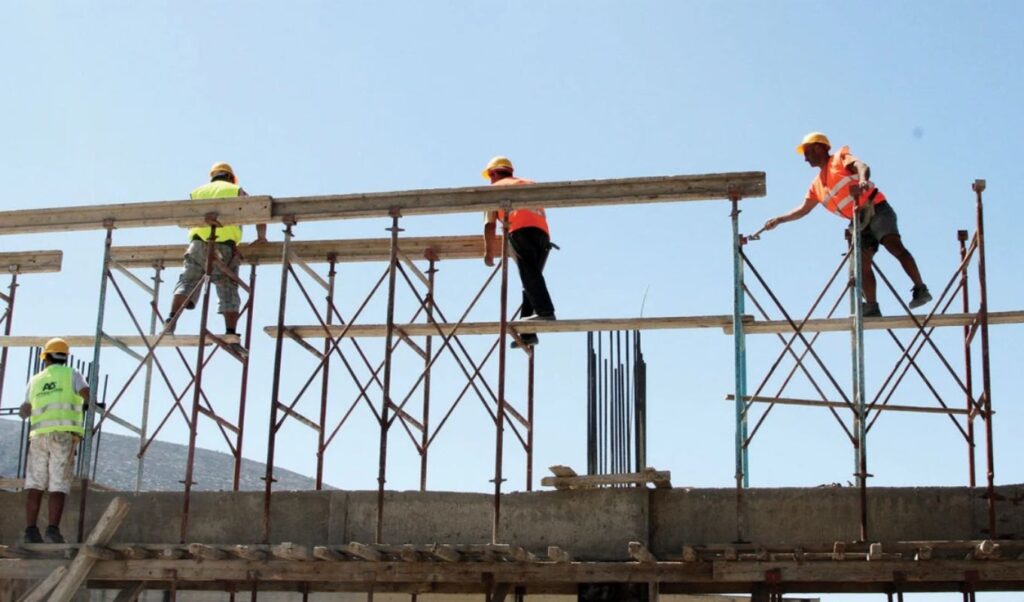
Building your own home in Greece today has become a luxury reserved for those with very deep pockets. Construction material costs have risen by approximately 40% since the inflationary crisis of the post-Covid era, with new price hikes adding even greater pressure on household budgets. Bricks are up 11.6%, copper pipes 10%, concrete 6.2%, plastic pipes 5.2%, aluminium window frames 4.8%, and reinforcing steel 3.4%.
Read also: What’s changing for abandoned settlements — terms, restrictions, and new building goals
How rising material costs impact project budgets
These materials form the backbone of every new construction project, and every price increase inevitably feeds through to the final project budget. The result is a new vicious cycle in the housing market: the more expensive it becomes to build a new home, the higher the price of newly built properties — and that pressure then flows through to older properties and ultimately to rents. According to Mecha Engineering, even a relatively straightforward modern build can exceed €1,400 per square metre, while the average net construction cost is approaching €1,700 per square metre. The push for higher energy efficiency is also driving up upfront costs, as enhanced insulation, heat pumps, advanced window systems, and modern heating solutions all require significant investment.
The cost of building a modern home
For a modern home that complies with the New Building Code and incorporates enhanced energy protection, the base construction cost is estimated at €1,600 to €1,800 per square metre. This category covers standard builds using mid-range materials and typical energy performance, usually rated B+ or A.
For a higher-quality turnkey build, the bar rises to €1,900–€2,300 per square metre. This tier includes superior quality materials, an A+ energy rating, a heat pump, underfloor heating, and advanced window and door systems.
Luxury homes: what the numbers look like
In the luxury residential segment, costs start at €2,500 per square metre and can climb significantly depending on the choices made. Smart home technology, expansive glass facades, exposed concrete finishes, distinctive architectural features, a swimming pool, and premium materials can all send the final budget soaring.
On top of these figures, building permit costs must be added — in 2025 these ranged from €100 to €150 per square metre. This typically covers design fees, permit issuance costs, contributions to public bodies, and the supervising engineer’s fee. Permits are valid for four years.
What it means for the islands
Final construction costs are not the same across the country. Location, the availability of contractors and materials, logistics, and the specific requirements of the plot can all significantly affect the overall budget. On the islands, shipping costs and difficult access can noticeably inflate construction expenses, while the picture looks quite different in Athens, Thessaloniki, and rural areas of the mainland.
The rise in construction costs is adding further strain to a market where demand remains robust. The increase in new-build prices is pulling older properties upward with it, as buyers turn to the secondary market in search of more affordable options.
According to data from Indomio, cited by iefimerida.gr, the average asking sale price for residential property in Greece reached €2,769 per square metre in July — up 5.6% year-on-year and a remarkable 37.8% over the past five years. In Attica, price increases in certain areas are reaching as high as 13.2%. Meanwhile, the national average asking rent has reached €10.70 per square metre, representing a 3.8% annual increase and a 39.5% rise over five years.
The big challenge: unlocking 800,000 empty homes
These developments are also complicating housing policy planning. A key focus is making use of a significant portion of the approximately 800,000 vacant properties across the country — however, much of this stock is located in areas with limited demand (such as rural villages), is old, and requires extensive renovation, energy upgrades, and technical modernisation. And all of that work is made more expensive by the very same surge in material costs.
Originally published in Apogevmatini