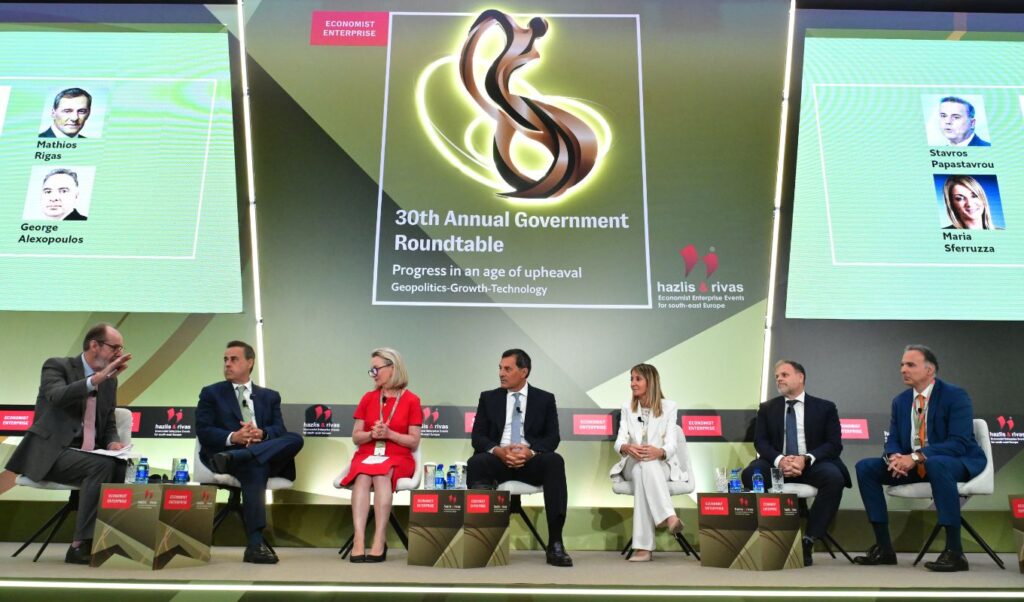
Many insightful positions were put forward during the 30th Government Roundtable with the Greek Government — “Progress in an Age of Turbulence” — as part of the second day of the annual conference organized by the Economist. Leading figures from the fields of energy, technology, and politics analyzed the prospects for green transition, energy security, and digital transformation.
Among the participants on day two of the conference were Frans Timmermans, former Executive Vice-President of the European Commission for the European Green Deal; Nikos Tsafos, Deputy Minister of Energy; Artem Rybchenko, Deputy Minister for Community and Territory Development of Ukraine; Kristian Ruby, Secretary General of Eurelectric; Emmanuel Brutin, Director General of NuclearEurope; Manos Manousakis, President and CEO of the Independent Power Transmission Operator (IPTO/ADMIE); Christina Tarnanidou, Associate Professor of Commercial and Financial Law at the Athens University of Economics and Business and Senior Partner at Sardelas Petsa Law Firm; Andreas Papandreou, Professor at the National and Kapodistrian University of Athens and Co-Chair of SDSN Greece; Jack Hidary, CEO of SandboxAQ; and Armen Sarkissian, former President and former Prime Minister of Armenia.
Frans Timmermans, former Executive Vice-President of the European Commission for the European Green Deal
“We need to cut emissions, deploy more renewable energy sources, and find capital for grid investments. I am not rejecting hydrocarbons, but we must reduce their role,” said Frans Timmermans, former Executive Vice-President of the European Commission for the European Green Deal, before observing that “renewables are cheaper and easier to implement, especially when combined with next-generation nuclear energy.” In that direction, he stated that electricity production must increase while electricity itself must become more affordable, though he acknowledged that “the lack of grids and supply is slowing us down.” He made clear that “we should not be in a position where someone can blackmail us over energy,” before noting that tackling the climate crisis and ensuring energy security are inherently interlinked. He called on Europe to remain committed to its targets and not abandon the Green Deal, while suggesting it could potentially be reframed as a “sovereign deal.” “There is much more to the world than ‘drill baby, drill’,” Timmermans concluded.
Nikos Tsafos, Deputy Minister of Energy
Deputy Minister of Energy Nikos Tsafos provided assurances that Greece has undergone a complete transformation of its energy system, referring to the country’s ongoing effort to phase out coal from its energy mix. As he explained, Greece is now “a net energy exporter — one of the largest in Europe.” He also noted that “the world is turning to sectors where we already have a surplus,” while affirming that the country continues to pursue lignite phase-out, island grid interconnections, decarbonization, electrification of the industrial sector, and building energy efficiency, among other goals. “We believe in a transition that will be cost-effective,” he added. “We want decarbonization, but let’s allow some flexibility in individual targets to reduce the cost of the transition,” he clarified, reiterating that “we need to find a way to decarbonize without losing competitiveness.” A balance must always be struck, he concluded.
Artem Rybchenko, Deputy Minister for Community and Territory Development of Ukraine
Artem Rybchenko, Ukraine’s Deputy Minister for Community and Territory Development, conveyed the message that Ukraine has been navigating a deeply difficult situation for four and a half years, while affirming that “we are becoming stronger every day.” Kyiv, he added, is ready to cooperate with all partners to address energy challenges. Although he acknowledged that managing the energy system has been difficult due to military strikes on energy infrastructure, he expressed the view that “we must find solutions to ensure the supply of energy and heat to Ukrainian citizens.” To that end, he highlighted that Ukraine is actively seeking alternative energy sources that will help the country remain resilient.
Kristian Ruby, Secretary General, Eurelectric
Eurelectric Secretary General Kristian Ruby delivered a clear message: “electrification is the solution,” pointedly stating that more drilling will not change the course of the energy transition. “If we want to move to the next step, we need to replace various energy sources with electricity and expand the supply system,” he made clear, among other points. He specified that renewables can provide large-scale coverage of the energy system, complemented by nuclear power and a small share of hydrocarbons. He also emphasized that electrification must be made attractive for industries as well, drawing particular attention to both the regulatory framework and the broader cultural shift required to achieve this.
Emmanuel Brutin, Director General, NuclearEurope
NuclearEurope Director General Emmanuel Brutin highlighted the importance of both extending the operational life of existing reactors and building new ones through dedicated investment programs, choosing to focus his remarks on nuclear energy’s contribution to the clean energy transition. “With new technology, we can advance the construction of smaller reactors […] New modular connectivity technologies that will meet the needs of industry and data centers,” he noted, among other points. In this way, he continued, the goals of decarbonization, energy supply security, carbon emission reductions, and universal energy access can all be achieved. He also added that investments in nuclear energy bring quality to the entire energy system. Furthermore, he observed that the regulatory framework is improving, that the narrative around nuclear is shifting, and that the European Commission’s stance is evolving — while stressing that all of these developments must ultimately be translated into concrete policies.
Manos Manousakis, President and CEO, Independent Power Transmission Operator (IPTO/ADMIE)
Welcoming the high penetration rate of renewable energy sources and Greece’s growing role as an energy exporter, IPTO/ADMIE President and CEO Manos Manousakis expressed confidence that “we can expect even better news ahead for the decarbonization of Greece’s electricity system.” He stressed that the next step is the broader electrification of the entire economy, citing household heating and industrial energy needs as prime examples. “It is in the country’s best interest,” he stated. Regarding the electrical interconnection of island regions, Manousakis explained that without these links, costs would be significantly higher due to the oil-dependent legacy generating units currently in use. He emphasized that interconnections benefit consumers, tourism, and energy security alike, describing them as an unavoidable path forward. He also revealed that major investment funds are already showing interest in projects that are still in early stages, such as the Greece–Egypt interconnection. Finally, he sent a strong message in favor of broader interconnections between European countries, which he said would strengthen both the EU market and its economy.
Christina Tarnanidou, Associate Professor of Commercial and Financial Law, Athens University of Economics and Business; Senior Partner, Sardelas Petsa Law Firm
The need to leverage modern financial and regulatory tools to shape a resilient and sustainable energy market was at the heart of Christina Tarnanidou’s intervention. The Associate Professor of Commercial and Financial Law at the Athens University of Economics and Business and Senior Partner at Sardelas Petsa Law Firm highlighted the decisive role of innovation, energy financial products, and regulatory maturity in the successful implementation of Europe’s green transition.
In this context, she presented the most significant developments that have shaped the modern European energy market — to which the Greek market is now fully aligned — focusing on:
- wholesale products in organized electricity markets, operating within the framework of EU Market Coupling;
- advanced risk management and transaction clearing processes (EU Clearing Regulations), which enhance market security and reduce systemic risks;
- financial products in both organized and over-the-counter (OTC) markets, which enable participants to effectively hedge their risks (EU Markets in Financial Instruments Regulations);
- as well as modern forms of Power Purchase Agreements (PPAs), which support the development of clean energy, investment security, and long-term market stability. In closing, Tarnanidou underscored that sound legal guidance has become a critical factor in the safe and effective use of modern regulatory and financial instruments.
Andreas Papandreou, Professor, National and Kapodistrian University of Athens; Co-Chair, SDSN Greece
Andreas Papandreou, Professor at the National and Kapodistrian University of Athens and Co-Chair of SDSN Greece, underlined the urgent need for Europe to accelerate its pace of decarbonization and proposed three key areas for intervention. He first focused on infrastructure, noting that effective deployment of renewables requires robust grid networks. He then turned to investors, pointing out that “cheap renewables do not automatically make them attractive for investment.” “Solar energy is cheap, but it’s not attractive to investors […] You need manageable risk and acceptable returns.” Third, he stressed the importance of distributing the costs and benefits of the transition fairly. “People want to share in the benefits of the transition. That means energy democracy,” he said pointedly. “The issue is not just that energy should be cheap, but that it should be affordable at the level the citizen actually pays,” he concluded.
Jack Hidary, CEO, SandboxAQ
AI based on large language models is not sufficient to solve the major challenges in energy, biotechnology, and defense, argued SandboxAQ CEO Jack Hidary, who introduced the concept of “Large Quantitative Models.” As he noted, “we all use AI platforms to handle many tasks,” but the real impact of artificial intelligence lies in “energy storage, medicine, and quantitative models.” He stressed that “we need to create datasets that will help us understand our physical world,” since this is “not a job for LLMs but for quantitative models.”
He explained that “SandboxAQ does not take data from the internet — we use data that has been generated in a laboratory,” leveraging specialized scientific data to develop new materials, batteries, and pharmaceuticals. As an example, he noted that the company can calculate the optimal metal alloy for hypersonic missiles or design new types of drone batteries. He also argued that countries like Greece can generate new intellectual property by applying existing scientific knowledge through SandboxAQ’s models. “We want to work in Greece, to form partnerships, to find collaborators,” he said, noting that the company is interested in cooperating both with the Greek government on defense matters and with universities to develop research programs and doctoral initiatives.
Armen Sarkissian, former President and former Prime Minister of Armenia
“The world has already entered a new era in which the old rules of geopolitics are no longer sufficient to explain international developments,” said former Armenian President and Prime Minister Armen Sarkissian, presenting his theory of “quantum politics.” As he noted, “everyone talks about a world that is changing — we will never go back to the way things were,” adding that “the world is not as we knew it 40 years ago.” Referring to his book, he explained that it describes “13 reasons for change,” emphasizing that “you don’t need to be big to be successful” — what matters is having a “smart, intelligent state.”
He made particular reference to the collapse of communism and Fukuyama’s theory, remarking that Fukuyama “was wrong to speak of the end of history” and that “it was actually the beginning of a new history — one that keeps changing, and changing fast.” He connected this transition to the birth of quantum mechanics, arguing that modern politics must be understood in entirely different terms. He further observed that “we