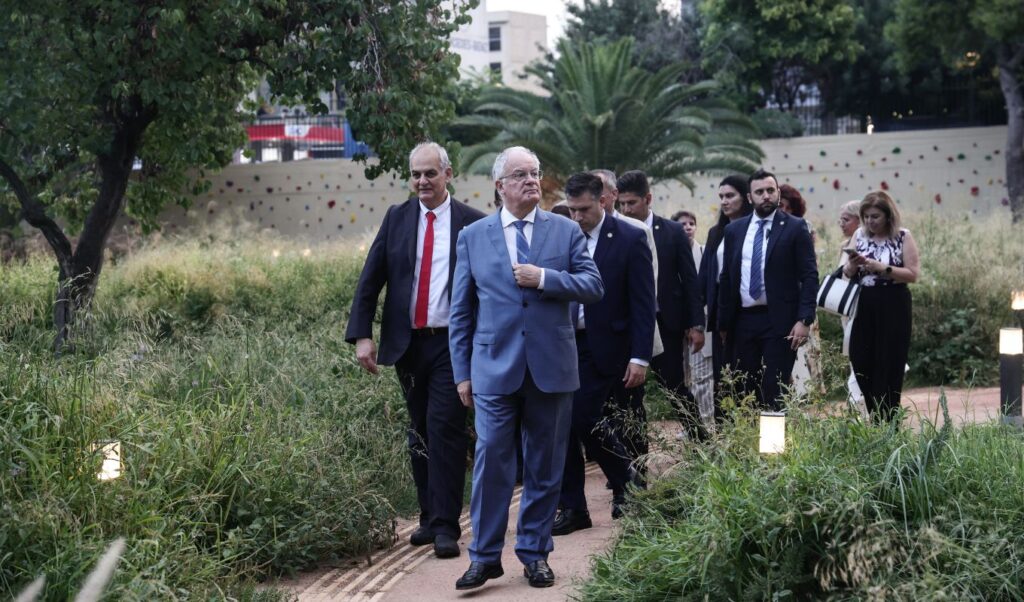
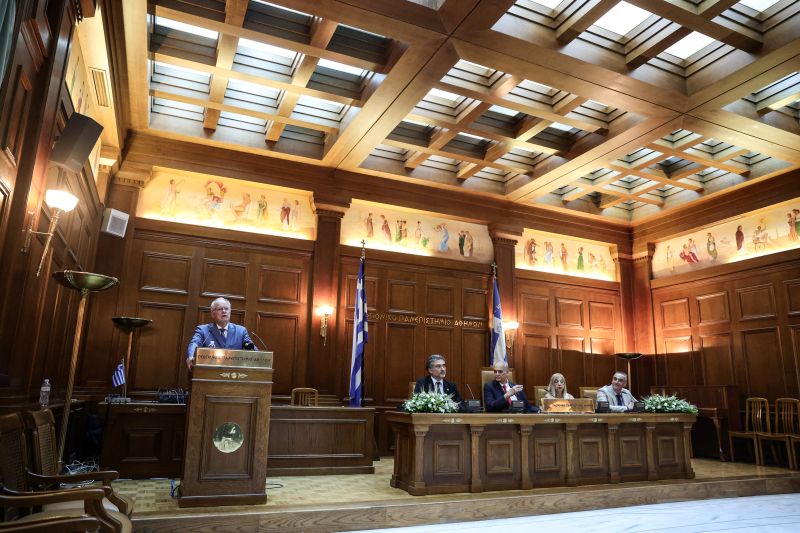
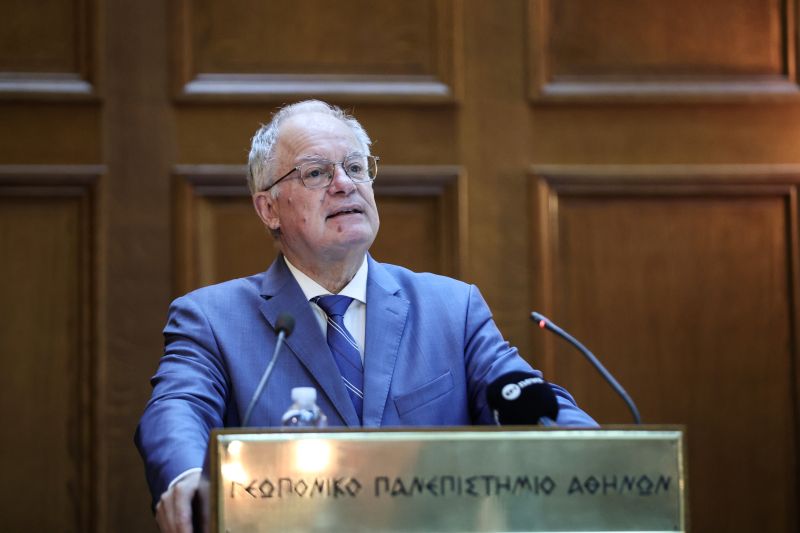
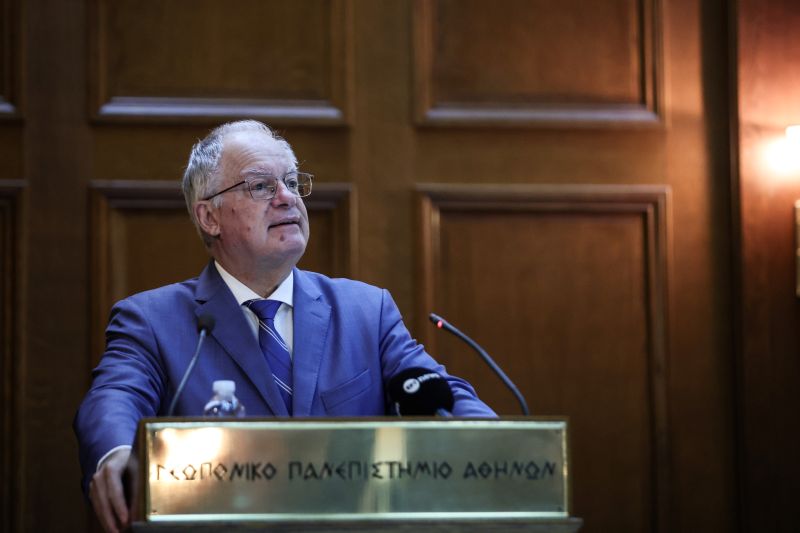
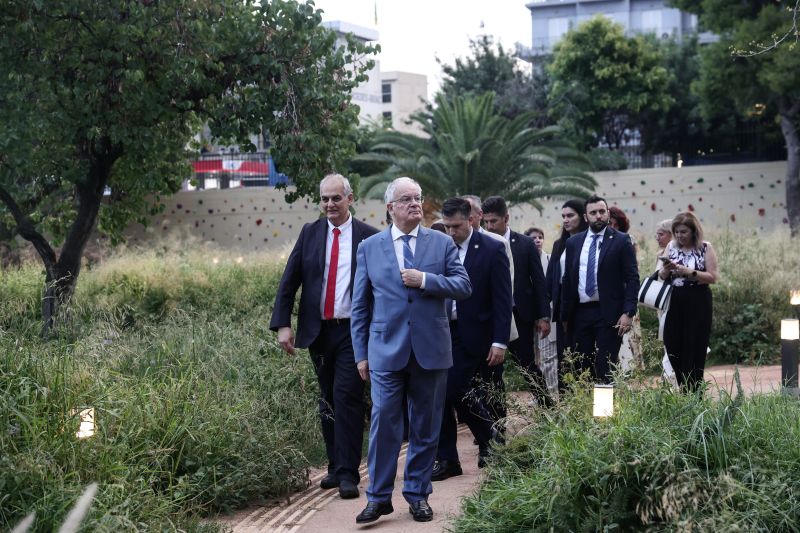
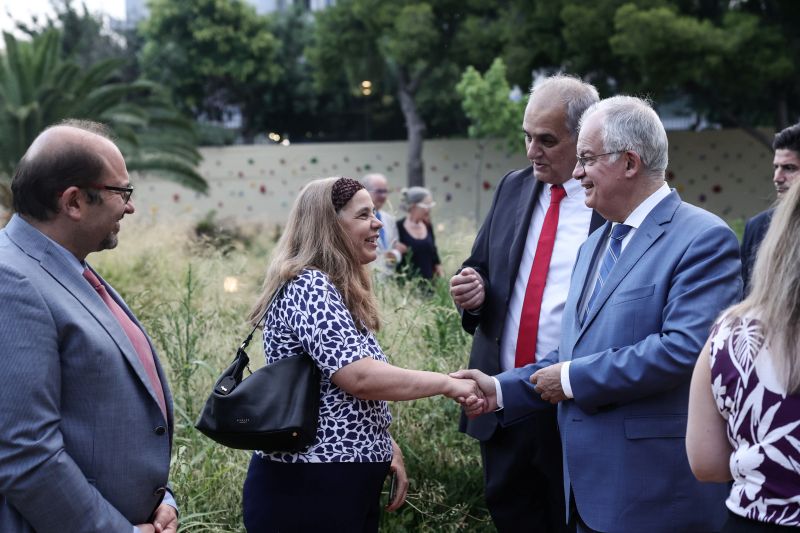
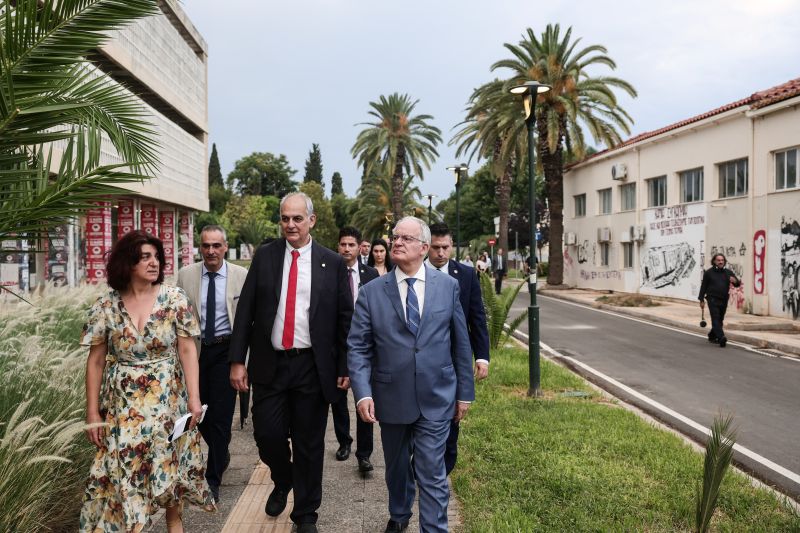
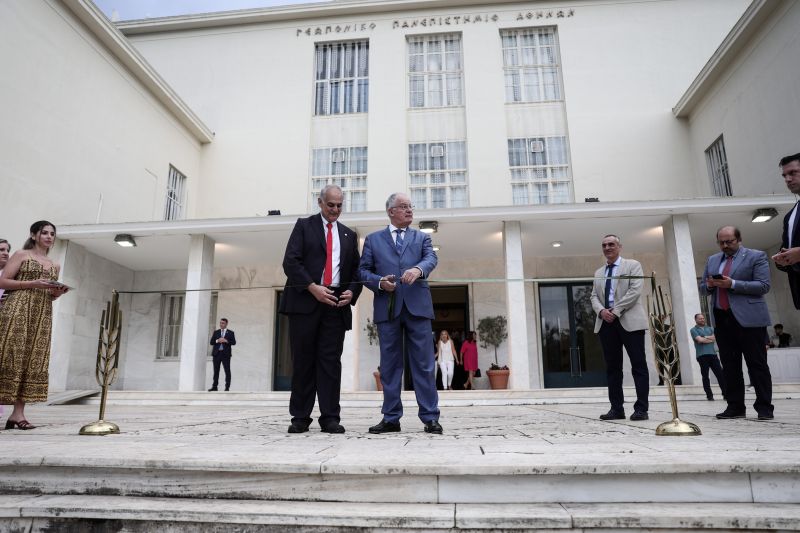
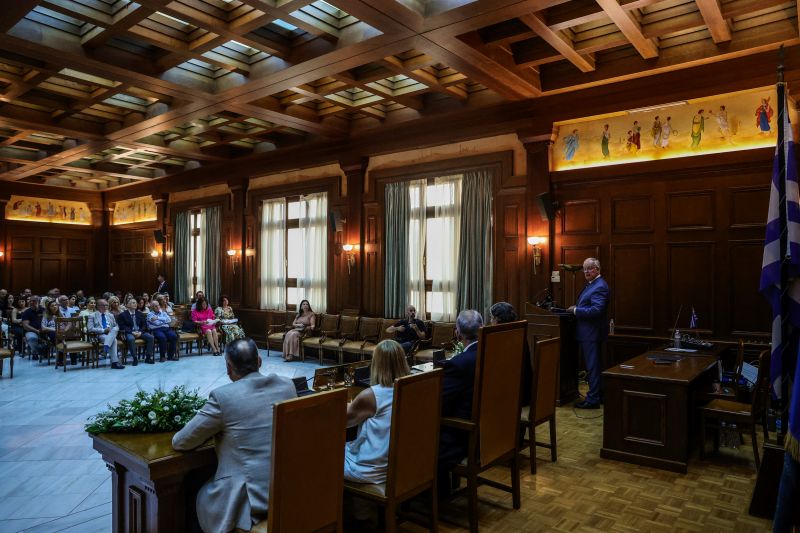
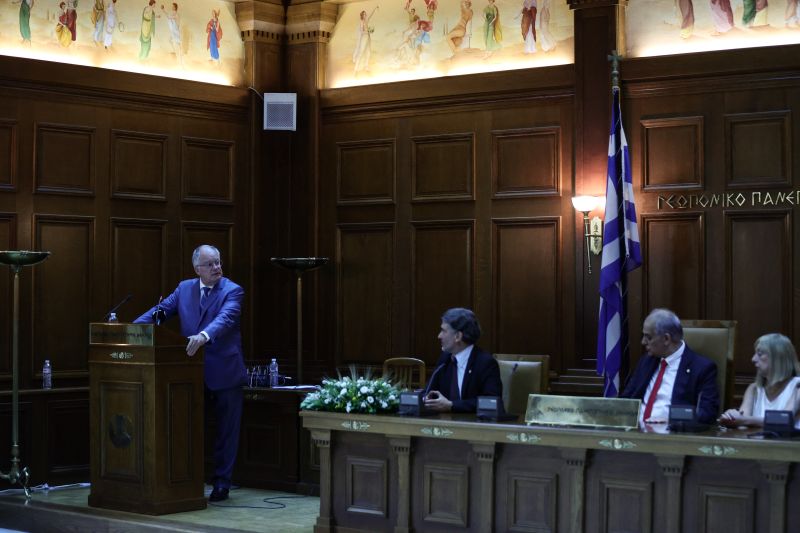
The “Green Walk” at the Agricultural University of Athens was inaugurated by Konstantinos Tasoulas on the evening of Thursday, July 9. “Here, in the gardens of this century-old Agricultural University, where I find myself thanks to your kind invitation, dear Rector, the visitor feels the realization of Aristotle’s maxim: “Nature makes nothing incomplete, and nothing in vain.” We stand on an ideal, multifunctional farm with extensive agricultural facilities, an arboretum, vineyards, experimental fields, ornamental plant gardens, greenhouses, cattle and sheep pens, a poultry yard, a dairy, and an aquarium — in one of the few places where the city remembers that it was once nature,” he said poetically.
Read also: Presidential Palace: Konstantinos Tasoulas climbed to the roof to inspect maintenance works up close
Tasoulas: “A little Eden”
The President of the Republic continued in the same spirit. “Walking through this little Eden,” he added, “where the elemental bond between humanity and the earth is etched into the urban fabric alongside technological progress, one witnesses the living journey of an institution that shaped Greek agricultural science, rural education, and agricultural policy. It is as if the paths, the trees, and the plants here form a unique archive — one that stores not only the past but also charts the future.”
The President also noted that “here, on the edges of the Sacred Way, along which the procession of the Eleusinian Mysteries once passed on its way to the sanctuary of Demeter — goddess of agriculture and the harvest, and of the link between the upper world and the underworld — the visitor recalls the history of Greek farming and marvels at the achievements of modern research. Within the lush environment of the University’s gardens, one is reminded of the words Xenophon puts in the mouth of Socrates in his Oeconomicus: ‘Well said was he who declared that agriculture is the mother and nurse of all other arts. For when agriculture flourishes, all other crafts prosper as well… both on land and at sea.'”
“Something primordial breathes here”
Mr. Tasoulas then described the “Green Walk” as a “significant upgrading project that showcases the agricultural university campus and reminds us that sustainability is an everyday act. It is the care of the soil, the understanding of life’s cycles, the recognition that human existence is inextricably bound to its environment. Something primordial breathes here, as agricultural knowledge is the oldest form of wisdom — the first organized science and art that laid the foundations for human civilization and organized society. For life to flourish, ‘all it takes is a plow to be found and a sharp sickle in a joyful hand,’ as Nikos Gatsos wrote in his legendary poem Amorgos. And at the same time, something profoundly modern, as the integration of new tools, methods, and techniques is clearly visible — harnessing technology to improve productivity and contribute to sustainability.”
He further emphasized that “it is clear that the site where we stand today was not chosen by chance to house, in 1920, the Athens Higher School of Agriculture — the forerunner of today’s Agricultural University. Originally the property of the notorious voivode of Athens from 1774 to 1796, Hadji Ali Haseki, with fertile lands and diverse crops, it was transformed by royal decree in 1835 into an arboretum, when the capital of the newly liberated Greek state was transferred to Athens. Among the orchards and fields of a city slowly and reluctantly shedding its agrarian character, this stretch of land was being transformed into a place of experimentation, cultivation, and learning. After the Asia Minor Catastrophe, the School gained even greater importance. Thousands of people needed to settle, to farm, to live off the land. Agricultural knowledge was not a luxury — it was a condition for survival. The Higher School of Agriculture played a decisive role in shaping agricultural policy, in land reform, in the resettlement of refugees, in the organization of cooperatives, in the modernization of production, and in research aimed at improving the yield and quality of farming and livestock products. The first professors and students worked with passion, often with minimal resources, to build a scientific foundation that would support the country’s rural development.”

“A gesture of great social significance”
“In the years that followed,” the President continued, “the University grew alongside Greece. It faced hardships, relocated temporarily, returned, and was rebuilt — notably, the iconic main building was completed in 1954 with support from the Marshall Plan. It was an era in which the country was being reborn, and the Agricultural University was part of that rebirth. Today, under the critical conditions shaped by climate change — an era in which food security, the preservation of water resources, and the protection of biodiversity are at the forefront of scientific and economic concern — the Agricultural University’s contribution to the primary sector remains invaluable. The primary sector is a key pillar of the Greek economy and society, with a multifaceted impact on both economic development and social cohesion.
By upgrading the university campus environment, however, the Agricultural University also performs a broader gesture of great social significance: aiming to improve the microclimate, reduce the urban heat island effect, lower noise levels and air pollution, it offers the heavily burdened Eleonas district a green lung — invaluable to local residents and welcoming to students. The superbly redesigned outdoor spaces, with reduced asphalt surfaces and expanded pedestrian areas, the thoughtful thematic integration with the campus arboretum gardens, the planting of new trees, ornamental shrubs and grasses, a new irrigation network making use of existing wells for rational and sustainable water management, and low-consumption renewable energy street lighting — all reflect a deep respect for biodiversity, ecological balance, and the institution’s agricultural heritage.”
In closing, he expressed his delight “that the Agricultural University maintains its close connection to practice and society, transforming academic knowledge into applicable innovation and a driver of development. I am glad of the institution’s outward-looking approach, its effective and creative contribution, and I wish you, Rector, continued success in this fine work — with inspiration, sensitivity, and boldness.”
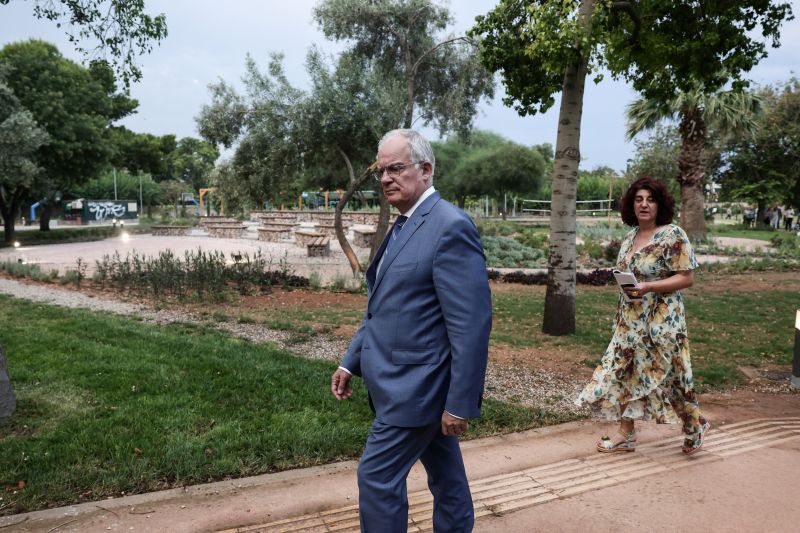
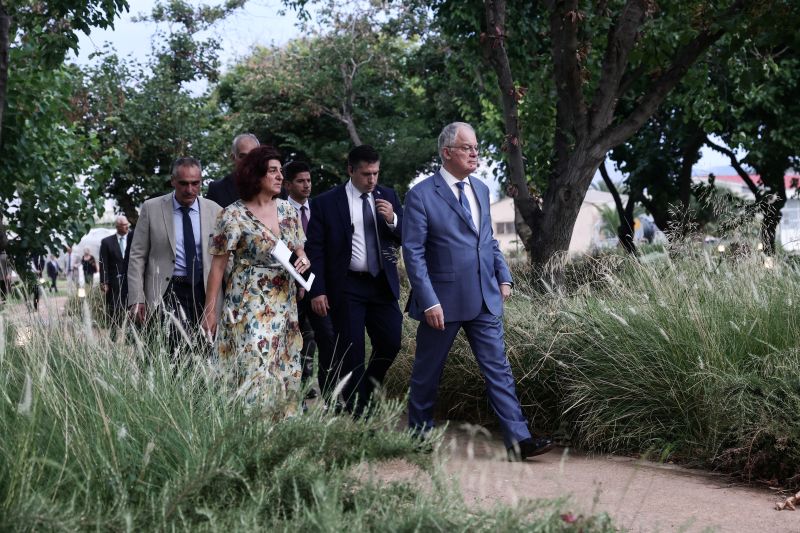
The President of the Republic was then guided on a tour of the “Green Walk” by the Rector of the Agricultural University of Athens, Professor Spyridon Kintzios.