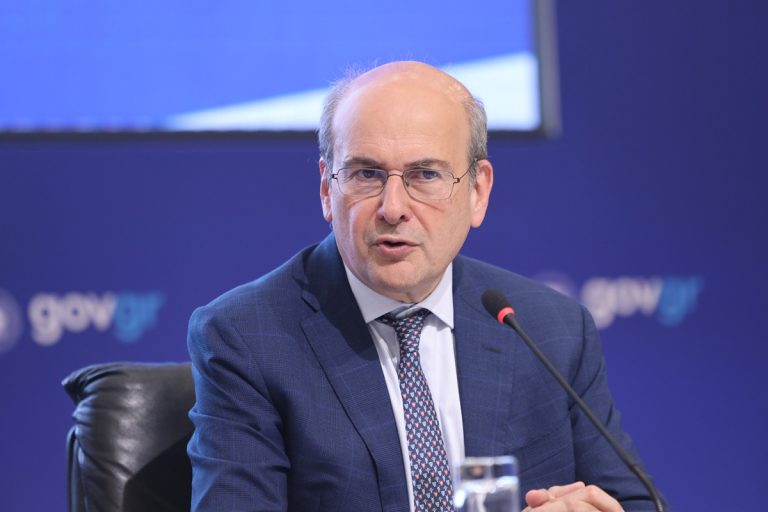
“The transition from OPEKEPE to AADE not only ensures transparency in the distribution of funds — the system has now begun operating in favor of real producers,” stressed Deputy Prime Minister and Minister of State Kostis Hatzidakis in an interview on ERTnews Radio 105.8. “Every year, the country receives approximately €1.8 billion from Brussels for the so-called first pillar — that is, direct subsidies for our farmers. Last year, through checks carried out under the new hybrid subsidy payment system, €160 million was saved. That money didn’t disappear. It is being distributed this year as additional payments to real producers — it went to livestock farmers, producers, and cotton growers who saw their subsidies increase. It was paid out in the first half of the year, as planned. A great many farmers saw more money in their accounts than last year, and these farmers are genuine producers,” he added.
“So here we have a combination of modernizing the system with a social dimension. This reform — the transition from OPEKEPE to AADE — is a reform that is here to stay, and it is a shame that it was supported only by New Democracy,” Mr. Hatzidakis noted.
“We have presented data showing that at this moment there are open cases before the courts involving 1,151 different instances with an estimated damage of €69 million. This means the government has not only acted within the framework of cleaning up the system and adopting a new, modern European framework following the relevant agreement with the European Commission on the Action Plan for agricultural subsidies. The government has also moved to ensure that the fraudsters are dealt with as they deserve — every crook gets their comeuppance,” he added.
Regarding the procedural changes to be implemented going forward, the Deputy Prime Minister stated: “In July, the new application form will be unveiled. The new application will begin to take on characteristics of a tax return — it will be largely pre-filled, and there will be a link connecting the agricultural subsidy declaration to electronic state records.”
“In any case, a presentation of the new declaration was made to 140 farmer representatives. The feedback was entirely positive, and what’s more, this new declaration will help bypass various intermediaries who have existed for years in the process of submitting these applications — so that the system becomes transparent, simple, modern, and signals, in its own right, the transition to a new era in the payment of agricultural subsidies,” he added.
Kostis Hatzidakis on OPEKEPE and the cost of living
When asked whether the €69 million black hole could grow larger, he said it cannot be ruled out. “I can’t tell you, because these are investigations carried out by the competent authorities — primarily the financial crimes police. In any case, the government is moving on both fronts,” he explained.
On the issue of recovering illegally collected funds — which the government had emphasized heavily when the scandal broke — Mr. Hatzidakis noted: “All of these are matters for the justice system. The government cannot bypass the courts on this specific issue and simply issue decrees. Assessments have been made. Some of those involved have filed appeals, as is their right in every democratic state under the rule of law, and it is ultimately up to the courts to decide.
From last year’s checks — and without the need for formal assessments in these specific cases, since those particular farmers never even received subsidies — €160 million was freed up out of the €1.8 billion the country is entitled to, and that money has now been redistributed.”
“What you will see is that once the system using boluses for sheep and goats, satellite technologies, and other tools is fully implemented, there will be an even greater boost for real producers. The country will receive the same amount of money, but genuine producers will receive more. That is the philosophy and the essence of this reform,” the Deputy Prime Minister continued.
Asked whether he believes this affair damaged the ruling party — despite the fact that it ultimately led to a significant reform — Mr. Hatzidakis said: “There is no doubt that New Democracy was affected. This was reflected at various stages when the issue captured public attention and in the party’s polling numbers. However, it is clear that the government acted immediately — and not only by accepting responsibility. We were, after all, the only ones who did. The other two parties that have governed present themselves as spotless and untainted. The government acted swiftly to address the problem and adopt a new, modern, transparent system. And I have no doubt that yes, we should have moved faster — I mean the relevant actions should have started earlier.
That said, let me repeat: first, there is a qualitative difference here. We were the only ones who, through the Prime Minister, accepted whatever responsibility there was. And second, we were the only ones who voted for this reform, while the others remained on the sidelines, throwing stones.”
When asked why it took seven years for this reform to happen, he offered the following position:
“Because OPEKEPE had structural problems. Various attempts were made to address the issue — I won’t go through them one by one. Those attempts didn’t succeed, and ultimately the Prime Minister — I remember it was last June — called me and said: ‘That’s it, we need to move to a different level. Let’s go to AADE, which has credibility in Brussels and is already a payment authority since it disburses various benefits — let’s go down this road.’ And a year later, it is proven that this decision was the right one. It had turbulence, it had difficulties, it caused anxiety — but every day things get better. And a year on, I believe real farmers are seeing the positive results in their own pockets.
And since people ask what we’ve done about the deep state and bureaucracy all these years — look, again, here is a government that has made a series of significant interventions. gov.gr is, I think, the most emblematic one. But also pensions — I know from personal experience, having handled it myself — are now processed in an average of two months, which is faster than Germany, and that was not a simple achievement. That is a blow to the deep state.
As are the steps taken with helplines 1555 and 1566, and the legislation we recently passed for a more citizen-friendly state, and so on.”
On the front of the cost of living crisis — which the opposition claims can be solved — Mr. Hatzidakis said pointedly: “Let them tell us what the solution is so we can implement it. What is certain is that the cost of living is genuinely the number one issue in the country right now. It is also certain that we were the government in 2019, 2020, and 2021 — when there was no cost of living crisis. So what has changed? Have we forgotten what we know? No. There is an international problem that emerged in 2022 and onwards for very specific reasons — let’s not go over them again and become tiresome. It is a problem across Europe, at the very least, if not across all advanced economies. Greece’s inflation has consistently been close to the European average since then. When it is slightly above the European average, there are fierce reactions and front-page headlines. When it is slightly below average, it’s just another Thursday.
That said, this does not mean the government should sit idle. The government has adopted a series of measures: the household basket scheme, special labeling in supermarkets, record-breaking fines for profiteering. And of course, a range of income interventions — whether through tax cuts that translate to higher take-home pay, various emergency benefits primarily for vulnerable groups, or wage increases, notably the minimum wage, which was €650 and is now €920. We don’t boast about these things. We coordinate our actions with other European countries.
If the opposition can point us — without exhausting itself searching for magic solutions — to a single country, any country in the European Union, that has tackled this issue and has no cost of living problem, then let them tell us exactly which model they are proposing, and we will look at it seriously.”
On New Democracy and parliamentary majority
Regarding polling figures and the upcoming national elections — where an outright parliamentary majority for the leading party appears out of reach — and when asked how New Democracy views this situation, particularly in the absence of a likely coalition partner and with the possibility of a new party being founded by Antonis Samaras, Mr. Hatzidakis noted: “Before the 2023 elections, there was a similar atmosphere. ‘Will you get a majority, won’t you?’ Polls were showing 32-33% at the time; when the election came, we got 41%. That doesn’t mean the same will happen now.
But still — first, the vast majority of undecided voters come from the New Democracy space. Second, the government’s efforts continue. Third, the electoral choices will be put to the public when the election comes, and at that point we will present our record. And know this: we can very easily stand behind what we say — ‘we said it, we did it’ — because we genuinely promised little and set out to deliver everything, and we delivered almost all of it.
There will be a head-to-head contest between political leaders. On one side, Mitsotakis — and on the other, it will be either Tsipras or Androulakis, Konstantopoulou, Velopoulos or Latinopoulou, or Koutsoumbas. We will say this clearly when the time comes — it is an accurate picture. We are not saying ‘Mitsotakis or chaos.’ Greeks must choose between specific political figures.
And third, we will at least present our own agenda for Greece 2030. We will make fewer promises than all the opposition parties combined, but what we say will be grounded in solutions adopted by advanced European countries and international best practices — things that will modernize Greece, improve everyday life, and elevate our country. And then Greeks will make their decisions. That is why I am optimistic about the election outcome. In the meantime, however, we must do our work with humility and seriousness.”