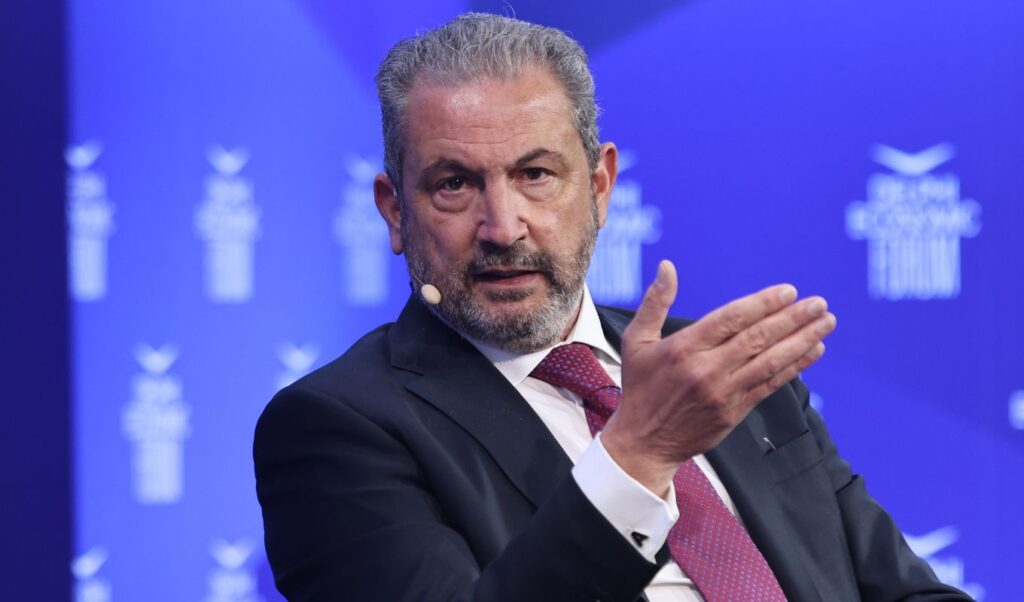
The president and CEO of the AKTOR Group, Alexandros Exarchou, has spoken out about the obstacles facing the development of the Vertical Corridor. He also offered a pessimistic outlook on European natural gas prices, warning that they are expected to rise even further. Against this backdrop, the CEO of Atlantic SEE LNG Trade called for immediate action from the European Union to prevent severe consequences for inflation and interest rates.
Alexandros Exarchou: Major geopolitical value of the Vertical Corridor
Speaking at the Green Deal Greece 2026 conference, Mr. Exarchou highlighted that the Vertical Corridor has acquired significant geopolitical value, as it has the potential to reverse traditional north-to-south gas flows — enabling the transport of American LNG through Greece to Southeastern and Central Europe, as well as Ukraine. However, he argued, this prospect has triggered pushback from competing interests seeking alternative supply routes. “The enemies are abroad, primarily in the United States,” he stated pointedly, clarifying that the conflict is rooted in the competition over who will secure long-term supply contracts for the vast quantities of natural gas the European market will require.
According to the head of the AKTOR Group, US-based competitors would prefer to route natural gas through alternative corridors, bypassing Greece entirely. As he explained, such a choice could allow non-EU countries — specifically Turkey — to blend American and Russian natural gas, thereby securing lower prices. This possibility, he said, is one of the key drivers of the ongoing conflict. He also acknowledged the existence of Greek interests that may oppose the development of the Vertical Corridor, though he was clear that he does not consider them the primary threat to the project. “What matters is the war that has been waged — and continues to be waged — by American interests,” he noted, adding that these moves have the potential to cause real damage.
Mr. Exarchou stressed, however, that developing the Vertical Corridor does not require building entirely new infrastructure from scratch. On the contrary, the Revythoussa terminal, the Alexandroupolis FSRU, and the existing pipeline networks already provide the necessary foundation for transporting LNG northward. The real challenge at this stage, therefore, is securing commercial agreements that will guarantee the required volumes and ensure that existing infrastructure is fully utilized. He also clarified that Atlantic SEE LNG Trade’s involvement does not imply exclusivity — any company can source American LNG and supply it to the European market.
Guilfoyle’s contribution
He made particular mention of the role played by Kimberly Guilfoyle in advancing the Vertical Corridor, describing her as a driving force behind its development. According to Mr. Exarchou, her efforts helped secure commercial agreements worth approximately €9 billion over a 20-year horizon — to the benefit of American LNG exports — without placing any corresponding financial burden on the United States. He also noted that the Greek government stands to benefit from these agreements without having taken on any volume commitment obligations.
The head of Atlantic SEE LNG Trade also underscored the significance of the long-term supply agreement for 1.5 billion cubic meters of LNG per year from Venture Global. As he pointed out, the price secured at the time of signing is no longer available in the market for new volumes, with the gap between that price and current market rates now being particularly wide.
He recalled that when the agreement was first signed, doubts had been raised about whether it was truly advantageous — even by certain figures within the Greek government. Today, however, he argued, market conditions have vindicated that decision beyond any doubt.
He also revealed that new commercial negotiations are currently underway, though none have yet been finalized. In particular, he referenced ongoing talks with Romania, which can move forward once a new government is formed, as well as negotiations with Bulgaria and other countries in the region.
Natural gas prices set to surge
In the second part of his address, Mr. Exarchou expressed serious concern about the trajectory of European energy prices, warning that the situation will deteriorate further as winter progresses.
He noted that natural gas prices have already approached €100 per megawatt-hour, and that rising heating demand could trigger another significant spike. He raised the possibility that prices could reach €120 or even €130 per megawatt-hour, questioning how such a scenario could be managed without serious economic fallout.
In his view, the European Union has not responded with the urgency the situation demands, despite other major markets actively moving to secure additional gas supplies. He cited China as a prime example — continuing to purchase American gas rather than drawing on its own reserves — as well as Qatar, which is also seeking supplies from the United States.
Europe, by contrast, has not moved decisively enough toward long-term supply agreements, according to Mr. Exarchou, leaving it exposed to the volatility of international energy markets.
His concerns extend beyond energy costs alone. He warned that further price increases will generate significant inflationary pressures throughout the winter, which will in turn drive up interest rates. “This is the risk I see — and it is immediate, it is now,” he emphasized, warning that such a development would weigh heavily on the European economy as a whole.
A call for immediate Eurobond issuance
In this context, Mr. Exarchou argued that the immediate activation of European financial support mechanisms is essential, specifically proposing the issuance of a Eurobond. He stressed that intervention must happen before the economic consequences of the energy crisis escalate — not in February or March, when financing needs could be far greater.
He also warned that a delayed response could carry serious political consequences at the European level, particularly in countries whose economies are already under considerable strain. Turning to Greece specifically, he expressed optimism about the resilience of the Greek economy, stating that it is in its best position in at least 50 years. However, he cautioned that even Greece would struggle to remain insulated from a broad-based European crisis, particularly if energy price increases hit Germany and France hard.
Russian gas could actually strengthen the Vertical Corridor
Of particular interest was his position on the potential return of Russian natural gas to the European market, should the geopolitical landscape shift. Mr. Exarchou argued that such a development would not undermine the Vertical Corridor — on the contrary, it could actually strengthen it. He explained that the ability to combine Russian pipeline gas with American LNG would allow for lower prices to be achieved for European consumers.
He also emphasized that Russian gas is inherently cheaper due to its mode of transport, adding that Europe must not replace its dependence on Russia with an equivalent dependence on the United States. In his view, the long-term solution lies in striking a balance between diverse supply sources. While he does not consider an immediate return of Russian gas to be likely, he noted that such a development could significantly enhance the Vertical Corridor’s competitiveness, opening up additional opportunities for its commercial exploitation.