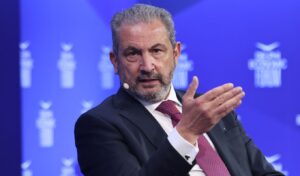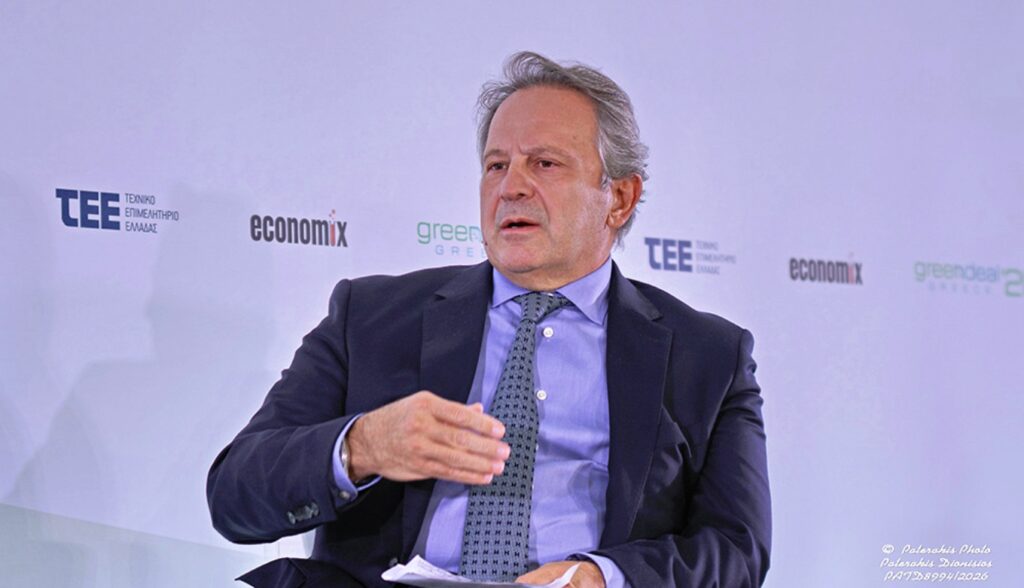
The use of Artificial Intelligence to enhance highway safety, the urgent need for systematic infrastructure maintenance, and the ongoing delays in critical road projects across Attica were the central themes of a keynote intervention by Petros Souretis, Executive Advisor at GEK TERNA, at the “Green Deal Greece 2026” conference. Speaking with journalist Fotis Kollias at the event — organized by the Technical Chamber of Greece and economix.gr, and now in its sixth consecutive year at the Stavros Niarchos Foundation Cultural Centre — Souretis stressed that the development of new infrastructure projects must go hand in hand with meaningful care for existing ones. He also called for decisive political action on the extension of Kymis Avenue and planned interventions on the Kifissos highway, warning that traffic congestion across the capital could significantly worsen over the next decade.
Read also: TERNA: The Komotini combined-cycle power plant — a global success story
GEK TERNA: Artificial Intelligence for safer roads
Petros Souretis placed particular emphasis on the transformative potential of modern technologies in highway monitoring and the early detection of dangerous incidents. He explained that Nea Odos — a flagship motorway stretching 400 kilometres — is continuously monitored through AI-powered systems that analyse real-time data from vehicle behaviour on the road.
“For example, Nea Odos, a model 400-kilometre highway, is permanently monitored through artificial intelligence systems. These systems enable faster incident detection by evaluating data points such as vehicle lights and braking patterns,” he stated. Similar technology is set to be deployed on Attiki Odos as well. According to Souretis, modern digital tools can deliver savings of up to 20%, while GEK TERNA is actively developing a digital infrastructure monitoring framework that tracks projects from the design phase all the way through to full operation.
Infrastructure maintenance and the lesson of Egnatia Odos
The GEK TERNA Executive Advisor highlighted that highway maintenance has not received the level of attention it requires. Citing the example of Egnatia Odos, he explained that the fragmentation of maintenance work into smaller contracts, combined with inadequate funding, has led to a dangerous backlog of accumulated needs. “When infrastructure is not properly maintained, the need for major interventions grows exponentially,” he warned.
He further underlined that projects must be designed with resilience against extreme weather events in mind, with technology playing a key role in predicting structural failures and preventing accidents before they occur.
Kifissos and Kymis Avenue: the projects that need decisions
Turning to Attica’s pressing transport challenges, Petros Souretis called for the immediate advancement of the Kymis Avenue extension, describing it as a project that already has secured funding and a contractor in place. He also noted that a model proposal for decongesting the Kifissos corridor has remained without any progress for three years, despite offering a financing solution that would place no additional burden on public resources.
Addressing the broader construction market, Souretis presented a backlog of €17 billion across the four major construction groups, with annual output standing at €15 billion and available resources reaching €30 billion — identifying the shortage of skilled personnel as the sector’s primary challenge. As for GEK TERNA specifically, he reported an EBITDA of €630 million for the previous year, with 70% derived from concessions, and liquidity of €2 billion.