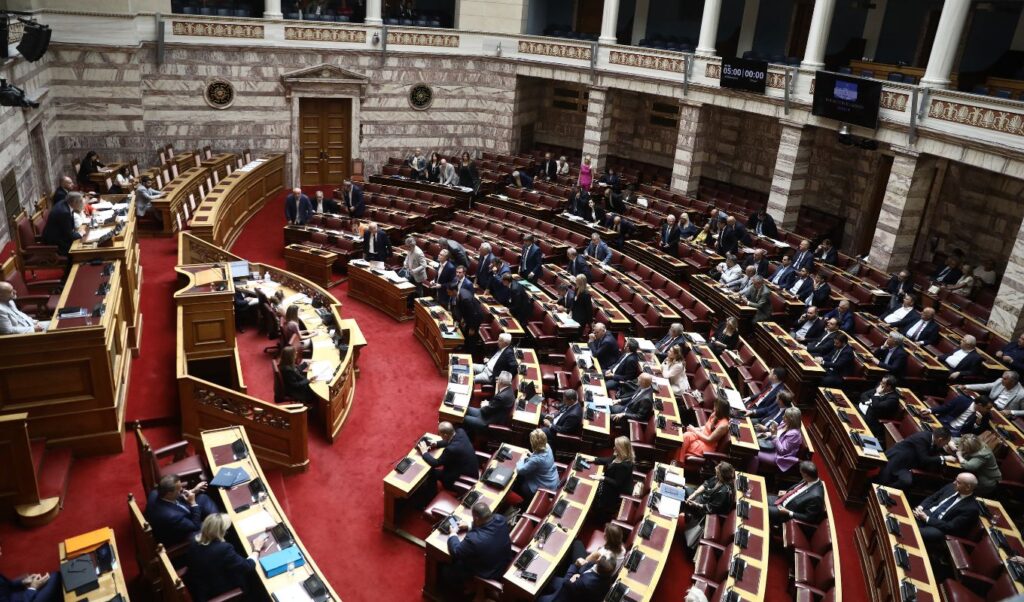
Today’s plenary session of the Greek Parliament marks the second act of the Constitutional Revision — and it promises to be anything but calm. Since the first vote held in late July, it has become abundantly clear that there is virtually no room for agreement between the government and the opposition. The ruling party’s proposed amendments were supported exclusively by government MPs and a handful of independents.
Read: Constitutional revision: The second act on Wednesday — PASOK’s stance and the opposition’s position
Against this backdrop, New Democracy (ND) will need to secure 180 votes in the Revisionary Parliament in order to push through the constitutional changes it seeks. As previously noted, all 33 proposed revision articles received backing from the governing majority and independent MPs, while PASOK voted “present” on 15 articles that the party itself considers worthy of revision.
Constitutional revision: First parliamentary debate after the summer recess
The parliamentary debate — held at party leaders’ level — will be the first since the return from summer recess, with both the government and the opposition taking up battle positions. It is widely expected that the discussion will extend well beyond the constitutional revision itself, as opposition parties are poised to bring to the forefront remarks made by the government spokesperson regarding the unemployment benefit.
The vote
Regarding the voting procedure, as was the case in the first round, the proposed revision articles will once again require a minimum of 151 votes to be forwarded for a final vote in the Revisionary Parliament that will be formed after the next general election. In the third and conclusive vote, they will need to secure 180 votes in order to take immediate effect.
It is worth noting that during the first vote, former Foreign Minister and New Democracy MP for Chania, Dora Bakoyannis, chose to vote “present” on Article 30, which concerns the single, non-renewable six-year term of the President of the Republic. It should be recalled that during the relevant committee discussions, two other government MPs had also distanced themselves from the party line — former Justice Minister and current MP for Lesvos, Charalampos Athanassiou, and MP for Eastern Attica, Giorgos Vlachos. Both, however, ultimately voted in favour during the plenary. For the record, Article 30 was passed by 158 MPs, while 135 voted against.
Which articles are up for revision
Among the articles coming up for revision, beyond Article 86 — which was approved by 159 MPs — is Article 16, which passed with 160 votes, and Article 103, relating to the abolition of permanent tenure in the public sector, which received 161 votes in favour. In addition, the proposed change to the selection process for senior judges — to be carried out through a special Parliamentary Committee without government interference, from a shortlist of three candidates nominated by the relevant plenary bodies — received 159 votes. The fiscal “circuit breaker” mechanism garnered 160 votes, while the abolition of retroactive taxation and the introduction of a stable tax framework for strategic investments, both included in Article 78, were approved with 161 and 159 votes respectively. Finally, the amendments to Article 24 — relating to climate change and, in particular, to water resources and renewable energy sources — secured 158 votes.